







What makes a playground inclusive?
An inclusive playground is one where a child using a wheelchair, an autistic child, a child with low vision, and their brothers, sisters and friends can all reach the play, take part in it together and stay comfortably. It isn't a separate "special" corner. It's the whole playground, designed so children of different abilities share the same space.
In practice it comes down to six things. Get these right and the rest of the design follows:
- A continuous, step-free route from the car park or gate to the play
- Ramps and transfer points onto elevated decks
- Plenty of ground-level, sensory and social play that everyone can reach
- Firm, seamless surfacing for wheelchairs, walking aids and prams
- A quieter zone for children who need a break from the noise
- Shade, seating and clear sightlines so families can stay
Inclusive vs accessible: what's the difference?
The two words get used interchangeably, but they mean different things. An accessible playground removes physical barriers: a child using a mobility aid can get in and reach some of the equipment. An inclusive playground goes further, so children of different abilities can play the same game, in the same place, at the same time, rather than alongside each other.
A ramp up to a single deck is accessibility. A ramp that leads to a wide deck with a shared slide, a talking tube to a friend at ground level and a basket swing big enough for two is inclusion. Accessibility is the minimum; inclusion is the goal. The NSW Government's Everyone Can Play guideline puts it as three questions worth asking of any design: can I get there, can I play, and can I stay?
The standards that apply: AS 1428.1, AS 4685 and AS 4422
Inclusive projects touch three Australian Standards, and it helps to know which one covers what.
AS 1428.1 (Design for access and mobility) is the access standard. It sets maximum gradients and minimum widths for access paths and ramps, along with requirements such as landings, handrails and circulation space. It's written for buildings, but councils, schools and designers commonly use it as the reference for the paths and ramps that lead into and around a play space.
AS 4685 is the playground equipment safety series. It covers how equipment is designed, installed, inspected and maintained, including fall heights, entrapment and impact areas. It applies to inclusive equipment exactly as it does to anything else, so an accessible ramp or a supported swing still has to meet it. AS 4422 covers playground surfacing and how well it absorbs impact under fall zones.
The practical split: AS 1428.1 governs how people get to and move around the playground, while AS 4685 and AS 4422 govern the safety of the equipment and the surface beneath it. A good inclusive design satisfies both. We build every installation to AS 4685 and AS 4422 and have it independently certified at handover.
Access paths and gradients
Inclusion starts at the gate, not at the equipment. Map the whole journey a family takes: from the car park or drop-off, along the path, through the gate, across the surfacing and onto the play. Every step, lip or steep pitch along the way is a barrier for someone.
AS 1428.1 sets the maximum gradients and minimum widths for those paths, and where landings and handrails are needed on ramps. Your designer or landscape architect sets the levels to suit. On a sloping site that can mean regrading or a longer, gentler path, so flag it early.
- Keep the main route step-free and continuous from entry to play
- Make surface transitions flush so wheels and small feet don't catch
- Allow room to pass and to turn a wheelchair at key points
- Bring the accessible path right up to the play points, not just near them
- Put seating and shade along the route so carers can rest
Ramps and transfer access to elevated play
Not every child can, or wants to, leave their wheelchair, and not every child who uses one wants to stay in it. Good inclusive play systems offer both routes.
Ramps take a child in a wheelchair or using a walker up onto a deck, with play panels, lookouts and slides at the top. A ramp needs more footprint than stairs to reach the same height, so it's a decision to make at concept stage, not a later add-on.
Transfer points let a child move from their chair onto the structure at seat height, then climb, shuffle or slide from there. A clear space to park the wheelchair beside the transfer point, and an easy route back to the chair from the bottom of the slide, are what make a transfer point work in real life.
Sensory play elements
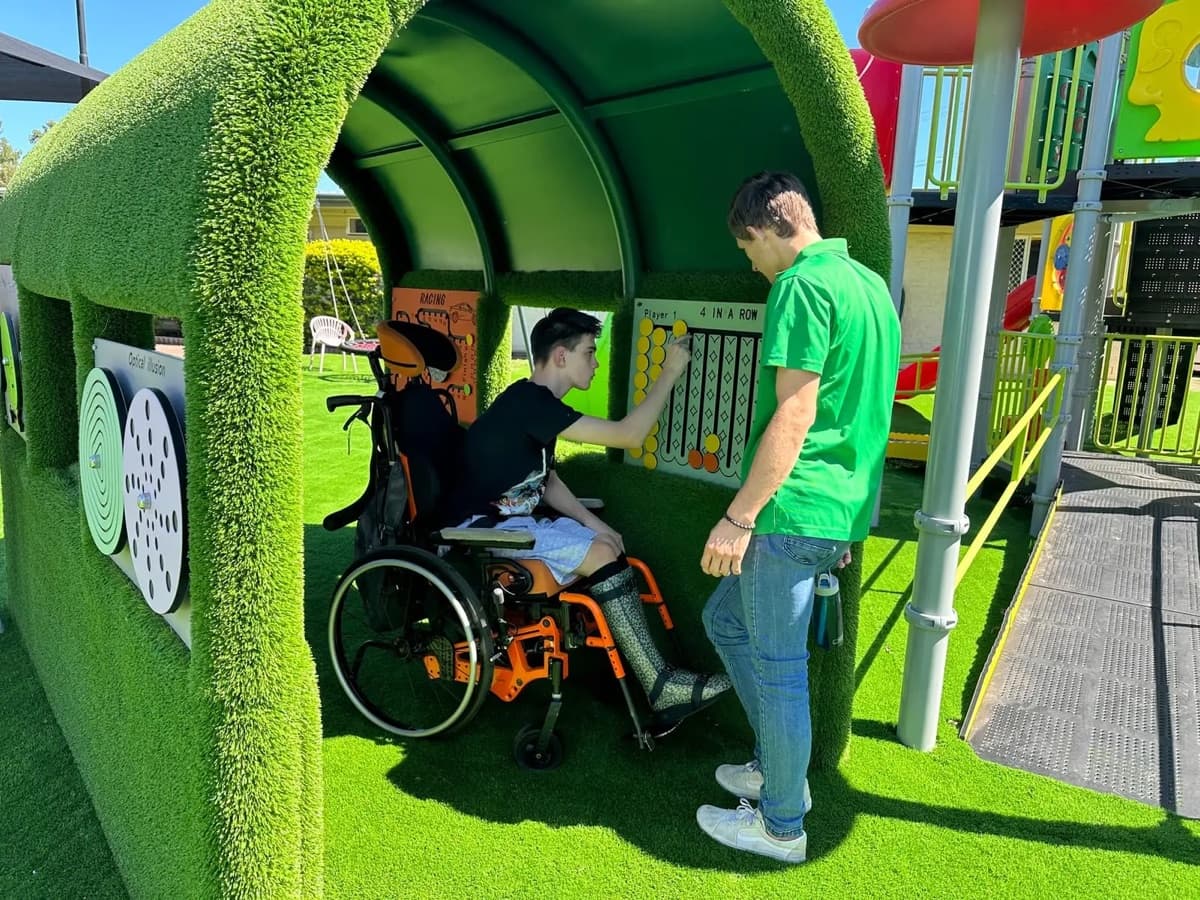
Inclusion isn't only physical. Many children, including autistic children and children with sensory processing differences, engage through sound, touch, movement and pattern. Sensory elements give them a way in, and they're some of the most-used pieces for every child.
Mount panels at heights that work for seated and standing children, and put some at the end of the accessible path so they're the first thing a child reaches.
- Musical play: drums, xylophones and chimes
- Talking tubes that carry a voice across the playground
- Interactive panels: gears, mazes, optical illusions and games
- Rocking and swinging: basket and nest swings and hammocks
- Texture, colour contrast and natural materials like timber, sand and planting
Surfacing for wheelchair access
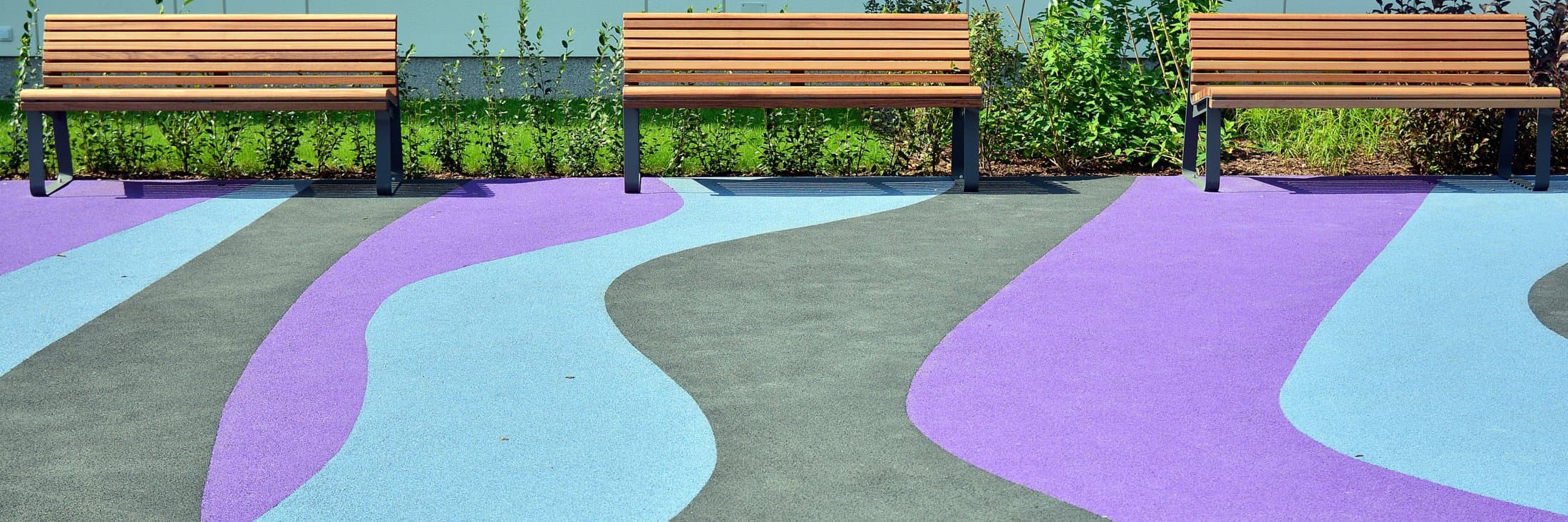
Surfacing decides who can actually reach the equipment. Loose fill such as sand or bark mulch is economical and meets AS 4422 at the right depth, but it's harder to cross with wheels or walking aids than a firm surface. For an inclusive playground, the main routes and key play points need a firm, continuous surface.
Wet-pour rubber is fully accessible: level, seamless and engineered to the critical fall height. Synthetic turf over a shock pad is firm and level, pram and wheelchair friendly, with a softer look. Many sites combine the two, and some keep loose fill in less-travelled areas to manage the budget. Whatever the mix, every surface under a fall zone still has to meet AS 4422.
Quiet zones, shade and seating
A busy playground can overwhelm some children. A quieter retreat, such as a cubby, a shaded nook or a planted corner a little away from the swings and slides, gives a child somewhere to settle and rejoin when they're ready. Keep it within sight of carers so it doesn't become a supervision blind spot.
Shade and seating are what let families stay. Shade over play and seating helps children who struggle with heat, and seating placed beside the play rather than at the edge keeps carers close. Clear sightlines and a predictable layout also help children who find busy, unpredictable spaces hard.
What does an inclusive playground cost?
An inclusive playground generally costs more than a standard one of the same size, and the extra goes into three places: ramps and wider decks instead of stairs, firm accessible surfacing instead of loose fill across the main areas, and longer, flatter access paths.
As a guide, a single freestanding accessible piece typically costs about $2,000 to $10,000, ex GST, while an inclusive playground moves into the $60,000-plus range depending on scale. Our inclusive play systems start at an indicative $31,100 ex GST (Open Path) for the equipment, before surfacing and installation. For comparison, a standard primary-school multi-activity system is about $60,000–$120,000 delivered, and council or destination playgrounds start from about $120,000.
Every fixed-price quote we give is itemised (equipment, compliant softfall surfacing, site preparation, installation and certification), so you can see exactly what the inclusive elements add.
Inclusive equipment from Kidzspace
Our inclusive range covers play systems, swings, sensory pieces and accessible fitness. Each product page lists its age range, footprint, fall height and indicative price, ready for a brief or tender.
- Open Path: play structure with a wide, gently sloped access ramp
- Accessible Adventure: wheelchair-accessible ramp and sensory panels
- Togetherland: all-abilities playground with ramp access throughout
- Harmony Hill: gentle ramps in place of stairs, five slides
- Sky Cradle Basket and Orbit Swing: shared basket swings
- Sensory Microphone: talking tube for four children
- Bongo Beat and Acoustic Drums: musical play
- Ramp & Stair Station: accessible fitness for all ages
- Browse all inclusive playgrounds
- Browse inclusive & accessible play and fitness
- Browse sensory play equipment