
Childcare Playground Requirements in Australia (NQS & AS 4685.6)

A plain-English guide to childcare playground requirements in Australia, covering the NQS, AS 4685.6 age-appropriate design, fall zones and softfall, and what assessors actually check at handover.
Building or upgrading a childcare playground in Australia means meeting two overlapping sets of expectations: the National Quality Standard (NQS) that your service is assessed against, and the playground equipment standard AS 4685, including Part 6 (AS 4685.6) for spatial requirements and fall protection. They are not the same thing, and understanding how they fit together saves a lot of expensive rework. This guide walks through age-appropriate design, fall zones, softfall and the practical things an authorised officer or assessor tends to look at.
NQS and AS 4685: how they fit together
The NQS, assessed under Quality Area 3 (physical environment) and Quality Area 2 (children's health and safety), is about whether your environment is safe, well maintained and supports children's learning. It does not republish the playground standards line by line, but it expects you to manage risk and maintain equipment to a recognised benchmark. In practice that benchmark is the AS 4685 series for equipment and AS 4422 for softfall surfacing.
So the simplest way to think about it: AS 4685.6 tells you how the equipment must be designed and spaced; the NQS asks you to prove you are managing it. Getting the equipment right makes the NQS conversation much easier. Our compliance overview sets out the standards in more detail.
Age-appropriate design comes first
Most long day care services cater for children from roughly six weeks to five years, which spans a huge range of physical ability. AS 4685.6 distinguishes equipment intended for different age groups, and good childcare design usually separates spaces so younger children are not competing with, or copying, older ones in ways they are not ready for.
- Separate or clearly zone areas for under-2s, toddlers and preschoolers rather than one mixed-ability structure.
- Keep platform heights, step rises and graspable rails suited to the youngest children using that zone.
- Limit free height of fall for the youngest age groups, and check that openings cannot trap a head, limb or clothing.
- Provide quieter sensory and imaginative play, not just gross-motor climbing, so the space supports the whole curriculum.
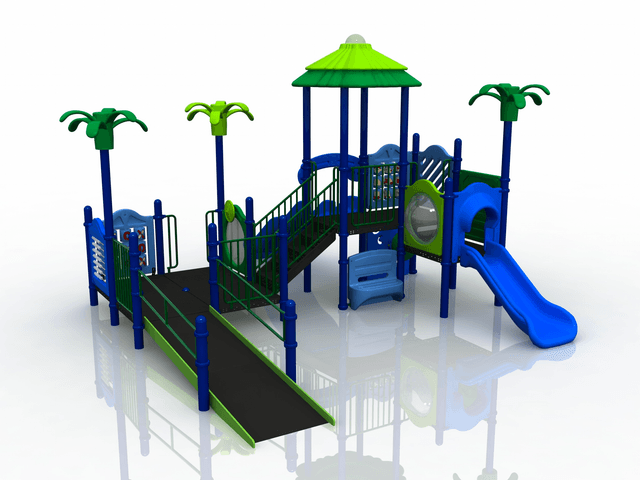
Designing this way also supports inclusion. Ramps, ground-level activities and a range of challenge levels mean more children can join in. See our notes on inclusive design and the childcare solutions page for examples.
Fall zones and free height of fall
Fall zones are where most plans come unstuck. Every piece of equipment with a raised play surface has a free height of fall (the distance a child could fall from the highest likely standing point) and a surrounding impact area that must stay clear of obstructions and be covered by compliant softfall.
As a rule of thumb, the impact area extends outward from the equipment, and that distance increases with height; swings and other moving equipment need larger clearances measured from the swing's full arc. The practical consequences are easy to miss on a tight childcare site:
- Fences, walls, tree trunks, garden edging and AC units must sit outside the impact area, not just outside the equipment footprint.
- Two pieces of equipment placed too close together can have overlapping fall zones that are not permitted.
- Pathways, edges and drainage pits need to be planned around the cleared softfall area, not through it.
Because outdoor space at childcare centres is often limited, fall zones are frequently the constraint that decides what equipment actually fits. It is far cheaper to resolve this at concept stage than after installation.
Softfall surfacing to AS 4422
Under any equipment with a free height of fall, you need impact-attenuating surfacing tested to AS 4422, with a critical fall height rating that meets or exceeds the equipment's free height of fall. Loose-fill options such as certified softfall mulch or sand, and unitary surfaces such as wet-pour rubber or rubber tiles, can all comply when correctly specified and installed to the right depth.
Each surface has trade-offs for a childcare setting: wet-pour is low-maintenance, wheelchair and pram friendly and good for accessible routes, while loose-fill is lower cost up front but needs regular topping up and raking to maintain its depth. Our surfacing guide compares the options in detail.
What assessors and inspectors check
Authorised officers assessing against the NQS, and any independent playground inspector you engage, tend to look at a consistent set of things. Knowing them in advance helps you prepare your documentation.
- Whether equipment is age-appropriate for the children using each space.
- That fall zones are clear and softfall depth is maintained, especially in loose-fill landing areas.
- Entrapment, protrusion, sharp edges and pinch or crush points.
- Gate latches, fencing and sightlines so staff can supervise easily.
- Evidence of routine inspections, a maintenance log and a current handover or compliance certificate.
A handover certificate is only the start. Assessors want to see the equipment is still being maintained to standard months and years later.
This is why we provide an independent compliance certificate at handover and supply clear maintenance guidance, so your evidence trail is ready before assessment. You can read more about how we stand behind our work on our warranties page.
Planning, cost and getting it right early
Most compliance problems are really planning problems caught too late. A free 2D or 3D concept design that accounts for age zoning, fall zones and softfall from the outset removes the guesswork, and an itemised fixed-price quote means no surprises once work starts. For budgeting, our cost guide and funding ideas are good starting points.
Kidzspace Playgrounds has delivered more than 1,000 commercial playgrounds Australia-wide since 2015, certified to AS 4685 with softfall to AS 4422 and independently certified at handover. If you are planning a new childcare playground or upgrading an existing one, get in touch for a free quote or call 1300 543 977, and we will help you design something that delights the children and sails through assessment.
Planning a playground?
Tell us about your site and we'll design something your community will love.
