

Do I need council approval for a playground in Australia?

Whether a new playground needs council approval depends on where it goes, who uses it and how big it is. Here is a plain-English guide to when a DA applies, what documents you will need, and how a good supplier helps it go smoothly.
It is one of the first questions we hear from schools, childcare centres, developers and community groups: do I actually need council approval to install a playground? The honest answer is that it depends. Some projects sail through with no formal approval at all, while others need a full development application (DA). The variables are where the playground is going, who owns the land, how it is used, and what is being built around it. This guide walks through when approval is likely, what councils tend to ask for, rough timelines, and how the right supplier takes the headache out of the process.
When approval is usually NOT required
Plenty of playground projects proceed without a DA. As a general rule, like-for-like replacement of existing equipment on the same footprint, or minor works that do not change how a site is used, often fall under exempt or complying development. Examples we see regularly:
- Swapping aged equipment for new units within the same play area and surfacing zone
- Adding a small piece of equipment to an existing, already-approved playground
- Internal play spaces inside a building that do not alter the approved use
- Works clearly covered by an existing DA or a council facilities upgrade program
Even when no DA is needed, your equipment and surfacing still have to comply with the relevant Australian Standards. That obligation never disappears. You can read more about what that involves on our compliance page.
When a DA is likely required
Approval becomes more likely as a project grows in scale, changes the use of a site, or touches sensitive land. A development application is commonly needed when:
- A new childcare centre or school is being built, with the playground forming part of the overall development
- A public park or open space is being created or significantly redeveloped
- The works affect flood-prone land, bushfire zones, heritage areas, or protected vegetation
- Shade structures, fencing, retaining walls, paths or car parking are added alongside the play equipment
- The land use itself is changing (for example, turning vacant land into a community play space)
Requirements vary between every council and state planning scheme, so the only reliable answer comes from a quick check with your local authority early on. It is far cheaper to confirm at the concept stage than to discover an issue after manufacture.
What documents councils typically ask for
If a DA does apply, the supporting documents are usually straightforward when your design work has been done properly. Councils commonly request:
- A site plan showing the playground location, setbacks and surrounding features
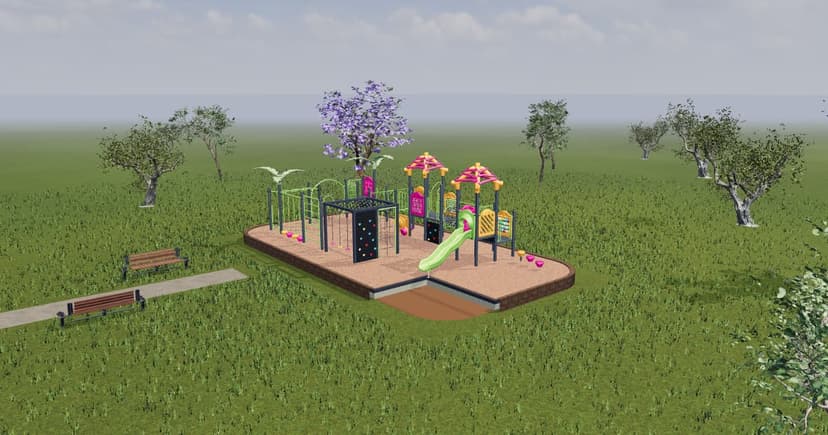
- 2D and 3D concept designs or layout drawings of the equipment
- Specifications and certification references for equipment (AS 4685) and softfall surfacing (AS 4422)
- A statement of environmental effects or planning report for larger works
- Details of shade, fencing, drainage and accessible access where relevant
Because we provide free 2D and 3D concept design and fixed-price, itemised quotes, much of this documentation comes together as a natural by-product of designing your space.
How long does approval take?
Timelines vary widely by council, project complexity and how complete your submission is. Exempt or complying works can be ready to go almost immediately, while a full DA can take anywhere from a few weeks to a few months. The single biggest driver of delay is an incomplete or unclear application that triggers requests for further information.
A clean, well-documented submission is the cheapest insurance you can buy against a slow approval.
Our advice is to confirm the approval pathway before you finalise the design, so the drawings and specifications you submit are the ones you actually build. That keeps the project moving and avoids costly rework.
How a supplier helps the process run smoothly
A good playground supplier should make approvals easier, not harder. With more than 1,000 projects delivered Australia-wide since 2015, we work alongside schools, childcare centres, councils and developers to keep submissions tidy and compliant. Practically, that means:
- Concept drawings and layouts ready for your planner or council in 2D and 3D
- Equipment certified to AS 4685 and softfall to AS 4422, with independent certification at handover
- Fixed-price, itemised quotes that double as clear cost documentation
- End-to-end delivery, from design and supply through to installation
It is worth budgeting for the surrounding works too, not just the equipment. Our guides on surfacing, cost and funding can help you scope the full picture before you submit.
Talk to us before you lodge
Every site and every council is a little different, so the smartest first step is a conversation about your specific project. We can help you understand the likely approval pathway, prepare the right concept documents, and deliver a playground that is compliant and certified from day one. Get a free, no-obligation quote and concept design via our contact page, or call us on 1300 543 977 to talk it through.
Planning a playground?
Tell us about your site and we'll design something your community will love.
