





You're likely doing what most parents do when starting their search for childcare in Cranbourne. You open several tabs, compare fees, scan photos, and check location, then try to determine which centre will feel safe, warm, organised, and developmentally strong once your child walks through the door.
That's the hard part. Any centre can look polished online.
If you want a useful way to assess learning ladder cranbourne, don't just ask whether it has vacancies or a nice website. Judge it like a serious early learning environment. Look at the building, the educational approach, the outdoor play space, the safety systems, and the way staff communicate with families. Learning Ladder ELC Cranbourne is a strong case study because it brings all of those questions into one place.
It usually starts the same way. You arrive for a tour with a list of practical questions, your child is taking in everything at once, and within five minutes you can tell whether a centre feels organised or whether it only photographs well.
That first impression matters, but parents should judge more than presentation. Learning Ladder ELC Cranbourne works well as a case study because it appears to be intentionally designed for early childhood use, not adapted as an afterthought. A purpose-built setting often creates better supervision lines, calmer transitions between parts of the day, and clearer separation between quieter learning areas and active play zones.
The physical environment deserves closer scrutiny than many parents give it. Children learn through movement, repetition, sensory input, and independent exploration. If you want a sharper framework for assessing that, this guide to play-based learning in early childhood is a useful reference. It helps you judge whether a centre's spaces support development or merely look attractive on a brochure.
Go in with standards, not vague impressions.
A good centre should reduce stress for families and expand a child's world every day.
Before your tour, it also helps to sort out the basics so your attention stays on the service itself. A simple daycare supply checklist for parents can help you organise labels, spare clothes, feeding items, and daily handover gear before you start comparing centres seriously.
A modern building means very little if the learning approach inside it is weak. Consequently, learning ladder cranbourne becomes more interesting.
The centre uses a Montessori-based curriculum aligned with Australia's Early Years Learning Framework, and it offers government-funded Kindergarten programs for 3-year-olds and 4-year-olds through the Montessori and service profile for Learning Ladder ELC Cranbourne. For parents, that combination is practical. Montessori brings structure, hands-on materials, and independence. The EYLF alignment keeps the service grounded in the broader Australian early childhood framework rather than turning Montessori into a rigid label.

A strong Montessori-informed room should feel calm, intentional, and child-sized. You want to see children choosing tasks, handling materials, concentrating for meaningful stretches, and moving with some independence instead of waiting passively for constant adult direction.
That doesn't mean children should be silent or overly controlled. It means the environment should help them practise agency.
If you want a plain-English explanation of how this connects with broader child development, this guide to play-based learning in early childhood is useful because it helps parents understand that purposeful play and structured learning don't compete. They work together.
Learning Ladder Cranbourne also makes some operational choices that matter more than parents sometimes realise.
Those inclusions point to a centre that's trying to reduce friction for families while maintaining a more attentive level of care.
Practical rule: When a centre includes meals, consumables, and regular communication, ask how those systems actually run on a busy day. The answer tells you more than the brochure does.
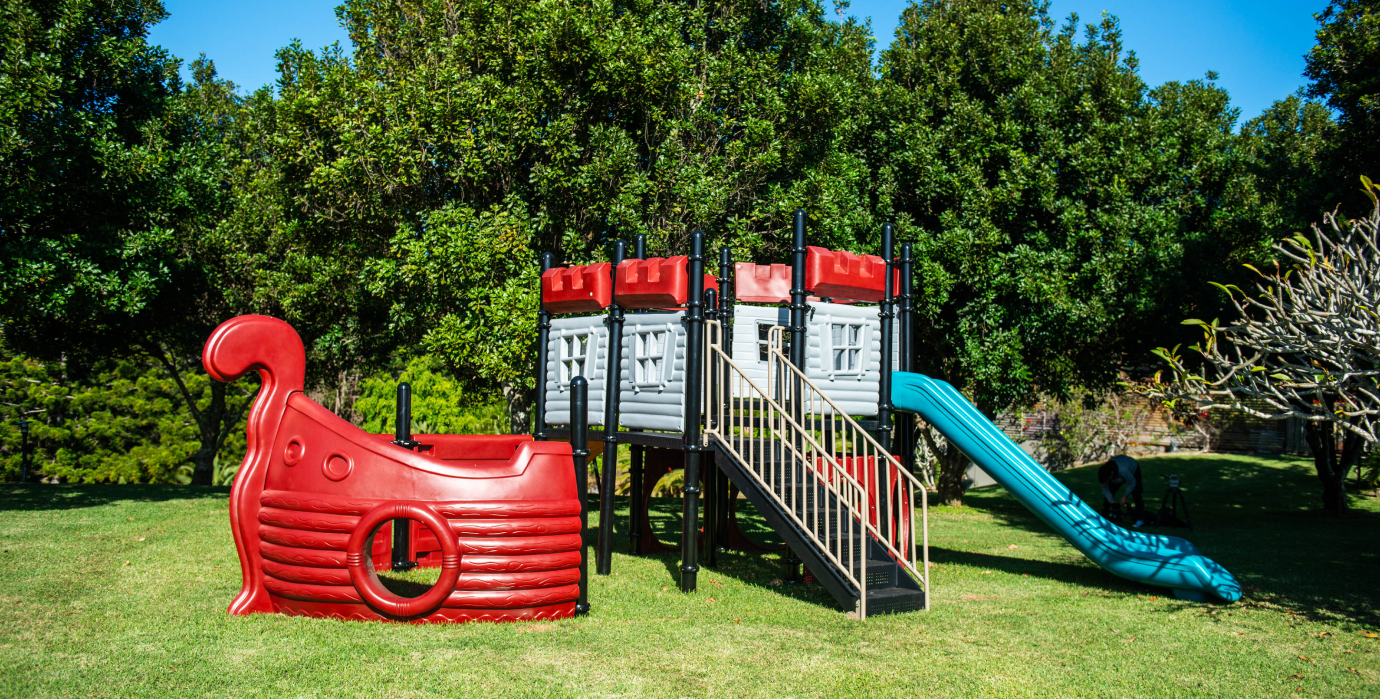
Parents often spend too much time judging classrooms and not enough time judging the yard. That's a mistake.
For young children, the outdoor environment isn't a break from learning. It's one of the main places where learning becomes visible. You see balance, confidence, language, negotiation, sensory exploration, movement planning, and early risk assessment happening in real time.
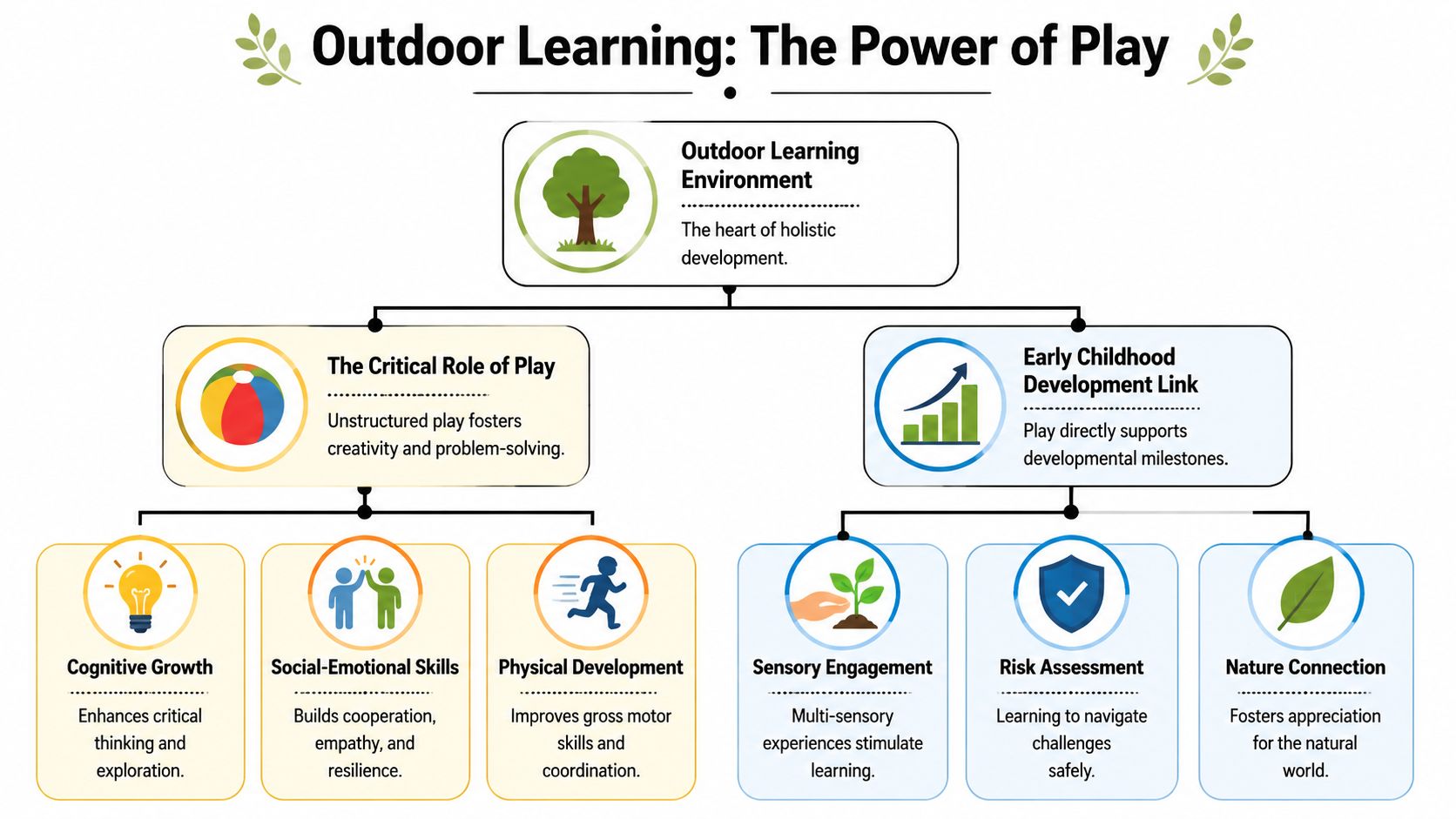
A good early learning playground does more than entertain children for half an hour. It should support different kinds of development at once.
Parents should look for age-appropriate zones rather than one generic playground. Babies and toddlers need safe exploratory areas with lower complexity. Older preschool children need more varied movement challenges and more opportunities for collaborative play.
If a centre talks about independence, exploration, and child-led learning, the outdoor space should prove it. A flat yard with a single plastic structure doesn't support that claim.
The best outdoor settings create options. Children should be able to choose between active movement, imaginative role play, quieter observation, and sensory investigation. If every child is funnelled into the same activity, the environment is underperforming.
For a broader view of what thoughtful design looks like in education settings, this resource on outdoor learning spaces for schools gives a useful lens for assessing how physical layout shapes behaviour and engagement.
A short video can also help parents think more critically about what outdoor learning should offer beyond basic recreation.
Don't just glance outside and think, “Looks nice.” Watch how the space works.
| What to observe | Why it matters |
|---|---|
| Children moving between different activity zones | Shows the space supports choice |
| Equipment sized for different stages | Indicates thoughtful planning |
| Natural elements and sensory variety | Supports broader development |
| Clear lines of supervision | Helps staff stay proactive, not reactive |
The best outdoor spaces invite children to test themselves without exposing them to unnecessary hazards. That balance is where real design skill shows.
Safety isn't a vibe. It's a system.
Learning Ladder Cranbourne is listed as having commenced operations on 9 February 2026, operating 6:30 AM to 6:30 PM on weekdays, with a last regulatory visit in June 2025, and the service information highlights that compliance with National Quality Standard requirements and AS 4685-1 playground standards is essential through the Starting Blocks service listing for Learning Ladder Early Learning, Kindergarten and Childcare Services. For parents, the key point is simple. A newer centre should be operating with current safety expectations built into its systems from the start.

You don't need to become a compliance officer, but you should ask direct questions.
If you want a practical reference point for understanding controlled entry in commercial settings, this Commercial access control systems Perth guide is helpful because many of the same principles apply to childcare. Parents don't need technical jargon. They need to know who can enter, when, and how that's monitored.
AS 4685-1 matters because playground injuries often come from preventable design or maintenance failures. Unsafe fall zones, poor surfacing, damaged components, and weak installation standards are not small issues. They're red flags.
If you'd like a parent-friendly overview of the physical features that make equipment safer, this page on safe playground equipment for schools gives a solid framework for what to notice during a visit.
Ask the centre to talk you through safety in plain language. If they can't explain it clearly, they probably can't execute it consistently either.
When a centre gets the physical environment right, children benefit every day. They move more confidently, play more creatively, and engage more thoroughly with each other. That doesn't happen by accident. It comes from design decisions.
A childcare playground should be planned around age, supervision, circulation, shade, accessibility, material durability, and the kind of learning the service wants to support. That means centres, schools, councils, and developers need partners who can translate educational goals into real, buildable outdoor spaces.

Some organisations try to choose equipment from a catalogue and hope it all works together. That approach usually creates a yard that looks busy but functions poorly.
A more disciplined approach includes:
Kidzspace designs and manufactures playground equipment and outdoor fitness solutions for education and community settings, including complete play systems, themed elements, and custom project support. For centres trying to build or upgrade an outdoor environment that is compliant, engaging, and specifically designed for their users, that kind of specialist involvement is often more practical than piecing together a space from disconnected suppliers.
You arrive for a tour with a neat list of questions, then your child spots the outdoor area and tells you everything with one reaction. They move toward it confidently, or they hang back. Parents should pay attention to that moment.
If Learning Ladder Cranbourne is on your shortlist, book a visit and assess the centre in person. A strong service should look organised, feel calm, and show clear evidence that children can move, play, and learn safely throughout the day. As noted earlier, the centre lists its Cranbourne location as 16 Monahans Road, Cranbourne VIC 3977, with contact details including 1800 954 563 and cr********@le***************.au.
| Feature | Detail |
|---|---|
| Centre name | Learning Ladder ELC Cranbourne |
| Address | 16 Monahans Road, Cranbourne VIC 3977 |
| Capacity | 112 places |
| Age range | 6 weeks to 6 years old |
| Rooms | 7 rooms |
| Session fee | $149.00 full day |
| Hours | 6:30 AM to 6:30 PM weekdays |
| Contact phone | 1800 954 563 |
| Contact email | cr********@le***************.au |
A tour should do more than confirm availability. It should help you judge whether the physical environment supports the centre's educational claims. That matters because even a thoughtful program falls flat if children lack enough room to climb, balance, explore, rest, and shift between active and quiet play with confidence.
Ask direct questions, then watch what the environment reveals.
If you cannot tour immediately, ask for a remote walkthrough that shows real circulation paths, entry points, room connections, toileting access, sleep spaces, and the outdoor yard in full. This guide to virtual tour software for universities is written for a different education setting, but it is still useful for spotting what a good virtual presentation should include. You want to see the space clearly, not just polished close-ups.
Trust your observations. Watch how children move through the yard, how educators position themselves, and whether the equipment invites purposeful play instead of aimless waiting.
For parents, that means choosing a centre with an outdoor environment that works well every day. For operators planning an upgrade or a new build, it means working with specialists such as Kidzspace to design and supply play spaces that are safe, durable, and developmentally useful.



Copyright © Kidzspace. All Rights Reserved.
Copyright © Kidzspace. All Rights Reserved.