




Injury surveillance in Australia has repeatedly shown the same pattern. Playground injuries are common, and falls account for a large share of the serious ones. For a school principal, that is the starting point. A playground is part of the learning environment, but it is also a place where height, impact, spacing, and wear must be controlled with the same care you would apply to a science lab or bus bay.
Safe playground equipment for schools is not only about buying a structure that looks compliant on installation day. It is about creating a system that keeps risk within acceptable limits over years of heavy student use, harsh sun, rain, and constant maintenance pressure. Australian Standards such as AS 4685 and AS 4422 matter because they turn broad safety intentions into measurable design rules. They address questions schools often miss at procurement stage, such as how far a child can fall, what surfacing must do on impact, where entrapment hazards occur, and how materials perform in the Australian climate.
A useful way to view playground safety is to treat the equipment and the ground beneath it as one unit. A climbing frame with the wrong surfacing is like a seatbelt fixed to a weak anchor point. Each part may look acceptable on its own, but the system fails at the moment it is needed most.
That is why a good school playground still includes challenge, movement, and social play, while removing hazards that do not add developmental value. Common examples include hard or poorly maintained fall zones, openings that can trap a child’s head or clothing, corroded fixings, unsafe gaps between elements, and equipment that does not suit the age group using it. Clear safety warning signage also has a role, especially where schools need to mark supervision expectations, age suitability, or areas temporarily closed for maintenance.
The sections that follow focus on the Australian requirements that shape safer decisions in practice, including standard updates, surfacing performance, material selection, and the long-term maintenance costs that determine whether a playground stays safe after the ribbon-cutting.
Falls account for a large share of playground injuries. For a school principal, that makes playground safety a practical management issue before it becomes a standards issue, because the consequences show up in student wellbeing, staff supervision load, parent confidence, and repair budgets.
A school playground is not just a break-time extra. It is part of the learning environment, part of the school’s duty of care, and a physical asset that has to keep performing year after year in Australian conditions. If one of those roles is overlooked, the others are affected as well. A playground that is exciting but hard to inspect creates supervision problems. A playground that is compliant on day one but expensive to maintain can drift out of safe condition within a few seasons.
The useful question is not whether children might fall. They will. The useful question is what happens when they do, how often foreseeable hazards are allowed to remain, and whether the equipment still suits the age groups using it after the first burst of enthusiasm has passed.
As noted earlier, injury patterns consistently point schools toward a small number of controls that have the biggest effect. In practice, principals should focus on four areas first:
This is similar to school traffic management. A crossing works because the road markings, signs, sightlines, and supervision all support one another. Playground safety works the same way. The platform, the barriers, the surfacing, the spacing, and the maintenance record form one control system.
Schools sometimes worry that a stricter safety approach will produce a dull playground. In well-planned projects, the reverse is usually true. Staff are more comfortable allowing active use when the foreseeable injury points have been controlled, and students get more benefit from equipment that invites climbing, balancing, hanging, and social play without hidden traps.
Safe design does not remove challenge. It removes hazards that add no developmental value.
Signage is a good example. Signs do not correct poor surfacing or a bad equipment layout, but they do support supervision and clearer use of the space. For campuses reviewing entry points, age guidance, or temporary closures, these examples of safety warning signage are useful for planning what should be visible near higher-risk areas.
Supplier brochures are built to attract attention. Your review process should do the opposite. It should slow the decision down and test whether the design will stay safe, serviceable, and affordable in your setting.
Three questions usually expose the weak options quickly:
That approach gives a principal something more useful than a catalogue comparison. It gives a basis for choosing equipment that protects students, supports active play, and holds its safety performance long after installation.
Before a school looks at standards, it helps to understand the basic logic behind them. Most playground failures don’t happen because someone ignored a clause number. They happen because the team never understood what the rule was trying to prevent.
A hazard is something with the potential to cause harm. A gap that can trap a child’s head is a hazard. A corroded bolt is a hazard. A hard surface under tall equipment is a hazard.
Risk is the likelihood and consequence of that hazard causing actual injury. A low platform over compliant surfacing may involve challenge, but the injury risk is controlled. A climbing unit beside a congested running path may create a much higher risk because children can collide in the landing area.
That distinction matters because schools shouldn’t try to remove all challenge. Climbing, balancing, hanging, and spinning are part of healthy play. The goal is to remove hidden traps and reduce the severity of foreseeable falls and impacts.
A common mistake is buying one mixed-use structure and expecting it to suit everyone from Prep to upper primary. It usually doesn’t.
Younger children need lower access points, simpler movement patterns, and clearer transition spaces. Older children often seek height, sequencing, and more demanding coordination. If those needs are blended carelessly, the younger cohort tends to enter spaces they can’t yet use safely.
Think of each age group as needing its own movement envelope. The more accurately the equipment matches the body size, grip strength, balance, and judgement of the user group, the safer the play becomes.
A useful way to explain a use zone to staff and parent committees is to call it a safety bubble around the equipment. Children don’t move only on the platform itself. They jump off, swing out, lose balance, and change direction suddenly.
If another item sits too close, or if a path cuts through that bubble, the school has created a predictable collision point.
Practical layout problems often include:
Practical rule: If a child fell, jumped, or changed direction suddenly, would they still land inside a protected space?
Schools sometimes treat supervision as the answer to every playground problem. It isn’t. Supervision is strongest when the site is easy to read.
A staff member can’t effectively monitor blind corners, enclosed congestion points, and overlapping play patterns all at once. Good design supports supervision by preserving sightlines, separating high-motion activities, and making student flow predictable.
When I audit a school playground, I don’t start by asking whether it looks modern. I start here:
Those questions turn a playground from a collection of parts into a managed environment.
A compliant playground is rarely the result of one good purchase. It comes from a chain of sound decisions, each one checked against the right Australian Standard at the right stage.
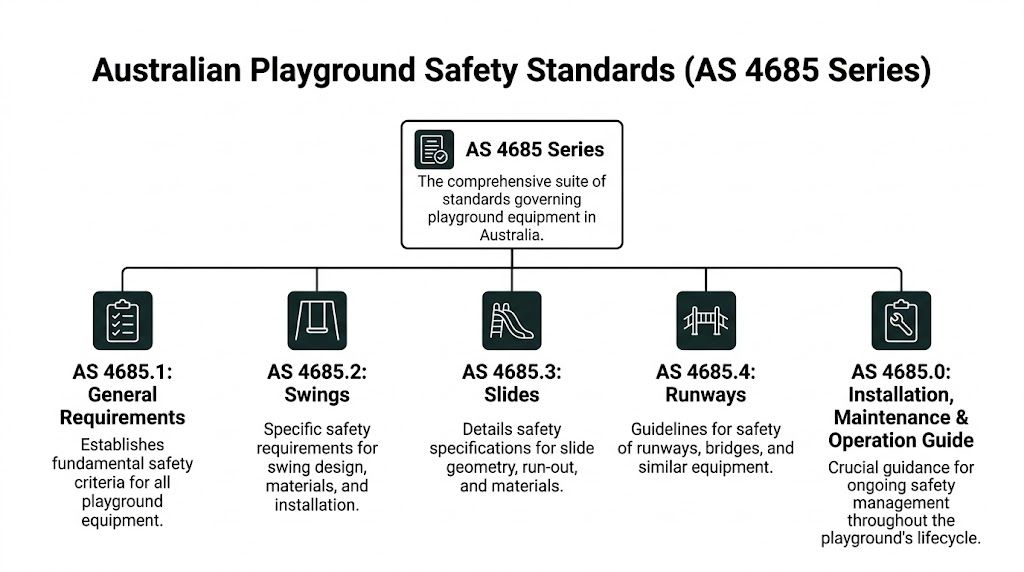
For schools, two standards set the technical baseline. AS 4685 covers playground equipment and the way it is designed, installed, inspected, and maintained. AS 4422 covers impact-attenuating surfacing, which becomes critical wherever a fall could occur. One standard addresses the equipment. The other addresses the surface that must reduce injury risk when equipment use goes wrong.
That distinction matters. A climbing unit can meet equipment requirements on paper and still create unacceptable risk if the surfacing, spacing, or installation details are wrong on site.
The first area to understand is safe design. AS 4685's inquiry isn't limited to whether a structure is strong enough to stand up to school use. It is asking whether the design reduces predictable injury mechanisms before the equipment ever arrives on campus.
In practical terms, that means checking for issues such as head and neck entrapment points, crush and shear hazards, projections that can catch clothing, unsafe openings, barrier and guardrail requirements, and access features that suit the intended age group. A principal does not need every clause number at hand. A principal does need clear evidence that the supplier has assessed those hazards against the relevant parts of AS 4685, rather than relying on broad claims such as “made to safety guidelines”.
Recent revisions to the standard series have sharpened that expectation. The 2024 revision of AS 4685.1 updated core design and safety requirements, and guidance established in 2025 reinforced annual inspection expectations as part of maintaining safe operation over time. Schools in bushfire-prone areas may also need to account for AS 3959 and the site’s Bushfire Attack Level, because location affects material selection, finishes, and replacement planning. Standards Australia’s playground equipment and surfacing standards catalogue is a more credible starting point than overseas guidance when you are checking what applies in an Australian school context.
Safe installation is where many school projects either hold their standard or lose it.
A useful comparison is classroom furniture. A well-made bookshelf is still unsafe if it is not anchored properly. Playground equipment works the same way, except the consequences involve movement, height, and repeated dynamic loading from hundreds of students each week.
Installation has to match the design intent. That includes the footing system, anchoring method, equipment clearances, orientation, and the interface between the structure and the nominated surface. It also has to reflect Australian site conditions. Coastal schools need corrosion resistance. High-UV locations need materials and finishes that will not become brittle, chalky, or dangerously hot too quickly. Bushfire-prone regions need a different level of scrutiny again.
A sound installation review should account for:
For procurement teams, that means asking for more than a product sheet. This guide to school playground safety standards is useful for structuring the questions schools should put to designers and installers before approval is given.
The third area is safe operation, which falls under the direct control of school leadership after handover.
A playground does not stay compliant because it started compliant. Surfaces compact. Fasteners loosen. Components wear. Students and contractors make informal changes that were never part of the certified design. The standards matter most when the school treats them as an operating system for inspection, recordkeeping, repair, and replacement.
If a school cannot show how hazards are identified, recorded, and corrected, the standard has not been put to work.
Annual inspections are part of that system, but they are not the whole system. Schools also need routine visual checks and operational inspections at intervals that suit the age of the equipment, intensity of use, and exposure conditions. A junior play area used heavily every day in full sun will not age at the same rate as a shaded senior area with lighter use.
“Certified” should never be the end of the conversation. It should be the start of proper due diligence.
A certificate may confirm that a product or system was assessed against a nominated standard under stated conditions. It does not automatically confirm that the installed outcome at your school matches those conditions, or that the materials chosen will perform well in your local climate over the next decade.
A stronger procurement process checks the following:
| What to check | Why it matters |
|---|---|
| Product compliance documentation | Confirms which parts of AS 4685 the equipment has been assessed against |
| Installation details | Shows whether site conditions, anchoring, and clearances have been allowed for |
| Surfacing test evidence | Verifies that impact attenuation aligns with the specified application and equipment |
| Inspection and maintenance instructions | Helps the school plan labour, budget, and repair intervals after handover |
| Material suitability for the site | Reduces premature deterioration in Australian coastal, high-UV, wet, or bushfire-prone settings |
Used properly, the standards help schools make better risk decisions and avoid expensive mistakes later. This is its primary benefit. Compliance supports safety, but it also protects the school from buying equipment that looks acceptable on delivery day and becomes a maintenance problem three summers later.
Falls are the injury mechanism schools need to plan for first. That is why surfacing sits at the centre of playground risk control, not at the end of the specification.
Critical Fall Height, or CFH, is a technical measure of a surface’s ability to absorb impact. It is the maximum height from which a fall is unlikely to cause a life-threatening head injury under test conditions.
A practical way to read that is simple. Every raised play item creates a fall risk zone, and the surface under that zone must be matched to the equipment’s tested fall height. If the equipment is suitable for active play but the surface is not suitable for the height, the system is incomplete.
Under Australian requirements, equipment and surfacing need to be considered together. AS 4685 sets out when impact-attenuating surfacing is required, and AS 4422 sets the test method used to confirm whether a surface achieves the nominated performance. For school decision-makers, the key point is that a surface is not “safe” because it feels soft underfoot. It is suitable only if it has been tested for the required application and installed in a way that preserves that performance.
A school principal does not need to become a test engineer, but it helps to understand the logic. CFH is not a guess and it is not a sales term. It is a verified performance threshold.
The easiest analogy is a bike helmet. A helmet is designed to manage impact within defined conditions. Surfacing works in the same way. It reduces injury risk only within the range it was tested for, and only while it remains in good condition.
That last point causes a lot of confusion. A compliant product can become a non-compliant installed surface if depth drops, edges erode, drainage fails, or the wrong substrate is used.
Schools are often caught by appearances. Grass, mulch, or loose sand may look forgiving during a site walk, yet still perform poorly beneath raised equipment.
Grass is the most common example. Once repeated foot traffic compacts the soil and wears the cover thin, it no longer provides reliable impact attenuation. Loose-fill materials can also lose performance if children kick them aside from landing zones, if rain causes migration, or if maintenance teams do not restore the required depth.
The better procurement question is this: what evidence shows this exact surface, in this exact application, meets the required CFH and can stay at that level with our maintenance capacity?
Material choice should reflect more than the day-one budget. It should reflect the school’s staffing, climate exposure, drainage, supervision patterns, and appetite for ongoing maintenance.
| Material | Typical CFH Protection | Initial Cost (per sqm) | Maintenance Needs | Durability (AU Climate) |
|---|---|---|---|---|
| Poured-in-place rubber | Can be specified to suit required CFH when tested to AS 4422 | Higher | Low to moderate. Inspect for wear, edge failure, cracking, and heat-related ageing | Good when correctly specified for UV exposure, drainage, and substrate movement |
| Rubber tiles | Can be selected for CFH performance when tested to AS 4422 | Moderate to higher | Moderate. Check for tile movement, trip edges, joint separation, and base defects | Good, but depends heavily on installation quality and base preparation |
| Engineered wood fibre | Can provide compliant protection when installed and maintained at correct depth | Lower to moderate | Higher. Requires topping up, raking, redistribution under exits, and depth checks | Can perform well, but moisture, decomposition, and displacement need close management |
| Sand | May suit some lower-risk applications if correctly specified and maintained | Lower | Higher. Requires levelling, contamination control, edge management, and depth monitoring | Variable. Wind, rain, and heavy use can reduce consistency |
| Grass | Not suitable as a reliable impact-attenuating safety surface for higher fall zones | Lower | Ongoing turf care, but poor as a compliant landing surface beneath elevated equipment | Low as a true safety surface in active fall zones |
For schools comparing options in more detail, this guide to playground surfacing materials is a practical starting point.
This is one area where international guidance often falls short for Australian schools. A surface that performs well in a mild northern climate may age very differently under strong UV, long dry periods, summer heat, coastal salt, or sudden heavy rain.
Rubber systems can become hotter and may degrade faster if the product is poorly specified for local conditions. Loose-fill surfaces can dry out, scatter, or wash away at edges and runouts. Shaded areas may hold moisture longer, which affects timber-based loose fill. Full sun can harden some materials over time.
For that reason, schools should ask for evidence that the proposed surface is suitable for the site, not just compliant in a generic catalogue sense.
A surface only protects children while it retains its tested condition.
Loose-fill systems need regular depth checks, especially under swings, slide exits, and high-traffic landing points. Unitary systems reduce daily raking and top-ups, but they still need inspections for cracks, shrinkage, edge separation, pooling water, and wear paths. If water sits on the surface, the problem may be drainage below, not the material above.
Often, schools save a little upfront and spend much more later. A cheaper surface that staff cannot realistically inspect and maintain usually becomes the expensive option.
Surfacing is an impact-control system. Treat it with the same seriousness as the equipment above it.
If a supplier cannot answer those questions clearly, the school does not yet have enough information to approve the surface.
The structure itself needs the same level of scrutiny as the surface below it. Many injuries don’t come from dramatic equipment failure. They come from smaller design faults that are easy to miss during procurement and easy to regret later.

A school can walk around a playground and see that it looks sturdy, colourful, and active. What they may not see are the gaps, openings, and protrusions that create trapping risks.
Under AS 4685.6, clearances must be controlled carefully. The standard limits gaps to less than 8mm or greater than 25mm to avoid finger and head entrapment, and compliance with these design rules has been shown to reduce entrapment incidents by 92%, as noted in the earlier standards guidance. That rule sounds technical, but the practical message is simple. Openings must either be clearly too small to admit a body part, or clearly large enough to avoid trapping it.
When reviewing safe playground equipment for schools, look closely at contact points rather than just the overall frame.
Pay special attention to:
Small gaps are rarely small problems when children’s fingers, drawstrings, and momentum are involved.
In Australian conditions, material selection isn’t mainly an aesthetic choice. It directly affects heat, corrosion, UV exposure, wear rates, and maintenance demands.
A few practical principles usually hold:
| Material type | Main strength | Main watch-out |
|---|---|---|
| Powder-coated galvanised steel | Strong, durable, and well suited to repeated school use when correctly finished | Coatings need inspection in coastal or abrasive environments |
| Aluminium | Good corrosion resistance and lighter weight in some applications | Heat and detailing still need attention |
| Plastics and moulded components | Can create smooth forms and enclosed play features | UV degradation and heat retention vary by formulation and colour |
| Timber elements | Natural appearance and tactile appeal | Ongoing checks for splitting, weathering, and fastener movement are essential |
The key issue isn’t just how the material performs on day one. It’s how it behaves after years of sun, rain, abrasion, and heavy recess use.
Accessible design should never be treated as a bolt-on feature. Ramps, transfer points, sensory panels, wider circulation zones, and graduated challenge all need the same hazard review as climbing units and towers.
An inclusive playground isn’t only about entry. It should allow children with different abilities to move, participate, and rest without encountering awkward transitions, trapped fingers, dead ends, or crowded collision points.
One example of a supplier working in this area is Kidzspace, which manufactures modular school playground systems and outdoor play equipment for Australian settings. For a school, the relevant question isn’t the brand name itself. It’s whether the proposed system gives clear evidence on materials, safe spacing, accessibility features, and lifecycle maintenance requirements.
A school playground starts ageing from the first day it is used. Sun, rain, loose hardware, foot traffic, and small acts of vandalism all work on it at once. If inspections are irregular, minor wear turns into a hazard in the same way a small roof leak turns into rotten framing. The repair bill rises, and so does the chance of injury.
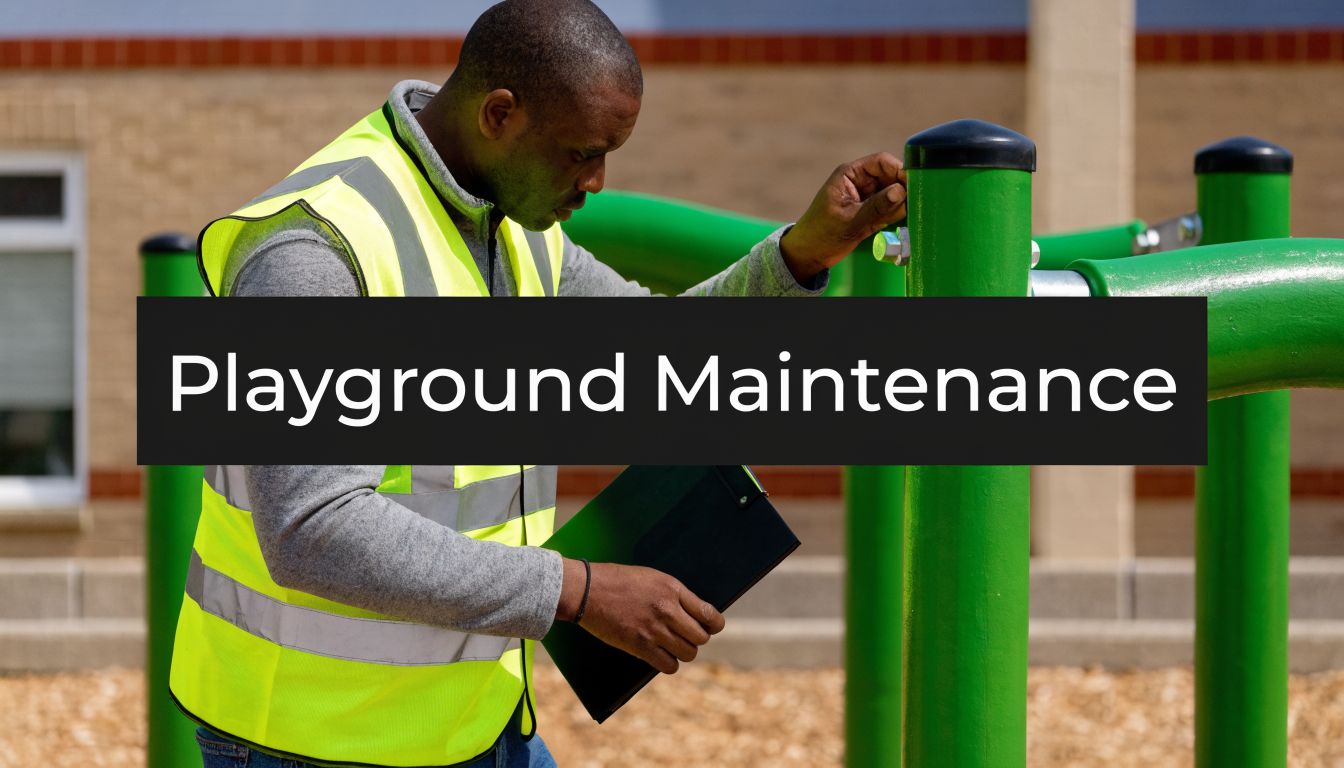
For principals, the practical question is not whether to inspect. It is how to build a schedule that matches Australian school conditions and supports ongoing conformity with AS 4685 and the impact-attenuation intent behind AS 4422. A good schedule gives staff clear triggers for action, creates an evidence trail, and helps the school plan maintenance before defects close equipment or expose students to preventable risk.
One annual visit from an inspector is not enough. Playground maintenance works best as a layered system. Daily checks catch urgent hazards. Monthly checks find wear before it becomes failure. Annual audits test whether the whole site is still performing as intended after a year of weather and use.
That layered approach is the maintenance equivalent of classroom assessment. A teacher does not rely on one test at the end of the year. They use frequent checks to spot problems early and respond before the gap widens.
These are quick observations by staff already on site. They do not replace technical inspection, but they often prevent same-day injuries.
Staff should check for:
The purpose is immediate risk control. If a hazard could injure a child during the next break, close off the area, report it, and record what was done.
This inspection is more deliberate. It focuses on parts that loosen, wear down, corrode, or shift under repeated use.
A monthly check often includes:
Schools that want a clearer planning model can benefit from understanding Planned Preventive Maintenance (PPM). The principle is straightforward. Schedule attention before wear turns into failure.
Documentation matters here. Record the date, the person who inspected, the issue found, the action taken, and the date of follow-up. Over time, these records show patterns. If one climbing element repeatedly loosens, or one softfall area repeatedly drops below the required depth, the school has evidence to support repair, redesign, or budget allocation.
Here’s a practical visual refresher on what a structured inspection mindset looks like in action:
The annual audit is the point where a school checks the whole playground against current condition, intended use, and the safety logic built into the original design. That includes structural soundness, surfacing performance, wear trends, clearance issues, and signs that the site has drifted away from compliant operation.
This is also where Australian conditions matter. A school near the coast may need closer attention to corrosion and coating breakdown. A western inland campus may see harsher UV exposure and hotter surface temperatures. A shaded site with organic mulch may have different drainage and compaction problems from a dry metropolitan site with rubber surfacing. International maintenance advice often misses those local pressures. Australian schools cannot afford to.
The budgeting lesson is simple. Durable materials and disciplined inspection usually cost less over the life of the asset than repeated reactive repairs. That is one reason principals should ask suppliers for clear maintenance instructions, replacement part availability, and realistic servicing intervals at the procurement stage, not after defects appear.
| Inspection level | What to check | Action |
|---|---|---|
| Daily | Debris, vandalism, obvious hazards | Remove hazard or isolate area |
| Monthly | Fixings, movement, wear, surfacing condition | Repair, tighten, top up, or escalate |
| Annual | Full structural, surfacing, and compliance review | Audit, document, plan repairs or capital works |
Schools that want a working format can adapt a playground maintenance checklist to suit their site, staff capacity, and inspection frequency.
Good maintenance records do two jobs. They reduce the chance of injury, and they show the school responded responsibly when defects were identified.
Procurement decisions shape the next decade of playground safety. If a school buys on price and appearance alone, it often inherits hidden costs in surfacing, repairs, downtime, and risk.
The better approach is to treat the purchase as a long-term safety investment.
The cheapest quotation is rarely the cheapest playground. Schools need to account for the full package:
A school near the coast has different material pressures from an inland campus. A bushfire-prone site has different requirements again. A junior school with dense daily use has different wear patterns from a small secondary courtyard.
Procurement only works when those realities are considered before the order is placed.
Don’t settle for broad assurances. Ask direct questions and request documents.
The quality of the answers usually tells you as much as the answers themselves. Strong suppliers explain risks plainly. Weak suppliers rely on vague language.
| Procurement check | What good looks like |
|---|---|
| Standards evidence | Clear documentation tied to the relevant Australian Standards |
| Surfacing plan | Tested system matched to equipment fall risk |
| Site suitability | Layout reflects supervision, drainage, shade, and circulation |
| Material durability | Finishes suit UV, corrosion, and local exposure conditions |
| Maintenance clarity | School receives realistic schedules and responsibilities |
| Accessibility | Inclusive routes and features are integrated, not added as an afterthought |
| Handover support | Inspection guidance and records are supplied |
Some warning signs appear early:
A good playground should survive scrutiny. If the proposal becomes harder to explain the closer you look, that’s a procurement problem, not an approval detail.
The best school projects usually come from a disciplined sequence. Define the users. Confirm the risks. Match the equipment to the age group. Match the surfacing to the fall risk. Match the materials to the site. Then insist on a realistic maintenance plan.
If your school is planning a new play space or upgrading an ageing one, Kidzspace can help you assess site needs, compare equipment options, and align your project with Australian safety requirements and long-term maintenance realities.


Copyright © Kidzspace. All Rights Reserved.
Copyright © Kidzspace. All Rights Reserved.