



A lot of school leaders are looking at the same problem right now. There’s an underused patch of asphalt, a hot corner near the library, or a playground that works for recess but does very little for teaching. Staff can see the potential, students would use it, and the budget committee still wants to know whether the investment will hold up in real Australian conditions.
That’s where most guides fall short. They talk about getting children outside, but they don’t deal properly with heat, maintenance, supervision, curriculum fit, or the awkward question every principal and business manager eventually asks. Will this space earn its keep over time?
Outdoor learning spaces for schools can do that, but only when they’re planned as teaching infrastructure, not as decoration. The strongest projects aren’t the ones with the biggest footprint. They’re the ones that match pedagogy, climate, safety, circulation, and maintenance from day one.
An outdoor learning space isn’t just a playground with a bench nearby. It’s an intentionally designed area where teachers can run real lessons, students can investigate, discuss, make, observe and reflect, and the environment itself supports the work.
That distinction matters. A traditional play area is usually built for break times, movement and social interaction. An outdoor learning area is built for those things too, but it also has to support instruction. That means sightlines, gathering points, shade, durable seating, storage, accessible paths, and features that connect directly to what teachers already teach.
In many schools, the starting point is ordinary. A quiet edge of the oval. A dead zone between buildings. A garden bed no one uses because there’s nowhere for a class to sit. Those spaces often become valuable once the school stops asking, “How do we fill this area?” and starts asking, “What learning behaviours do we want here?”
A genuine outdoor classroom usually has three elements working together:
That’s why the best spaces feel organised without feeling rigid. Students still get the sensory and social benefits of being outside, but teachers don’t lose control of the lesson.
Australia already has strong cultural and educational support for this approach. The value of outdoor learning is widely recognised, with the 2017 Muddy Hands report indicating that 97% of Australian teachers believe outdoor play is critical for children to reach their full potential, and 88% say children are happier when they learn outdoors, as noted in the Dimensions Foundation report on natural outdoor classrooms. That sits comfortably with the longer history of bush school programs from the 1990s and the Australian Curriculum’s sustainability focus.
Practical rule: If a space can’t support a lesson on an ordinary school day, it isn’t finished yet.
Well-designed outdoor learning spaces for schools often become a kind of third teaching environment alongside the classroom and the playground. They give schools another way to deliver learning, especially when students need movement, fresh context, lower sensory load, or hands-on work.
They also solve a common site problem. Many campuses already have outdoor area. What they often lack is outdoor area that’s organised for learning.
Schools don’t need to rely on intuition alone here. There’s a clear academic and wellbeing case for using outdoor settings as part of normal teaching, not as an occasional extra.

A useful benchmark comes from research summarised by Dunaway. Outdoor learning programs were associated with a 27% increase in science test scores, while 90% of teachers reported happier children after outdoor sessions and 72% noted improvements in student physical and mental health, according to this outdoor learning and campus safety overview. For school leaders, that matters because it reframes the discussion. Outdoor learning doesn’t compete with academic goals. It can strengthen them.
The first shift is usually behavioural. Students who struggle to stay regulated indoors often do better when the task has physical context. A measuring lesson feels more concrete when students are pacing out distances. A science discussion becomes less abstract when students can touch bark, inspect soil, or compare microhabitats.
Teachers also tend to notice that outdoor sessions change the tone of participation. Some students who are quiet in class contribute more readily outside, especially in paired and small-group tasks. Others benefit from the lower-pressure setting.
If your staff are already talking about focus, wellbeing and engagement, it’s worth looking at how nature play supports child development in practical school settings.
The strongest outdoor learning spaces for schools work because they combine several benefits at once:
Outdoor learning works best when the environment isn’t treated as a reward after the real lesson. The environment becomes part of the lesson.
For principals and committees, the key point is simple. Outdoor spaces shouldn’t be judged only by whether they look appealing or add another play option. They should be judged by whether they improve delivery, support student wellbeing, and give teachers another reliable setting to teach in.
That’s a different standard. It also leads to better design decisions, because the conversation moves away from novelty and towards teaching value.
Good outdoor spaces rarely come from a long wish list. They come from a few design decisions made properly. On Australian sites, those decisions need to balance pedagogy with harsh sun, drainage, supervision, accessibility and long-term wear.
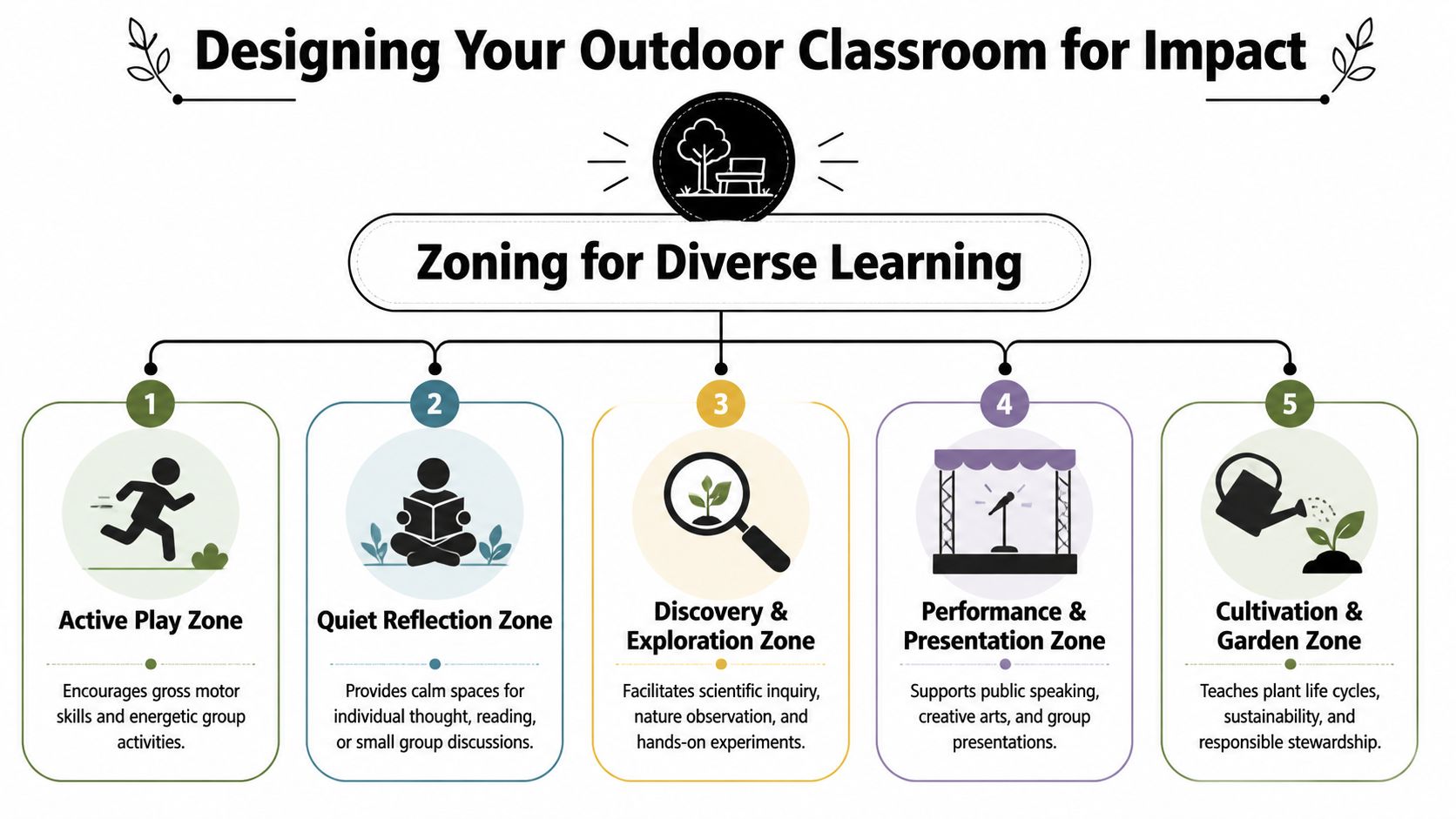
The most useful planning move is to divide the site by learning function. That prevents the common mistake of putting every feature in one multipurpose area that ends up doing nothing particularly well.
A practical zoning approach often includes:
| Zone | Best use | What it looks like in a school |
|---|---|---|
| Active play | Movement and energetic collaboration | Open area with durable surfacing and room for group challenges |
| Quiet reflection | Reading, journalling, support work | Shaded seating nook away from main circulation |
| Discovery and exploration | Science and inquiry | Planting, logs, loose materials, weather tools |
| Performance and presentation | Speaking and creative work | Small deck, stepped seating, open semicircle |
| Cultivation and garden | Sustainability and life-cycle learning | Raised beds, potting bench, water access |
A primary school might place discovery and cultivation near junior classrooms, while a secondary school may prioritise quiet study zones and presentation areas.
A beautiful layout fails quickly if the site becomes unusable in heat or rain. Passive climate design matters more than many schools expect. Strategic shade structures such as pavilions and pergolas, planned with local climatic data, can extend the usability of outdoor classrooms by an estimated 40 to 60% of the academic year compared with unprotected spaces, according to DLR Group’s guidance on outdoor learning environments.
That principle changes the brief. Shade isn’t an accessory. It’s operational infrastructure.
What this looks like in practice:
On-site test: Stand in the proposed teaching zone at the time staff would actually use it. If the sun angle, reflected heat or noise makes you want to leave, the class will feel the same.
Material choice is where budget pressure and long-term value collide. Timber can deliver warmth and sensory richness, but it needs the right detailing and maintenance plan. Steel offers strength and consistency, though it can create heat issues if exposed in the wrong places. Recycled composites can work well where schools want lower maintenance and stable performance over time.
There isn’t one right answer. The key is to match material to use, exposure and maintenance capacity. A shaded storytelling deck has different demands from a high-traffic climbing edge or a wet area near a garden tap.
For schools developing planting and outdoor character alongside built elements, broad outdoor design ideas from creating a beautiful New Zealand garden can be a helpful reference point for thinking about structure, texture and seasonal interest, even though the final plant palette and detailing need to suit local Australian conditions.
An outdoor classroom doesn’t work if a portion of students can’t move through it easily or if teachers can’t supervise it without constant repositioning.
Prioritise:
The best inclusive spaces don’t announce themselves as specialist. They work for more students, more often.
A strong outdoor space earns trust when teachers can use it without rewriting their entire program. The easiest way to get there is to design one feature so it can support several learning areas at once.
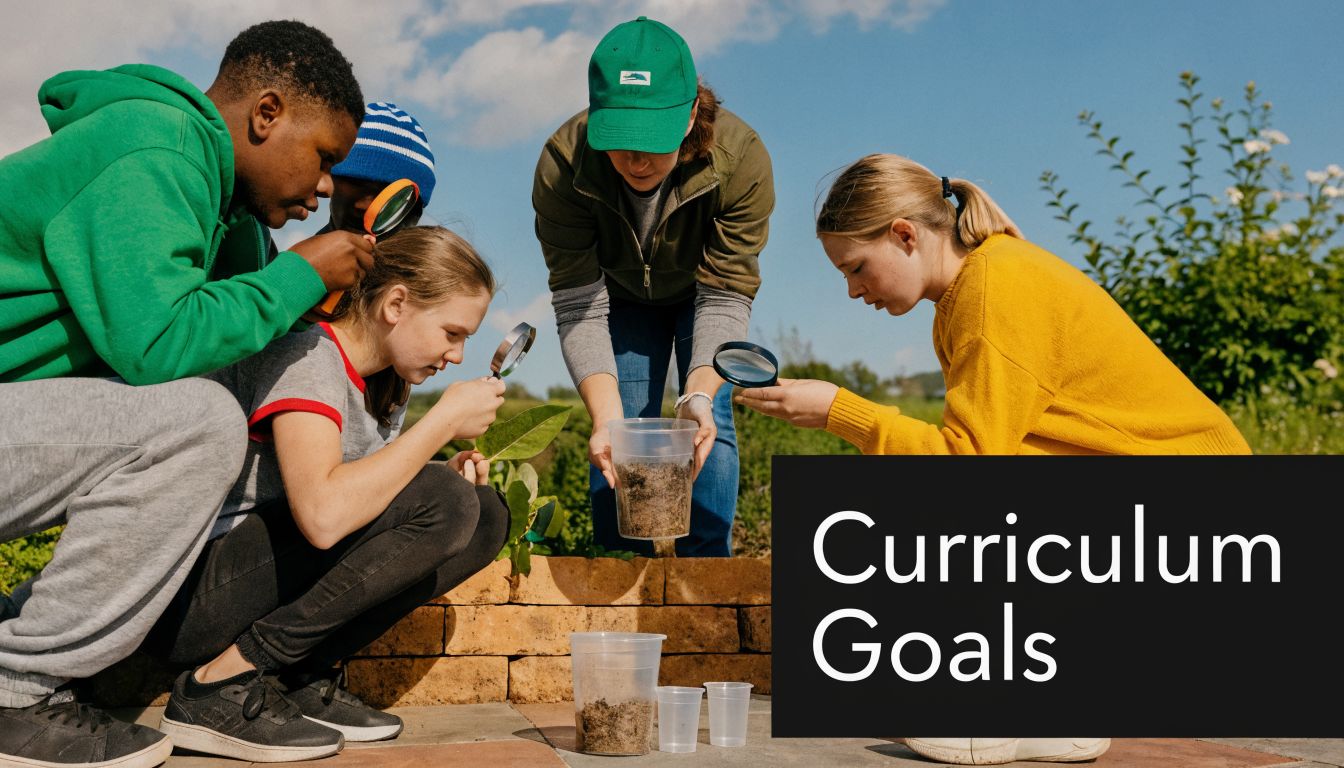
Take a Year 4 science lesson on ecosystems. The class begins in a shaded gathering area where the teacher introduces the idea of habitat and asks students to predict what they’ll find in different parts of the yard. Students then move into a discovery zone with clipboards, magnifiers and collection trays. One group inspects leaf litter, another compares damp and dry soil, and another maps where insects are most active.
Back in the same session, the lesson can branch into English. Students describe what they observed using precise language, then compare their field notes. In maths, they might sort and graph simple findings. In Visual Arts, the same materials become the basis for texture rubbings or observational sketches.
A school weather station is a good example of a feature with real curriculum reach. As described in this guide to outdoor classrooms and nature-based learning, weather stations can include thermometers, rain gauges and wind measurement tools that let students collect data for graphing, statistical analysis and long-term environmental observation. That turns the site into a working research space rather than a themed backdrop.
A weather station can support:
The most effective outdoor lessons are usually simple in structure:
That rhythm helps teachers keep control while still using the environment properly.
A space becomes curriculum-ready when teachers can answer three questions quickly. Where do I brief the class, where do they investigate, and where do we regroup?
Schools often worry that outdoor learning adds work. In practice, it tends to reduce friction when the space is organised around ordinary teaching habits. Teachers don’t need a completely new pedagogy. They need a setting that makes familiar pedagogy more vivid.
Most outdoor learning projects stall for predictable reasons. Too many ideas arrive at once. Budget conversations start before the school is clear on priorities. Or the design is driven by appearance before anyone sorts out supervision, access and maintenance.
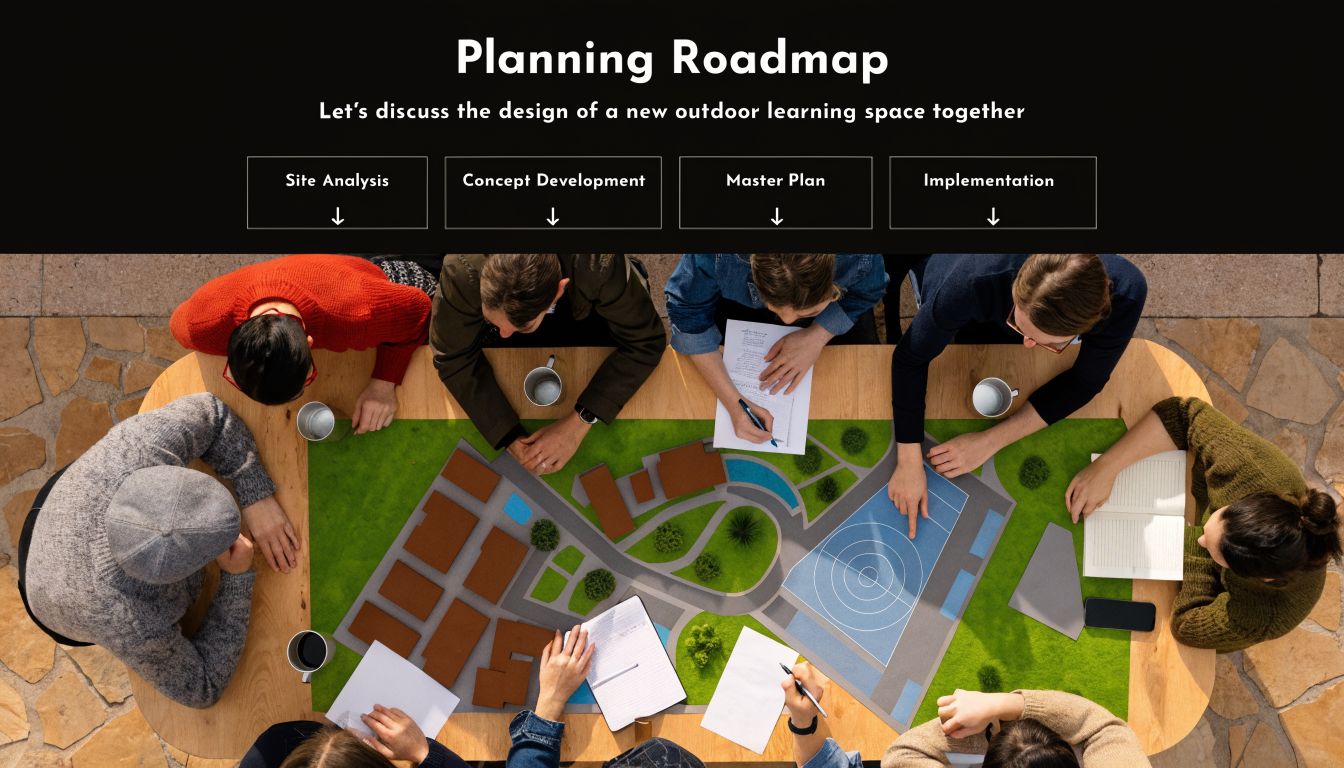
A better process is sequential. Build the case, define the uses, test the constraints, then shape the budget.
Start with a small working group. Include leadership, teaching staff, facilities or grounds input, and someone who understands how the site is used before school, during breaks and after hours. If the school has learning support staff, bring them in early. Their perspective usually improves accessibility and practical layout.
Ask direct questions:
Student input helps too, especially around how spaces feel, where bottlenecks happen, and which areas already attract calm or active behaviour.
Financial justification is often the sticking point. A 2025 Productivity Commission report found that 68% of regional Australian schools cite unclear savings data as a barrier to investment, while data from the Australian Curriculum Studies Association indicates that schools with well-designed outdoor spaces report 18% higher NAPLAN scores in STEM and 22% fewer behavioural incidents, as summarised in this outdoor learning spaces funding discussion.
Those numbers don’t remove the need for local planning, but they give committees something more concrete than “students will enjoy it”.
A practical business case should include:
| Planning question | What to document |
|---|---|
| Educational value | Which learning areas the space will support |
| Operational benefit | How the space reduces pressure on indoor rooms or underused areas |
| Behaviour and wellbeing | Where better zoning may support calmer transitions and engagement |
| Asset life | How materials and layout affect future repair and replacement demands |
For schools preparing applications, practical guidance on securing playground funding and grants can help translate a good concept into a more fundable proposal.
Not every school can build the whole vision at once. That’s normal. A staged approach often works better than a compromised all-in build.
A sensible sequence might be:
Budget reality: The cheapest first option isn’t always the cheapest long-term option. Schools usually feel that most clearly in surfacing, shade and drainage.
When committees stay disciplined about purpose and staging, projects move forward faster and deliver more value.
The most convincing examples are the ones that solve a specific teaching problem. Different age groups need different kinds of space, and schools get better results when they stop trying to make one area do everything.
An early learning service had a yard that looked pleasant but didn’t support sustained exploration. There was plenty of movement, but not much depth. Educators wanted more sensory play, more language-rich interaction, and better opportunities for fine motor development.
The solution was a low-height, nature-based layout with loose materials, planting pockets, stepping elements, water-accessible discovery points and sheltered seating for small-group interaction. The key lesson wasn’t about adding more equipment. It was about slowing the environment down enough for children to handle, sort, carry, build and describe.
What mattered most was scale. Features were sized to invite repetition and confidence rather than one-off novelty.
A primary campus had generous outdoor area, but teachers mostly used it for transitions and lunch supervision. Students had energy, imagination and space, but very little structure that linked directly to literacy, inquiry or collaborative storytelling.
The school reorganised the grounds into themed zones with stronger identity. One area suggested a forest trail, another worked as a storytelling and performance point, and another supported messy investigation and nature play. This kind of planning often benefits from curriculum prompts and sequence ideas. Resources such as Kuraplan's engaging forest school plans can be useful for schools wanting practical activity concepts that fit outdoor settings.
The biggest learning outcome came from teacher confidence. Once the environment offered a clear place to gather, a clear place to explore, and a clear place to present, outdoor lessons became easier to repeat.
A secondary school faced a different issue. Students needed spaces that respected their age and supported both wellbeing and independent work. The existing outdoor areas felt either too exposed or too juvenile, so older students rarely chose them for study.
The response was to create a quieter outdoor precinct with shaded seating, small-group tables, planting for soft separation, and circulation that allowed passive supervision without making the area feel controlled. The space supported pastoral care conversations, paired work, reading, and informal retreat during busy days.
What worked here was restraint. Secondary students usually don’t need a heavily themed space. They need comfort, dignity, and a setting that supports focus.
The build is only the beginning. Outdoor learning spaces for schools hold their value when the school treats them as working assets with a simple maintenance routine and a clear review cycle.
Create a schedule that covers both safety and presentation. It doesn’t need to be complicated, but it does need ownership.
If your space includes impact-absorbing surfaces, it’s worth understanding how wet pour rubber surfacing performs, where it suits educational settings, and what to watch for in ongoing upkeep.
An annual review helps the school protect the original investment and adapt the space to changing needs.
Use three simple lenses:
| Lens | What to ask |
|---|---|
| Use | Which classes are using it, and which areas stay empty |
| Function | What helps teaching run smoothly, and what creates friction |
| Condition | Which materials are ageing well, and what needs attention before it becomes expensive |
If teachers stop using the space, the issue is rarely motivation alone. It’s usually comfort, logistics, supervision, or setup friction.
A good outdoor area should evolve. Schools change, cohorts change, and teaching priorities shift. The strongest spaces can absorb those changes without needing a total redesign.
If your school is planning an outdoor upgrade, Kidzspace can help you turn broad ideas into a practical, durable plan. Their team works with schools on consultation, design thinking, equipment selection, budgeting and project support, with a focus on Australian conditions, safety, accessibility and long-term value.



Copyright © Kidzspace. All Rights Reserved.
Copyright © Kidzspace. All Rights Reserved.