




You’re probably looking at a patch of turf, a corner of an oval, or a tired fitness area that isn’t doing much for anyone. It might be technically usable, but not meaningfully used. People walk past it, maintenance crews mow it, and the community barely notices it exists.
That’s where a well-planned adult obstacle course can change the role of a space. Done properly, it’s not a novelty item and it’s not a mini racecourse for elite athletes. It becomes a permanent, high-use public asset that supports everyday exercise, informal training, social connection, school wellbeing programs, and active ageing.
In Australian projects, the difference between a successful installation and an expensive regret usually comes down to early decisions. The best results start with a clear brief, realistic user profiles, proper engineering, and a layout that suits local weather, site drainage, maintenance capacity, and community expectations. The flashy obstacle is rarely the hard part. The hard part is making the whole course safe, durable, insurable, inclusive, and still engaging five years from now.
Adult outdoor fitness has moved well beyond static pull-up bars and isolated exercise stations. Communities now expect spaces that feel active, social, and enjoyable to use. That shift matters for councils, schools, and planners because underused land can now support a much broader mix of users than a traditional gym circuit ever did.
A lot of that demand has been shaped by the public appetite for obstacle-based fitness. The arrival of Tough Mudder in Australia in 2013 marked a visible turning point for obstacle course racing in the region, and the same year the brand reached one million cumulative participants worldwide according to Tough Mudder history. That growth helped move obstacle training from fringe endurance culture into the mainstream and influenced how parks and outdoor training spaces were imagined in Australia.
Temporary event courses attract attention, but permanent installations create routine. They give residents a place they can use before work, after school, during club sessions, or as part of rehab and wellbeing programs. That day-to-day usability is where the long-term value sits.
A permanent adult obstacle course also changes how people interact with a park. Instead of a destination used by one age group at one time, the site starts to support overlapping uses:
Public spaces get stronger when they support repeat use, not one-off excitement.
The most successful projects often start with modest sites. A narrow reserve edge, a buffer zone beside an oval, or a forgotten section of a foreshore park can become a standout community feature if the design matches the space.
What works is a course that looks approachable from a distance and rewarding up close. If every obstacle appears punishing, many users won’t start. If the equipment feels too easy or too childlike, active adults won’t return. The balance sits in layered challenge: visible, inviting, and scalable.
That’s also why the term adult playground resonates. It gives permission for movement that isn’t confined to formal sport. People climb, balance, traverse, hang, crawl, and test themselves in ways that feel playful without being trivial.
Many briefs still assume obstacle environments are only for highly fit users. That’s too narrow. In practice, the strongest-performing spaces are the ones that serve broad community use while still offering challenge.
A permanent adult obstacle course can become a local landmark because it gives people something they can do together. Not just pass by. Not just look at. Use.
Most problems in obstacle course projects are locked in before fabrication begins. The site looked fine at concept stage, the equipment list sounded exciting, and then the actual constraints appeared: drainage, fall zones, path access, root protection, maintenance vehicle access, neighbour visibility, or the fact that the intended users were never clearly defined.
That’s why the planning stage needs discipline.
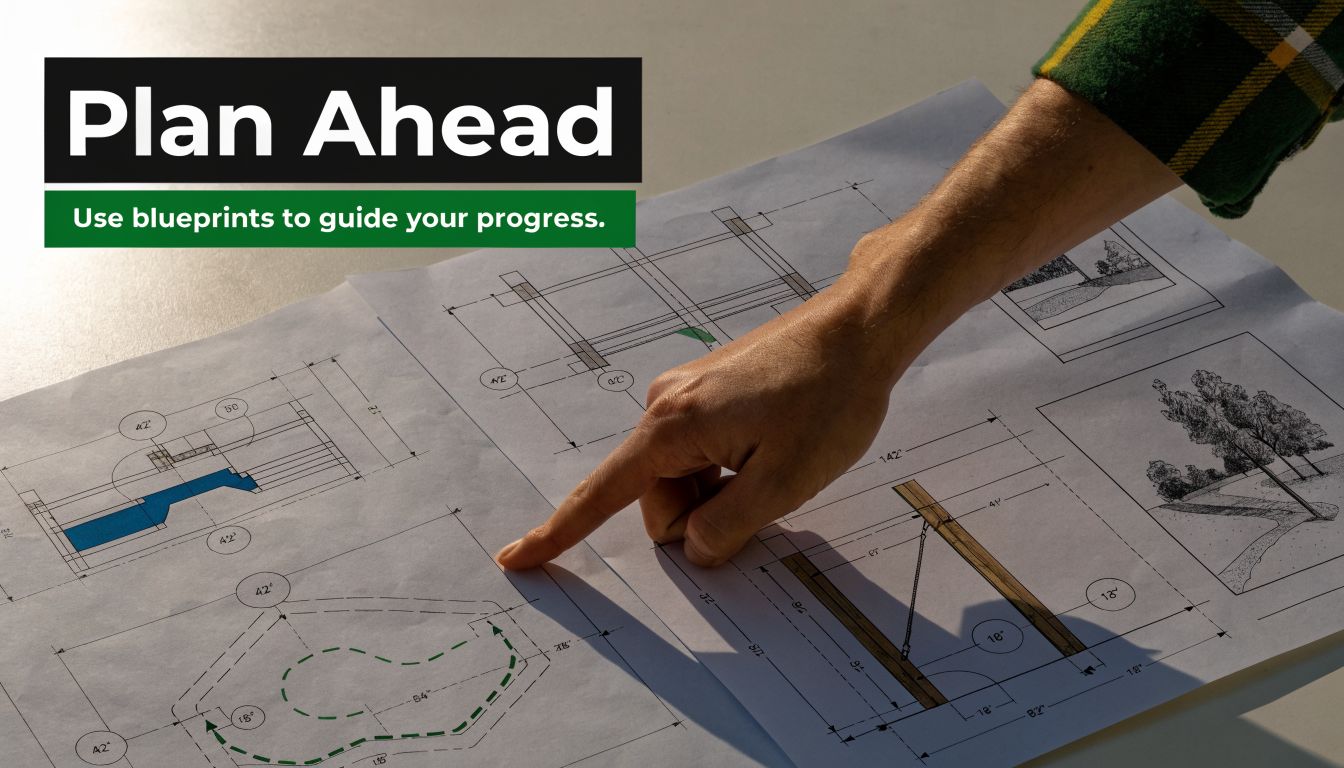
An adult obstacle course for a secondary school is different from one in a suburban reserve. A tactical training space, a community wellness trail, and a coastal fitness node all need different layouts, intensity levels, and support features.
Global race data also suggests participation can be 26.8% higher for age groups ending in 0 or 5, which is a useful reminder that adults in their 30s, 40s, and 50s are a strong audience for these spaces, especially when the course feels accessible rather than exclusive, according to RunRepeat’s OCR participation analysis.
Ask practical questions early:
Who will use the course most often?
Daily school use, general public use, or structured training groups lead to different design decisions.
What kind of challenge is appropriate?
Grip-intensive overhead work might suit one site and be wrong for another.
Will beginners feel welcome?
If the first obstacle intimidates users, the whole course underperforms.
How will the site be accessed?
Good paths, sightlines, and nearby seating often matter as much as the obstacles themselves.
Site assessment shouldn’t stop at dimensions. You need to think like the people who’ll build it, inspect it, maintain it, and use it after rain.
Key site checks include:
Drainage behaviour
Low spots, runoff paths, and compacted ground can turn active areas into muddy no-go zones.
Sun and heat exposure
Metal surfaces, unshaded queue areas, and west-facing layouts can make a course uncomfortable for large parts of the day.
Existing circulation
Desire lines tell you where people already move. A course that interrupts those paths can create conflict.
Passive surveillance
Sites with clear visibility from paths, roads, or nearby buildings generally perform better and deter misuse.
Tree impacts
Mature trees improve comfort and amenity, but root zones can limit excavation and footing placement.
Practical rule: If you can’t explain how the site will behave after heavy rain, you’re not ready to lock in the layout.
A lot of briefs say they want a “challenging” course. That word is too vague to guide design. You need a sharper project outcome.
For example, your priority might be:
The clearer the outcome, the easier it is to decide what to leave out. That matters because overcrowded layouts usually age badly. They’re harder to maintain, harder to supervise, and often less enjoyable to use.
Budget planning should include more than equipment supply. Site preparation, surfacing, edging, footings, drainage treatment, access works, engineering review, signage, shade, and future inspections all affect total project cost.
A useful way to frame early decisions is to review how a broader outdoor fitness station is assembled and specified in practice. This guide to building an outdoor fitness station is a good reference point for the planning logic behind permanent public equipment.
At concept stage, simpler usually wins. A compact, well-zoned course with clear movement flow will outperform a cluttered one. Leave room for progression, supervision, and maintenance access. If the site proves popular, it’s far easier to add to a strong base than to correct a confused original layout.
The compliance side of an adult obstacle course is where many projects either become durable public assets or start accumulating risk. The challenge isn’t just choosing equipment that looks strong. It’s proving that the whole system, including spacing, footing design, surfacing, edges, access, and inspection pathways, holds up under real use in Australian conditions.
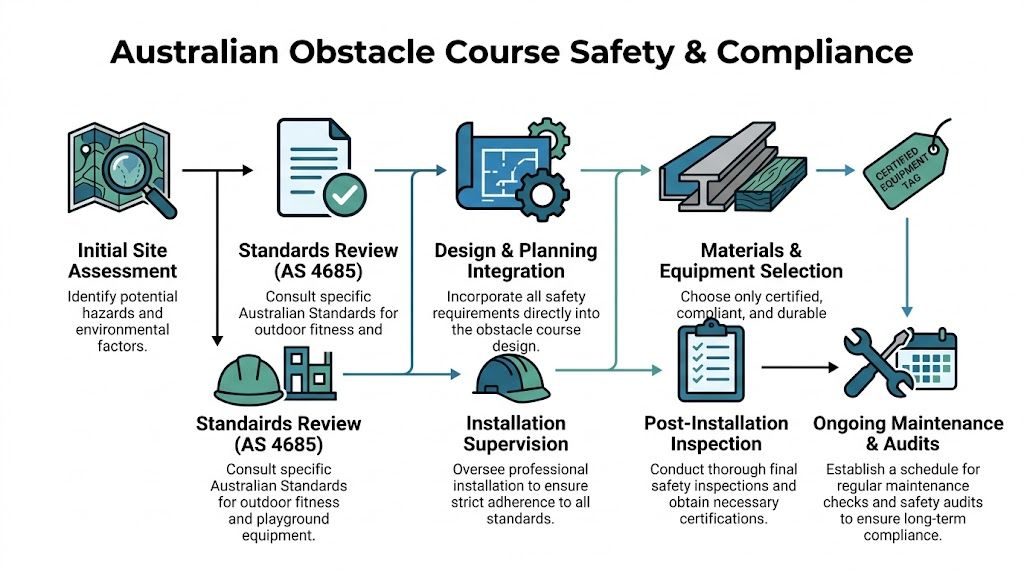
In Australia, these projects usually sit across several compliance considerations rather than one simple rulebook. AS 4685 is central because it deals with general safety requirements and test methods for playground equipment. Adult obstacle environments can also intersect with other standards and site-specific requirements depending on location, surfacing, adjacent water, tree protection, and structural conditions.
That’s why “similar to a playground” isn’t enough as a design instruction. The equipment may be for adults, but the public risk profile still requires disciplined safety interpretation.
Three areas cause the most trouble:
This is the point many decision-makers don’t see until an engineer explains it. A person hanging still from a bar creates one type of load. A person swinging, dropping, jumping, or traversing quickly creates another. In adult obstacle courses, user momentum can amplify forces to 2 to 3 times static body weight, and ignoring that factor accounts for 25% of equipment failures, based on Robson Forensic’s obstacle course engineering analysis.
That one issue affects everything from member sizing to weld detail, footing design, rope fixings, and connection hardware.
If a concept has overhead movement, swinging action, or dismount impact, static load assumptions won’t be enough.
A sound compliance pathway is usually straightforward when handled early. The trouble starts when design ambition outruns technical review.
Use this sequence:
Assess the site properly
Check grades, drainage, root zones, surrounding circulation, and available clearances before obstacles are selected.
Map risk by element type
Walls, traverse rigs, beams, ropes, and stepping sequences all create different hazard profiles.
Confirm surfacing strategy
Surface choice must suit fall exposure, expected wear, drainage, and maintenance capability.
Engineer for real-world use
Public equipment must tolerate misuse, weathering, and repeated loading, not just intended use.
Document inspections and handover requirements
If there’s no practical inspection regime, the asset is harder to defend and maintain.
Surfacing gets treated as a late-stage line item far too often. It should be part of the core safety design from day one. Wet conditions, repeated foot traffic, erosion, and edge breakdown all affect the ongoing safety of an adult obstacle course.
Where impact attenuation and all-weather usability are priorities, a purpose-designed surface system can support more reliable operation than loose, shifting ground conditions. For projects comparing options, wet pour rubber surfacing is often part of that conversation because it offers predictable coverage, clear edge definition, and easier maintenance planning than some alternatives.
Most serious project headaches don’t come from dramatic failures. They come from preventable oversights:
A compliant design needs to work not only on opening day but during ordinary use, school use, wet weather, and low-supervision periods.
By handover, you want more than a nice-looking build. You want engineering sign-off, installation records, clear maintenance instructions, and a defensible inspection framework. That documentation matters for insurers, for internal asset teams, and for anyone responsible for long-term public safety.
Good compliance work rarely looks glamorous. It looks organised, traceable, and difficult to argue with.
A compliant obstacle course can still fail as a public asset if it’s boring, awkward to move through, or expensive to keep in good condition. Good design has to do two jobs at once. It must survive years of Australian weather and frequent use, and it must keep people coming back.
That means choosing materials with discipline and arranging obstacles with intent. The most successful layouts feel natural underfoot, visually clear, and varied enough that users can train differently on each visit.
The visual concept is only the start. Over time, your maintenance team lives with the material schedule, not the render.
Here’s a practical comparison for an outdoor adult obstacle course.
| Material | Durability & Vandal Resistance | Maintenance Requirement | Upfront Cost | Best For |
|---|---|---|---|---|
| Galvanised steel | Strong, hard to damage, performs well in high-use public settings | Low to moderate. Inspect coatings, welds, fixings, and corrosion points | Moderate to higher | Permanent council and school installs, coastal-adjacent sites with the right finish specification |
| Timber | Can look warm and fit natural landscapes, but is more vulnerable to wear, splitting, and surface degradation | Moderate to high. Requires regular inspection for cracking, movement, rot, and finish wear | Moderate | Nature-based settings, lower-intensity features, projects prioritising a softer visual character |
| Composite plastics and HDPE elements | Good weather resistance and colour stability when correctly specified, but not ideal for all structural demands | Low to moderate. Check fixings, edges, and wear surfaces | Moderate | Panels, low-impact activity elements, wayfinding, and non-structural components |
| Rope and webbing systems | Highly engaging when specified correctly, but wear rates depend heavily on use intensity and environmental exposure | Moderate. Needs routine inspection for fray, tension, and connection wear | Moderate | Traverse challenges, climbs, and grip-focused elements |
| Powder-coated feature finishes | Visually strong but finish life depends on exposure and maintenance | Moderate. Chips and abrasion need attention before corrosion spreads | Variable | Signature features where aesthetics matter and maintenance is budgeted |
For primary structural frames, steel is often the practical winner because it handles repeated loading, impact, and public wear better than lighter alternatives. In harsh environments, the detailing matters as much as the material itself. Water traps, inaccessible bolts, and exposed cut ends can undermine an otherwise solid specification.
Timber still has a place, especially where planners want a more natural fit within a reserve or school setting. The trade-off is that timber needs more vigilance. It can weather attractively, but it doesn’t forgive neglect.
A common mistake is selecting popular obstacle types one by one and dropping them into the site. That creates a disjointed experience. A good adult obstacle course should guide the user through effort changes, movement variation, and moments of progression.
Think in movement families:
Site note: If users have to stop and figure out where to go next, the layout needs work.
An obstacle might be impressive on its own and still be wrong for the course. The test is whether it fits the sequence. A warped wall after a slippery descent might create frustration. A technical traverse too early in the route may turn beginners away. A narrow challenge point can create queues and passive standing, which lowers overall engagement.
Useful layout principles include:
Make the first move easy to understand
People should know where to begin without reading a sign.
Offer visible progression
Users should be able to attempt a simpler version or move to a harder line.
Separate active paths from spectator paths
This reduces conflict and helps supervision.
Avoid bunching high-skill elements together
Spread out technical challenges so users can recover and continue.
A public course isn’t a one-day event setup. It needs repeatability. People should be able to use it for circuit training, mobility work, lunchtime movement, supervised sessions, and casual social exercise. If every station is maximal, most users will sample it once and avoid it later.
That’s why mixed-intensity design works. Pair a climbing wall with nearby steps or holds at different heights. Place beam work near support rails or alternate routes. Give users options without making the course feel diluted.
The hardware and finish schedule often determines whether the site still looks good after years of use.
Focus on:
If maintenance staff can’t reach a connector, inspect a rope termination, or clean out a drainage edge, the design is incomplete. Good obstacle course design includes practical serviceability. Public assets last longer when maintenance is simple, visible, and built into the original detailing.
Many adult obstacle environments are still designed around one user type. Fit, confident, mobile, and already comfortable with challenge. That approach leaves a large part of the community out before the first footing is poured.

In Australia, an estimated 65% of adults over 45 are inactive, and only 15% of outdoor fitness facilities meet full accessibility standards under the Disability Discrimination Act 1992, according to adult program accessibility observations. For councils and schools, that should change the brief immediately. The biggest opportunity often isn’t attracting the fittest users. It’s welcoming the people public fitness spaces usually miss.
An inclusive adult obstacle course doesn’t mean removing challenge. It means offering more than one way to participate. That usually leads to stronger use because beginners, older adults, support workers, teachers, and mixed-ability groups can all engage with the same space.
The practical gains are clear:
A helpful companion reference is this guide on what to install in an inclusive playground. While it’s written for play spaces, the same thinking applies to adult movement settings: access, dignity, choice, and multiple levels of challenge.
The shift is less about one special feature and more about a series of design decisions.
Consider including:
A course that only rewards speed and strength will exclude many people who still want to move, improve, and participate.
A lot of adults avoid outdoor fitness because they don’t want to fail in public. Inclusive design addresses that social barrier. Lower first steps, wider platforms, obvious hand supports, and alternative routes let people test themselves without feeling exposed.
This is especially important in schools and public reserves where users arrive with very different confidence levels. One person may want a hard traverse. Another may want to rebuild balance after inactivity. Both should feel the site was built with them in mind.
A short visual example helps show how broad community movement spaces can support mixed users and varied participation.
You don’t need to turn an obstacle course into a rehab clinic. You do need to avoid designing every feature at one intensity.
Focus on these adjustments:
Lower at least some handholds and grips
Reach range matters more than many concept plans acknowledge.
Provide support choices
Adjacent rails, side steps, or bypass routes let more people stay involved.
Use forgiving surfaces around low-impact stations
Comfort influences repeat use, especially for older adults.
Think about social participation
Not everyone engages by racing. Some users need room to pause, observe, and then join in.
When a course accommodates different bodies and different confidence levels, it stops being a niche facility and starts acting like true community infrastructure.
A strong concept can still unravel during procurement if the brief is vague or the supplier assessment is superficial. This stage is where you protect the project from shortcuts, scope confusion, and avoidable maintenance problems.
Tender documents should describe more than a desired look. They need to define intended users, required standards alignment, site conditions, surfacing expectations, maintenance responsibilities, and documentation deliverables.
At minimum, include:
In this category, supplier capability matters. You’re not buying a loose collection of fitness items. You’re procuring a public asset that has to stand up to scrutiny from engineers, insurers, facilities teams, and the community.
When assessing partners, look for proven compliance records. Experienced suppliers such as Kidzspace report a 98% compliance pass rate on initial council submissions, with engineered designs showing less than 1% failure from metal fatigue over their lifespan, based on the verified project benchmark cited for this article.
Ask to see how the supplier documents engineering, installation, and ongoing inspection requirements. If that process is vague, the risk is usually being pushed back onto the client.
The best installs are methodical and boring in the right ways. Site set-out is confirmed. Footings are checked against the engineering. Drainage treatment is handled before surface failures appear. Components are assembled with access for future maintenance, not just speed.
A typical sequence includes:
Adult obstacle courses don’t need constant heavy maintenance, but they do need disciplined routine care. Most issues start small. A loose fixing, worn rope sleeve, chipped coating, water pooling at a landing, or vandal damage at an access point.
A workable maintenance schedule usually includes:
The simplest rule is this: maintenance must be practical enough that it happens.
A well-executed adult obstacle course does more than fill a spare corner of a site. It gives people a reason to arrive, move, connect, and return. The strongest projects combine clear planning, disciplined compliance, durable specification, inclusive design, and a maintenance model that’s realistic for the asset owner.
For councils and schools, that makes the investment far more valuable than a set of standalone fitness items. It becomes part of the community’s daily rhythm.
If you’re planning an adult obstacle course for a school, council, or shared public space, Kidzspace can help you shape the project from concept through to compliant delivery. Their team offers free consultations to clarify site constraints, user needs, budget priorities, and the right fit for Australian conditions.




Copyright © Kidzspace. All Rights Reserved.
Copyright © Kidzspace. All Rights Reserved.