



Most clients start in the same place. They’ve outgrown the old swing set, the site feels tired, and everyone wants more from the space without creating a maintenance headache or a compliance problem. A school wants play that works across year levels. A council wants stronger community use. An early learning centre wants something beautiful, safe, and easy to supervise.
That’s where good outdoor playground design ideas separate themselves from generic wish lists. A strong playground doesn’t come from adding random pieces of equipment. It comes from matching play value to site conditions, user needs, circulation, surfacing, shade, access, and long-term upkeep.
In Australia, that practical layer matters. Playground safety standards are governed by the AS 4685 series, first introduced in 2001 and progressively updated. The 2014 revision added stronger requirements for impact-attenuating surfaces and fall heights, helping reduce injuries by up to 40% in compliant installations according to the Australian Competition and Consumer Commission summary referenced here. Good design starts with that reality, not after the concept sketch is done.
The other pressure is activity. In 2022, the Australian Bureau of Statistics reported that 38% of children aged 5 to 14 weren’t getting enough physical activity. Outdoor playgrounds help, with moderate-to-vigorous activity rising during visits according to a University of Sydney playground study published in PMC. That means design decisions affect more than appearance. They affect how long children stay, how they move, and whether a space gets used.
Below are 10 outdoor playground design ideas that work in practical settings. Each one balances imagination with safety, budget discipline, and the kind of durability Australian sites demand.
A themed playground works best when the theme changes behaviour, not just colour.
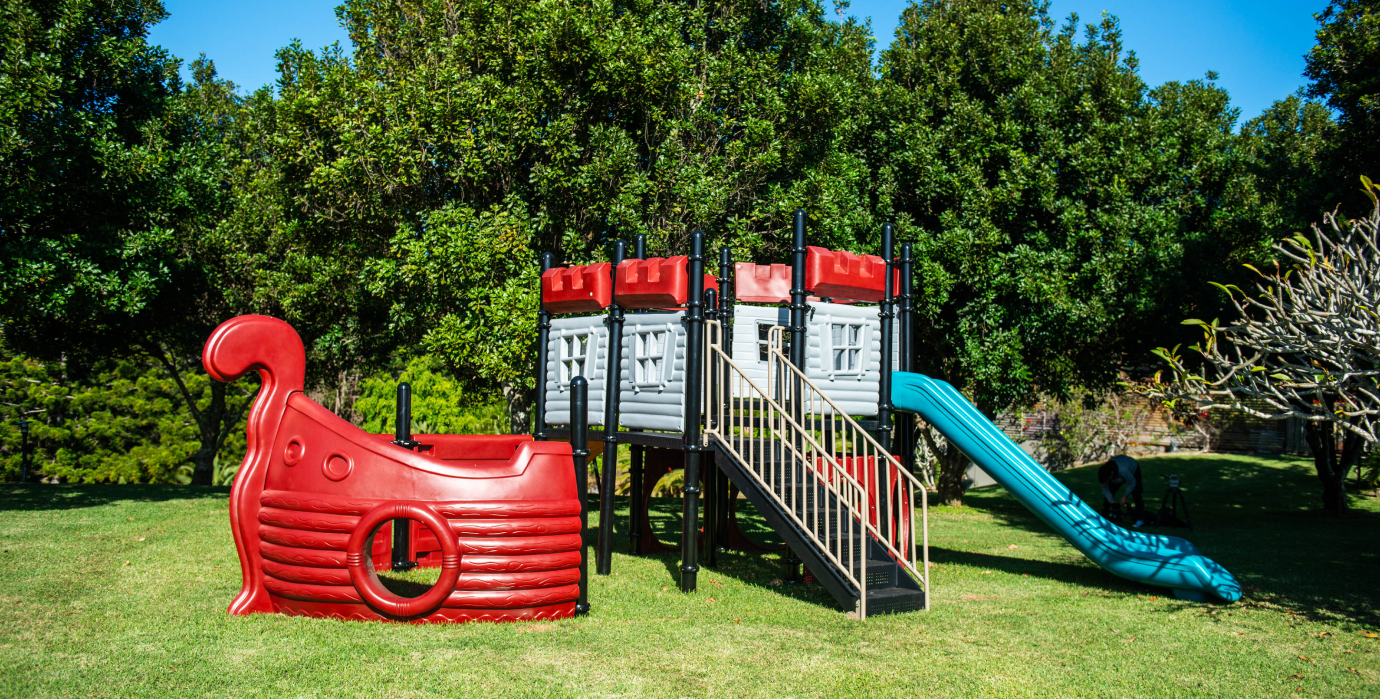
The strongest examples use a clear story across the whole site. Forest trails, animal habitats, pirate decks, transport yards, and adventure villages all give children a reason to move from one element to the next. Instead of one tower, one slide, and one swing bay sitting apart, the space starts to feel connected.
A forest-themed school playground, for example, might combine climbing nets, balance pods, sensory panels, log-style edging, green and timber tones, and interpretive signs about local habitat. A coastal council site might use a pirate or marine theme more effectively because the story already fits the place.
For inspiration on how those narratives come together, this guide on how to create a themed playground is useful because it shows how equipment families and visual language can stay consistent across a site.
Themed ecosystems perform well when you keep three layers aligned:
What doesn’t work is forcing a theme onto a standard catalogue layout. That usually produces a space that looks busy but plays flat.
Practical rule: If removing the graphics leaves the design with no identity, the theme wasn’t integrated thoroughly enough.
Budget-wise, themed spaces can be handled in stages. Start with a strong hero structure, matching colour palette, and one or two custom details. Add signage, greenery, or extra play nodes later. That approach usually protects the concept without pushing the project into unnecessary custom fabrication.
For schools, I’d also keep at least one zone deliberately unthemed. Open-ended areas often support the best informal games, and they stop the whole playground from becoming too prescriptive.
Inclusive design isn’t a separate add-on. It’s the baseline for a modern public or school playground.
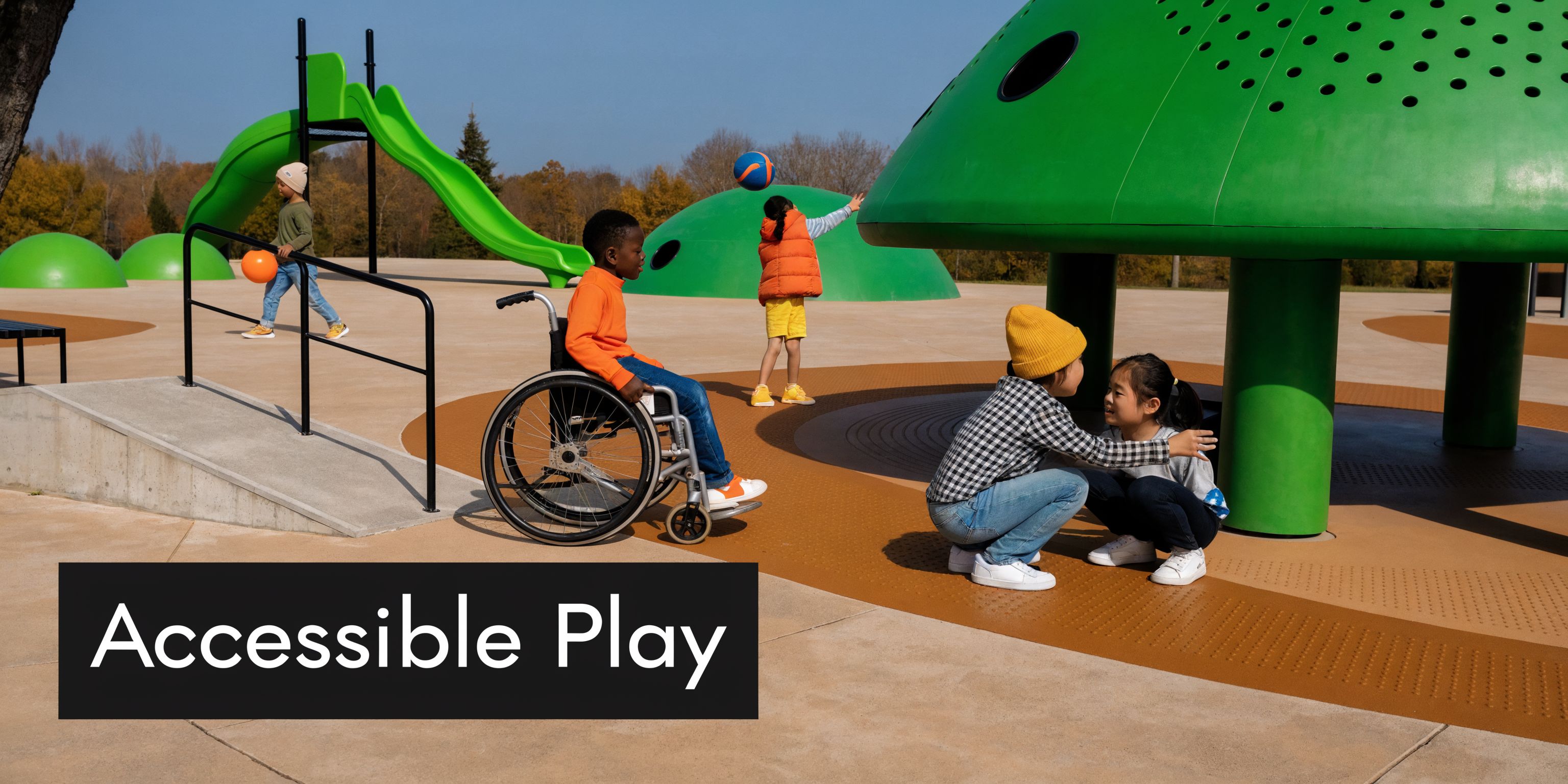
In Australia, inclusive playground upgrades are becoming standard practice. The ABS 2024 Community Infrastructure Survey found that 62% of municipal playground upgrades include universal access elements, up from 38% in 2019. The same verified dataset also notes the National Disability Strategy 2021 to 2031 requires ongoing growth in accessible recreation investment. That shift matters because clients now expect access, sensory value, and dignity of use from the first concept, not at the end of value engineering.
A practical starting point is to think beyond wheelchair entry. Real inclusion also means circulation width, transfer points, contrast, sensory cues, refuge spaces, and equipment that offers challenge without excluding users.
For ideas that translate those principles into actual equipment mixes, see what to install in an inclusive playground.
The technical basics matter. The verified standards data allows for ramps aligned with AS 1428.1 at a maximum 1:14 gradient, and transfer platforms at 450 to 600mm heights under AS 4685.6. Those details influence the whole layout. If they’re bolted on later, circulation usually becomes awkward.
A good inclusive layout often includes:
The surface choice matters too. Many projects combine compliant surfacing zones with pathways and support areas designed for easier wheeled movement. Some clients also explore creating a safer play space with artificial turf in selected zones, particularly where they want a softer visual finish and lower loose-fill migration.
Later in the design process, it helps to show stakeholders what inclusive movement looks like in real use.
What doesn’t work is the “one accessible item equals inclusion” mindset. Children don’t experience playgrounds as compliance diagrams. They experience them as shared places. If only one child can access one piece while everyone else moves elsewhere, the design has missed the point.
Natural play is often the first idea clients love and the first one they underestimate.
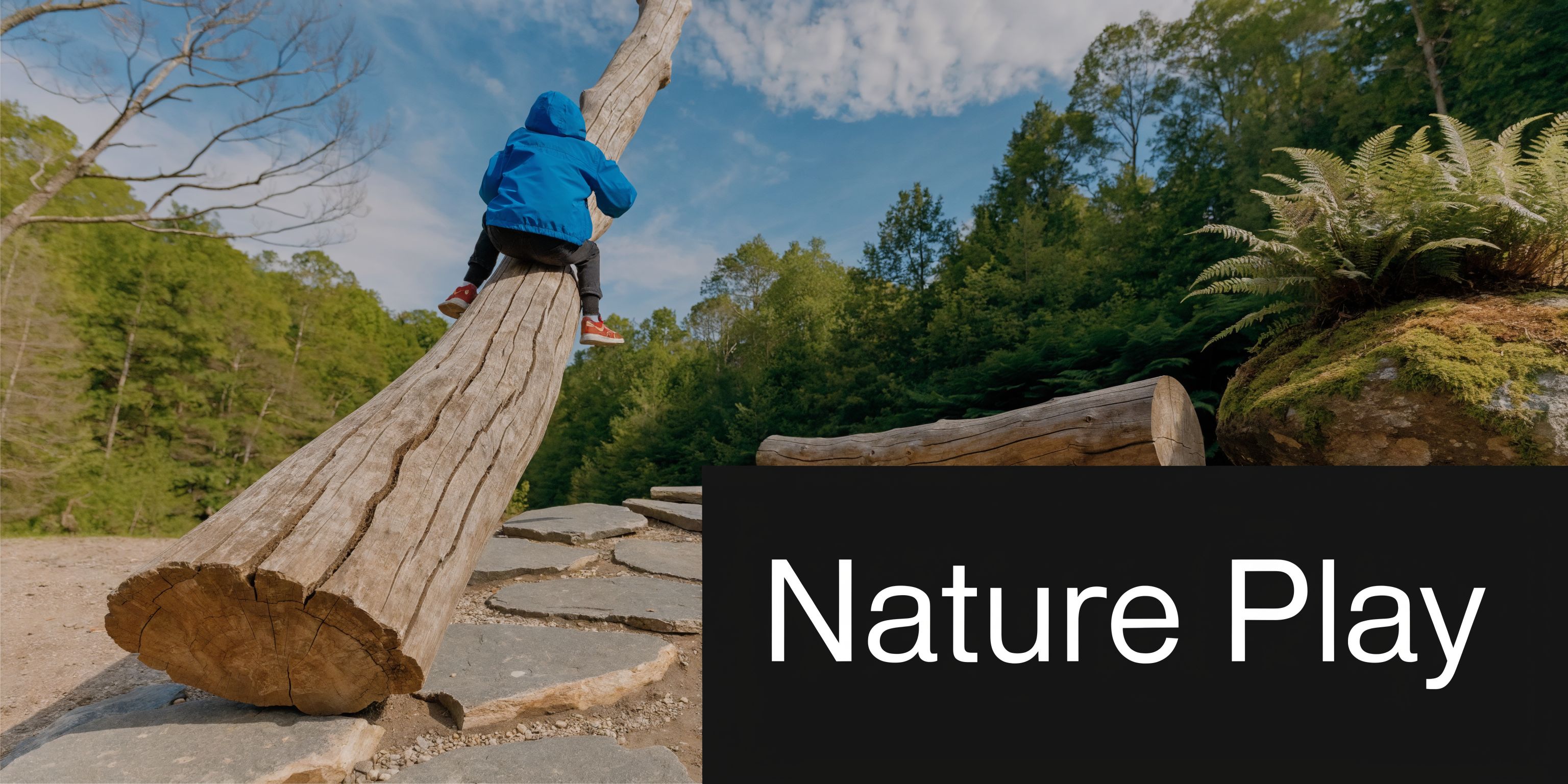
Logs, boulders, dry creek beds, stepping routes, cubby spaces, water channels, and planting can create some of the richest play experiences on a site. Children read those spaces differently from fixed equipment. They invent rules, test boundaries, and return to the same area in new ways.
The strongest natural play spaces don’t try to imitate untouched bushland. They’re carefully designed settings. Edges are controlled. Fall zones are understood. Planting is selected for durability and safety. Loose materials are used where staff or council maintenance teams can manage them.
A useful starting point is understanding why nature play is important and then translating that value into a site plan that’s realistic to maintain.
Natural play gives you flexibility, but it can also expose weak maintenance planning.
Loose branches, leaf drop, compacted pathways, and worn planting beds all change how the site performs over time. I’ve seen beautiful natural concepts lose their value because no one defined who clears debris, inspects timber, or manages drainage after storms.
The design response is simple:
Natural play should feel loose for children and tightly resolved for adults.
There’s also an Australian climate reality. In the verified dataset, the Black Summer bushfires burned 18.6 million hectares, and the Australian Institute of Health and Welfare indicates heat-related incidents in outdoor play spaces have increased since 2020. In high-risk parts of Victoria and NSW, natural aesthetics need balancing with bushfire and heat resilience. That might mean using treated timbers that meet AS 3959, choosing heat-reflective surfaces, limiting dense combustible planting near core structures, and creating defendable play edges rather than heavily vegetated enclosures.
Natural play works best when it’s honest. If the site can support a living environment, lean into it. If it can’t, use nature-inspired forms and durable materials instead of creating a fragile version of “wild”.
Some playgrounds fail because they stop serving children once they hit the upper primary years.
Multi-age fitness stations fix that by giving older children and teens a reason to stay engaged. Climbing frames with strength elements, pull-up bars, traverse walls, balance circuits, stepping sequences, and agility markers all extend the life of the site. They also make better use of dead edges that often sit empty in standard layouts.
This approach has a strong public health case. The National Guidelines for Physical Activity recommend 60 daily minutes of moderate-to-vigorous activity, yet only 22% of children meet that without structured play areas according to the verified physical activity dataset. For schools, that means active infrastructure isn’t a nice extra. It’s part of the movement solution.
The best place for fitness-oriented elements usually isn’t in the middle of the junior play zone. They work better on a perimeter loop, near courts, beside an oval connection, or in a separate but visible training strip. That allows different age groups to use the same site without constant conflict.
Designers should also avoid making every station look like an adult gym. Children and teenagers engage more with equipment that still feels playful. Angled monkey bars, rope traverses, low vault elements, reaction walls, and challenge ladders usually outperform overly literal “fitness” pieces.
A practical layout often includes:
What doesn’t work is over-programming. If every element tells users exactly how many repetitions to complete, the site starts to feel like compulsory exercise. The better model is a hybrid. Give enough guidance for PE and active breaks, but leave room for spontaneous use.
For schools, this type of zone is especially effective when staff can connect it to sport, wellbeing, and movement breaks across the day rather than confining it to one lesson block.
Older students often want risk, but what they need is graduated challenge.
That distinction matters. A good adventure zone doesn’t chase height for its own sake. It builds sequence, decision-making, and confidence. Rope traverses, raised bridges, overhead ladders, boulder-style climbs, angled nets, and obstacle runs all work when users can choose an easier route or a harder one without feeling excluded.
Here, many outdoor playground design ideas either become excellent or become problematic. If challenge equipment is too easy, older children abandon it. If it’s too concentrated, supervision becomes difficult and the area can feel intimidating to everyone else.
Start with the movement pattern. Ask what children do first, second, and third. A simple challenge route might begin with low balance elements, move into a rope crossing, then finish in a higher net or lookout. That progression creates confidence.
Older-style playgrounds often caused problems because they relied on rigid, hard-edged equipment. In the verified safety history, pre-1990s rigid metal swings were linked to 60% of injuries in that older generation of design, before the shift to softer-edged, age-zoned systems noted in the same safety reference. The lesson still applies. Modern challenge areas need to feel adventurous while staying readable and forgiving.
"Children will test the hardest route available. Good design makes that route legible and supportable."
For schools, challenge zones work best when staff have a straightforward supervision position and clear rules. For councils, they need enough separation from toddler areas to prevent constant age mixing in the highest-use moments.
A few practical filters help:
The payoff is worth it. Challenge spaces often become the part of the site that older children identify as “theirs”, which is exactly what many mixed-age schools and parks are missing.
Water play changes how long families stay. It also changes your maintenance obligations immediately.
That’s why splash pads, spray features, hand pumps, rills, and water tables need more discipline in planning than most clients expect. The upside is obvious. Water cools the site, supports sensory and collaborative play, and gives younger children a strong reason to revisit the space in warmer months.
In the verified activity dataset, water play appears in 43% prevalence within the referenced design context. That tells you it’s no longer a novelty feature. It’s a mainstream design move when climate and site operations support it.
The best water play spaces are shallow, visible, and easy to shut down. Parents need clear sightlines. Operators need drainage they can trust. Maintenance staff need fast access to filters, pumps, valves, and wash-down points.
I’d divide water play into two broad categories:
Shade is essential. So is slip resistance in surrounding circulation paths. Seating also matters more here than in many dry play zones because carers tend to stay put while children cycle repeatedly through the same features.
What doesn’t work is placing water at the bottom of a busy circulation corridor. That usually creates congestion, wet prams, and constant edge conflicts. Put it slightly aside from the main movement spine, but not so far away that it loses supervision.
Water play also pairs well with environmental learning. Measured channels, weirs, gates, and flow wheels can turn a splash area into a simple lesson on movement, gravity, and resource awareness without making it feel like schoolwork.
Educational play only works when it still feels like play.
That sounds obvious, but many STEM-led playgrounds become signage projects with equipment attached. Children don’t engage with a wall of facts. They engage with movement, cause and effect, experimentation, and repetition.
A better model is to embed learning into action. Spinners demonstrate force. Water channels show flow and direction. Climbing routes develop sequencing and problem-solving. Measuring posts, shadow points, sound panels, gears, and cooperative puzzles all support curriculum links without flattening the play experience.
Schools usually get the best value from educational integration when the design serves two groups at once. During class time, teachers can use it deliberately. During breaks, children can ignore the lesson framing and just play.
In the verified activity dataset, playgrounds with climbers averaged 11.2 per site in the Sydney study setting, and swings were present in 80% of sites. That’s useful because it reinforces a practical truth. Educational value doesn’t replace popular movement-based equipment. It sits alongside it.
A balanced educational playground often includes:
What doesn’t work is over-labelling every element. If a child has to stop and decode text before they can play, the equipment has lost momentum.
Councils can also use this approach well in botanic settings, libraries, and civic parks. A transport-themed space near a station precinct, for example, can incorporate route logic, directional graphics, and turning mechanisms without becoming heavy-handed. The educational layer should sharpen curiosity, not dominate the site.
A staged playground isn’t a compromise if the master plan is strong.
That’s the key idea behind modular systems. Schools, councils, and developers often need to open a site with a realistic first-stage budget, then expand as funding, grants, or community support grows. Modular systems make that possible without leaving the playground looking unfinished for years.
The practical benefit is growing. In the verified materials and procurement dataset, the Australian Parks and Leisure Australia 2023 Industry Report found a 42% increase in procurement of modular, low-maintenance systems since 2020, with lifecycle savings averaging AUD 15,000 to 25,000 per installation over 10 years compared with imported non-compliant alternatives. That’s the kind of operational argument that gets projects approved.
The mistake is buying isolated pieces now and trying to “join them up later”. Good staged design does the opposite. It starts with the full future layout, then builds the highest-value backbone first.
That usually means stage one includes:
If the site uses a consistent product family, expansion gets much easier. The visual language stays coherent, replacement parts are simpler to source, and users don’t feel like the site was assembled from unrelated projects.
A master plan should show what the playground becomes, not just what the budget buys this year.
This approach works well for school campuses and new residential communities. A developer can deliver a credible stage-one play space for the first residents, then expand the equipment mix as the population grows. A school can start with junior and all-abilities elements, then add challenge or fitness zones later as student needs become clearer.
What doesn’t work is leaving no room for growth. Once shade posts, fences, trees, and footpaths lock the site in, even excellent modular systems become difficult to extend cleanly.
Some of the best design decisions come from the people who will use the site.
Children often identify circulation problems adults miss. Educators know where conflict happens at lunch. Parents point out access barriers quickly. Council teams understand the maintenance burden of certain materials. Co-design brings those truths forward before they become expensive problems.
This doesn’t mean every workshop idea should be built. It means the design process should capture what matters, translate it professionally, and feed it back clearly so the community can see how their input shaped the result.
For schools, useful consultation usually mixes student drawing sessions, staff workshops, and a short parent survey. For councils, I’d add on-site pop-ups, disability advocacy input, and maintenance review meetings. The goal is not endless consultation. The goal is better decisions.
A few methods work particularly well:
The strongest co-designed spaces often end up simpler than expected because the process clarifies priorities. One community may want more informal gathering space. Another may want shaded early years play. Another may value challenge equipment for older children because there’s nowhere else nearby for them.
What doesn’t work is token consultation. Children notice when adults ask for input then build the opposite. So do parents.
This principle becomes even more important in culturally specific settings, remote communities, and multi-user civic parks where local patterns of use are distinct. Participation isn’t just politically useful. It’s one of the most effective tools for making sure the finished playground belongs to the place.
A place-based playground gives children a stronger sense of where they are, not just what they can climb.
That can come through local history, ecology, industry, language, art, and especially First Nations knowledge when the process is led properly with community partnership. In Australia, this area is still underdeveloped in many projects, which is why it deserves more attention than a single plaque or motif.
The verified dataset on this issue shows that ABS 2023 data found 28% of playgrounds in remote NT and WA lack cultural elements, with lower participation among Indigenous children reported in the related Productivity Commission reference. It also notes a 2025 Play and Recreation Victoria study finding stronger engagement in culturally responsive designs, alongside federal Closing the Gap funding and updated co-design guidance. Even without repeating every figure in design meetings, the message is clear. Cultural fit affects use.
The strongest culturally responsive playgrounds don’t rely on generic symbols. They draw from local stories, local species, local materials, and local collaboration.
That might include:
For schools with Reconciliation Action Plans, the playground can become one of the most visible expressions of that commitment. For councils, it can help a park feel grounded in its actual setting instead of reading like a generic catalogue install.
The trade-off is time. Genuine partnership takes longer than standard procurement. It also needs proper fees for artists, cultural advisors, and consultation. That’s not a design problem. That’s part of doing the work responsibly.
What doesn’t work is treating culture as decoration. Children recognise authenticity quickly, and communities do too. Place-based design succeeds when local voices shape the concept early enough to influence layout, story, and experience, not just the graphics package at the end.
| Title | Implementation Complexity 🔄 | Resource Requirements ⚡ | Expected Outcomes 📊 | Ideal Use Cases 💡 | Key Advantages ⭐ |
|---|---|---|---|---|---|
| Themed Play Ecosystems | High, integrated design, planting, and storytelling | Premium capital, specialist designers, higher maintenance | Strong engagement, longer dwell time, narrative learning | Parks, community hubs, schools seeking identity | Highly engaging, memorable, supports collaborative imaginative play |
| Inclusive Universal Design Playgrounds | High, accessibility standards and specialist input | Higher capital, accessible surfacing, expert consultants | Broad inclusion, legal compliance, increased community access | Schools, public parks requiring universal access | Promotes equity, meets standards, increases participation |
| Natural Play and Forest Playgrounds | Moderate-High, site-specific ecological design & risk management | Land area, ongoing vegetation management, seasonal upkeep | Improved wellbeing, risk assessment skills, environmental learning | Nature reserves, large parks, outdoor classrooms | Sustainable, sensory-rich, fosters nature connection |
| Multi-Age Fitness and Activity Stations | Moderate, clear zoning, instructional design | Durable equipment, signage, periodic training & maintenance | Measurable fitness gains, reduced sedentary behaviour | Schools, sports-oriented parks, wellness programs | Encourages daily activity, supports curriculum and health outcomes |
| Adventure and Challenge Course Elements | Very High, certified design, safety systems, trained staff | High capital, professional installation, frequent inspections | Increased confidence, resilience, teamwork and problem-solving | Secondary schools, adventure parks, outdoor education centres | Builds leadership, high engagement for older children |
| Water Play and Splash Pad Systems | High, complex plumbing, filtration and hygiene systems | Significant operational costs, filtration, seasonal management | Cooling relief, sensory play, family attraction | Hot climates, family-focused parks, community centres | Inclusive water play, strong seasonal draw, sensory benefits |
| STEM and Educational Integration Playgrounds | Moderate, curriculum alignment and interactive design | Educational consultants, signage/tech maintenance | Enhanced STEM understanding, hands-on problem solving | Schools, science centres, curriculum-led outdoor learning | Reinforces learning, attracts educational funding, sparks curiosity |
| Modular and Expandable Playground Systems | Moderate, requires master planning for phasing | Standardized components, lower initial capital, documentation | Scalable infrastructure, phased investment, long-term relevance | Budget-conscious councils, multi-year school projects | Flexible expansion, cost-manageable, reusable parts |
| Community Co-Design and Participatory Playgrounds | High, extended consultation and facilitation needs | Time, facilitation expertise, stakeholder coordination | Strong ownership, higher satisfaction, social cohesion | Community-led projects, placemaking and participatory budgets | Deep local buy-in, custom outcomes, strengthens community ties |
| Culturally Responsive and Place-Based Playgrounds | High, sensitive consultation, partnership obligations | Funding for artists, long-term cultural stewardship, advisory fees | Cultural recognition, inclusive representation, educational value | Indigenous partnerships, reconciliation initiatives, place-making | Honors local culture, builds relationships, creates unique identity |
The best outdoor playground design ideas don’t start with equipment. They start with a clear brief.
That brief should answer a few practical questions early. Who is the space for day to day. What age ranges need to be served well, not just technically included. How visible must the site be for staff or carers. What conditions will the materials face across heat, UV, coastal exposure, storm events, or heavy school use. And just as important, who will maintain the site once the ribbon cutting is over.
Those questions shape everything that follows. A themed ecosystem may be the right answer for a school trying to build identity and imaginative play. A modular system may suit a council that needs a staged rollout across several suburbs. A natural play area may be ideal where the site can support ongoing upkeep of greenery. An inclusive layout may become the central priority where access, dignity, and social play need to improve immediately.
The common thread is that good projects balance aspiration with restraint. They don’t try to force every current trend into one site. They choose a few ideas and execute them properly. In practice, that often means protecting the parts of the design that affect use most: circulation, shade, surfacing, supervision, accessibility, and durable materials.
Material selection deserves special attention in Australian conditions. The verified materials dataset notes that galvanised steel components can require an 85-micron zinc coating with post-fabrication hot-dip galvanising for durability, while UV-stabilised polyethylene is tested for strength retention after accelerated weathering. It also reports that 78% of local councils prioritise weather-resilient materials, and that compliant designs achieve 92% parent and carer satisfaction for safety perception in the referenced national audit. Those figures support what practitioners already see on site. When materials are specified properly, the space stays attractive, safer, and cheaper to run over time.
There’s also a wider community payoff. The verified activity dataset notes that inclusive designs installed by Victorian councils saw usage rise after installation, and that larger playgrounds with mature trees can support longer stays in the referenced study context. Those aren’t abstract wins. They translate to stronger daily use, more social interaction, and parks or school grounds that people want to return to.
If you’re weighing concepts right now, don’t ask which idea is most fashionable. Ask which idea will still be working hard for the site years from now. Will the challenge zone still appeal to older students. Will the natural play area still function after a wet season. Will the themed elements still feel cohesive if the project is staged. Will the inclusive features support real shared play, not just access on paper.
That’s where professional planning pays for itself. A strong consultant or design-and-supply partner can test the concept against AS 4685 compliance, circulation logic, surfacing requirements, staging constraints, and ongoing maintenance before expensive mistakes are built in. Even details outside the equipment footprint, such as playset foundations, affect how well the final space performs and how long it lasts.
A better playground is rarely the result of one big idea alone. It comes from hundreds of sensible decisions made in the right order. Get those right, and the site becomes more than a place to fill space between buildings. It becomes part of how children move, connect, learn, and remember their community.
If you’re planning a new playground or upgrading an existing one, Kidzspace can help turn early ideas into a practical, compliant design that suits your site, users, and budget. Their team works with schools, councils, early learning centres, and designers to develop themed, inclusive, durable play spaces built for Australian conditions.




Copyright © Kidzspace. All Rights Reserved.
Copyright © Kidzspace. All Rights Reserved.