






If you're planning a new play space, or trying to fix one that never quite worked, sand & water play usually sits in the middle of the debate. Everyone likes the idea. Then the important questions start. Where does the water go, who cleans it, what happens in summer, how do you make it accessible, and will it still look good after hard use?
Those are the right questions.
In school grounds, parks, and early learning settings, sand & water play can become one of the most used parts of a site. It can also become the first area people complain about if drainage, hygiene, supervision, and material selection weren’t properly considered. Good outcomes don’t come from dropping in a sandpit and hoping for the best. They come from careful planning, practical detailing, and a sustainable maintenance model for staff.
Sand & water play earns its footprint because it does several jobs at once. It supports sensory exploration, gives children a place to test ideas with their hands, and creates a form of play that works for a wide range of ages and confidence levels.

In early childhood settings, that matters because the best play spaces don’t force children into one mode of participation. Some children want to dig, pour, and repeat. Others want to construct channels, fill containers, and test what happens when dry sand becomes damp and workable. Queensland early learning guidance points directly to that kind of exploration, linking sand play with concepts such as shape, weight, and capacity through actions like filling containers and noticing the difference between wet and dry textures at https://earlychildhood.qld.gov.au/early-years/early-learning-at-home/play/learning-from-the-elements.
Usage matters. A feature can be beautifully designed and still fail if children don’t return to it.
Observational research summarised in a systematic review found that sandpits can account for up to one-fifth of total playground activity in early childhood education settings, and it also noted that children engage in sand play more frequently than any other activity, with about 70 to 80% of interactions occurring as parallel play rather than direct cooperation at https://pmc.ncbi.nlm.nih.gov/articles/PMC8508018/.
That pattern is often misunderstood. People sometimes see parallel play and assume the space isn’t socially successful. In practice, it often means the area is doing something valuable. It gives children room to work beside each other without the pressure of joining a game, following rules, or competing for turns.
Practical rule: Don’t judge a sand area only by loud group interaction. Quiet, repeated, side-by-side play is often a sign the space feels safe and usable.
The sensory piece is real, but it’s only part of the picture. When children scoop, sift, pour, scrape, pack, and release, they’re building hand control and hand-eye coordination through repeated movements that have clear physical feedback. They can feel resistance, weight, texture, moisture, and flow straight away.
That direct feedback is why sand & water zones often become useful learning environments without looking formal. Volume, capacity, comparison, prediction, and cause and effect all sit naturally inside the play itself. If you want a simple explanation of the wider concept, What Is Sensory Play? is a helpful primer for teams discussing why tactile environments matter.
For Australian schools and centres, the stronger argument is that these spaces align with young children's natural way of learning. They’re active, repetitive, messy, and open-ended. That makes them a practical fit for settings working around play-based frameworks, not an ornamental extra. Kidzspace has written more on that connection in its article on the https://kidzspace.com.au/the-importance-of-sensory-play/.
The strongest sand & water spaces share a few traits:
A common mistake is designing the area as a themed feature first and a play system second. Themed elements can help with visual identity, but children stay for the materials, the tools, and the chance to manipulate the environment.
Sand & water play works best when children can change something visible. A channel shifts, a mound collapses, a bucket fills, a texture changes. That immediate result keeps them engaged.
Councils and schools often need a hard-nosed justification before they invest in this category. The practical case is simple. When a play element supports repeat use, accommodates different confidence levels, and ties into early learning outcomes through normal play behaviour, it becomes easier to defend in budget discussions and easier to keep relevant over time.
Most problems in sand & water play start before the first item is ordered. The site is wrong, the drainage path is unclear, the sun exposure is harsh, or the brief is so vague that every decision becomes a compromise.
The planning phase needs discipline. Not bureaucracy. A clear brief saves money because it prevents expensive corrections later.
Walk the site at different times of day if you can. A location that looks fine at 9 am can become exposed and uncomfortable by early afternoon. Watch where people already move, where supervision naturally happens, and where water will collect after rain.
On school and council projects, I’d usually want the planning notes to answer five basic questions:
Who will use it most often
Early learning children need different reach ranges, depths, and circulation space from mixed-age public park users.
How wet can the surrounding area get
Some sites can tolerate splash and overflow. Others sit next to paths, entries, or synthetic surfaces where uncontrolled water becomes a slip and maintenance problem.
Who supervises the space
Staff need clear sightlines. If the area is tucked behind taller structures or planting, the design is already fighting operations.
How will it be cleaned
If staff can’t easily rake, cover, drain, or inspect it, the feature won’t be looked after consistently.
What role should it play in the broader environment
It can be a destination, a quiet sensory node, or a linked zone beside loose parts, nature play, or junior equipment.
The same hardware can perform very differently depending on the objective.
If your goal is early numeracy and hands-on learning, structured sand-water zones have strong support. A 2018 Australian study across more than 200 Sydney and Melbourne facilities found a direct correlation with Year 3 NAPLAN numeracy scores rising 12% in schools with such play areas, and Parks Australia usage data from 2023 to 2025 linked these elements to 30% higher play duration per child, averaging 45 minutes per session at https://earlychildhood.qld.gov.au/early-years/early-learning-at-home/play/learning-from-the-elements.
That doesn’t mean every site needs the same installation. It means the brief should state what success looks like. For example:
| Project type | Strong planning priority | Usual risk if missed |
|---|---|---|
| Primary school | Learning integration and supervision | Great equipment, poor curriculum use |
| Public park | Durability and passive surveillance | Heavy wear and hygiene complaints |
| Early learning centre | Reach range and sensory gradation | Overstimulating or awkward setup |
A cheap install can become an expensive asset if it demands constant repairs or staff workarounds. Sand & water play needs a whole-of-life mindset.
Include these cost areas in your brief:
The trap is under-budgeting the invisible items. Drainage, storage, edging details, and service access rarely win design meetings, but they decide whether the space remains functional after the opening day photos are done.
For teams shaping a broader access brief, the guidance in https://kidzspace.com.au/what-to-install-in-an-inclusive-playground/ is useful because it puts play selection in the context of actual user diversity rather than token inclusive features.
A good project brief isn’t long. It’s precise.
On-site reality: If a contractor has to guess how water drains, where tools are stored, or how a wheelchair approaches the activity edge, the brief is incomplete.
At minimum, I’d want the brief to cover intended users, supervision conditions, desired learning or community outcomes, maintenance expectations, preferred materials, accessibility requirements, and how the sand & water zone connects to adjacent play areas. Once those points are settled, product selection becomes much easier and far less reactive.
A well-designed sand & water area feels obvious to use. Children move through it naturally. Staff can supervise it without chasing blind spots. Maintenance teams can reach the components that need attention. Accessibility isn’t bolted on afterward because it already shaped the layout.
That’s the difference between a feature and a functioning play environment.
Flow is how children enter, move through, and leave a space. In sand & water play, bad flow shows up fast. One child wants to pump water, another wants to fill a channel, another is carrying a bucket across the main path, and someone else is seated at the edge trying to play without being bumped.
The layout should separate movement types without making the area feel rigid.
A practical arrangement usually includes:
If all of those functions are compressed into one tight footprint, conflict rises. Children cross paths constantly, water spills into access routes, and staff spend their time managing collisions rather than supporting play.
Compliance matters, but paperwork doesn’t rescue a poor design. Safety in this category is mostly about intuitive placement and sensible detailing.
For sand & water play, the common trouble points are usually practical rather than dramatic. Slippery overspray on adjoining surfaces. Hard edges where children lean or kneel. Congestion around one popular element. Poorly considered changes in level. Hidden drainage grates that catch tools or small hands.
Equipment should be selected and installed with AS 4685 in mind, but the stronger discipline is to resolve safety issues before the final specification is locked. If the only way to make a layout compliant is to layer on restrictions, barriers, or afterthought controls, the design probably wasn’t right to begin with.
For surfacing transitions around these zones, the material choice affects both movement and upkeep. The guide at https://kidzspace.com.au/a-guide-to-playground-surfacing-materials/ is worth reviewing when you’re weighing permeability, slip resistance, and how the adjacent surface will behave once sand starts migrating into it.
The accessibility gap in Australian public play remains significant. AIHW data shows 4.4% of children aged 0 to 14 have a profound or severe disability, while a 2023 Play Australia report found only 30% of public playgrounds fully meet accessibility criteria, including those aligned with AS 1428 at https://blog.kaplanco.com/ii/making-sand-and-water-learning-centers-accessible.
Those numbers matter because they expose a common design failure. Teams provide a compliant path to the zone, then stop. Access to the area is not the same as access to the play.
Real universal access in sand & water play usually means a mix of features rather than one hero item:
| Design element | Why it matters | What often goes wrong |
|---|---|---|
| Reachable table heights | Supports seated and standing use | Edge is too high for practical participation |
| Knee and toe clearance | Allows wheelchair approach | Decorative panel blocks access |
| Mixed sensory intensity | Supports different processing needs | All play points are noisy or splash-heavy |
| Clear circulation width | Reduces conflict and crowding | Tools, edging, or planting narrow the route |
Physical access is one part of inclusion. Sensory access matters too.
Some children seek tactile input and want deep engagement with wet sand, flowing water, or repetitive pouring. Others need a gentler setup with less splash, less noise, and more personal space. Good design gives both options without labelling one as the “special” area.
Inclusive design works when children can choose how to participate. They shouldn’t need adult intervention just to find a usable play position.
This is also where zoning helps. A pump and cascade can sit within the same play family as a lower, quieter sand table or a contained basin with a softer sensory experience. The area feels connected, but it doesn’t force every child into the same interaction style.
Poor drainage excludes users quickly. When puddles form around the entry, the area becomes awkward for mobility devices, harder for staff to supervise, and less inviting for everyone.
Design for managed water movement. That means knowing where overflow goes, preventing ponding in main circulation routes, and making sure the play value of water doesn’t create an operational mess around it. If a site can’t support free-draining water play, the answer may be a more controlled table-based system rather than an open channel layout.
Universal access, safety, and flow aren’t separate design tasks. They’re one design discipline. When they’re handled together, the space feels calmer, clearer, and far more durable in day-to-day use.
Australian conditions punish weak specifications. UV exposure, heat, coastal air, hard use, and inconsistent maintenance will all find the soft spots in a design.
That’s why equipment selection for sand & water play has to do two jobs. It has to support good play, and it has to survive.
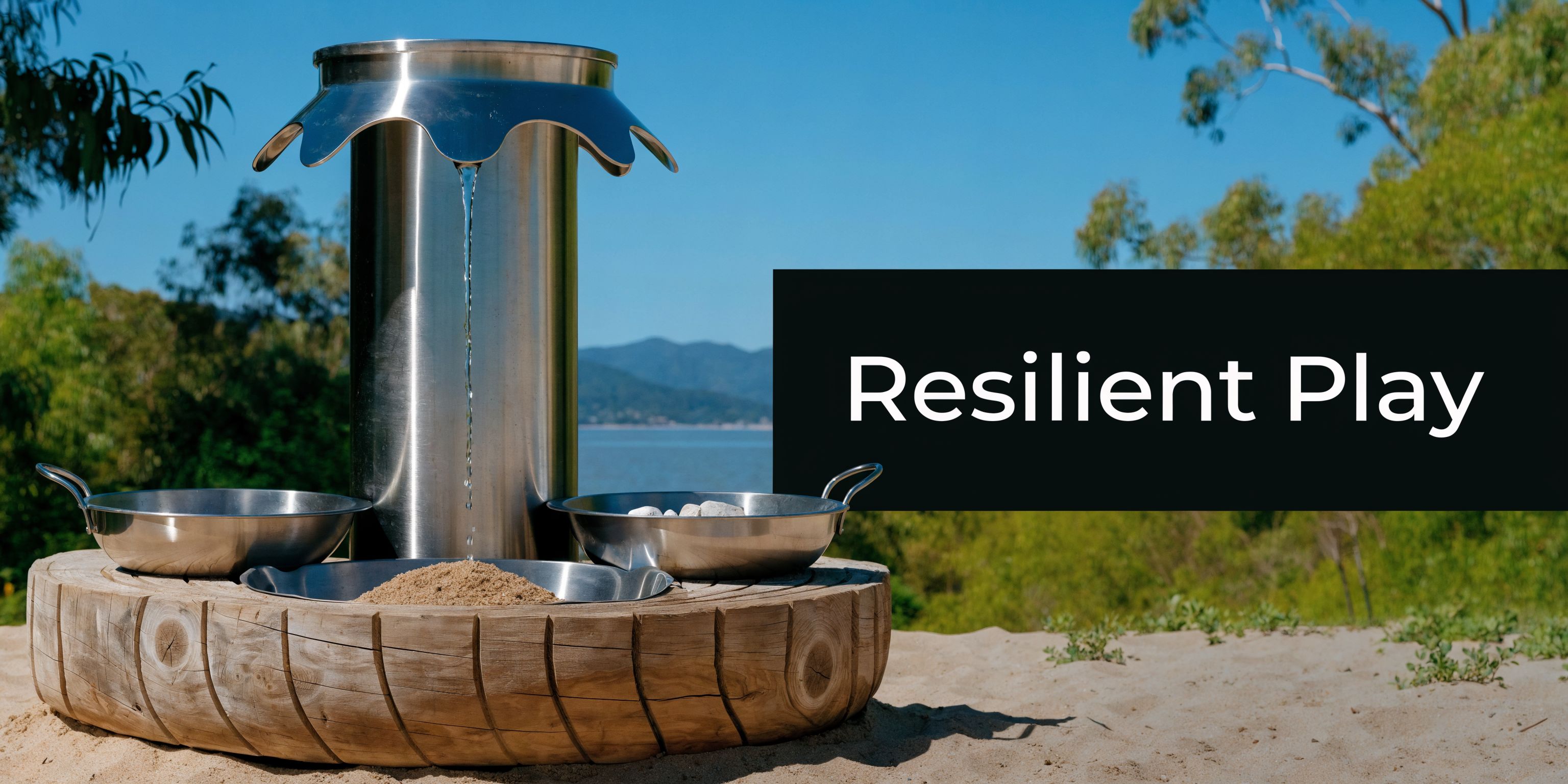
There isn’t one correct format. The right choice depends on your users, footprint, and maintenance capacity.
Integrated sand and water stations work well when you want a compact, legible play sequence. Water source, transfer path, and sand interaction are all connected. They’re easier to supervise because the activity is concentrated, and they suit tighter sites.
Separate pits, troughs, and tables offer more flexibility. They let different age groups or activity types occupy the area at the same time. They also make staged upgrades easier because one component can change without rebuilding the whole zone.
Here’s how the trade-off usually looks:
| Option | Strength | Limitation |
|---|---|---|
| Integrated station | Clear play logic, compact footprint | Less flexible if one component underperforms |
| Separate elements | Easier zoning and staged replacement | Needs stronger layout planning to avoid fragmentation |
The material palette matters as much as the product type.
Stainless steel performs well in wet play components, pumps, and channels because it handles moisture and repeated cleaning. It also gives a crisp tactile finish and generally ages predictably.
Timber can work beautifully in nature-based settings, but detailing is everything. If moisture traps in joints, end grain stays exposed, or hardware creates staining points, the visual softness of timber quickly turns into maintenance burden.
UV-stabilised recycled plastics can be practical for panels, edging, and some play components where colour retention and low maintenance matter. The key is making sure the part isn’t relying on thin sections that flex, crack, or heat up excessively in exposed areas.
One option in the market is Kidzspace, which manufactures playground equipment designed for Australian conditions and custom site requirements. In this category, the practical question isn’t branding. It’s whether the chosen system gives you durable materials, maintainable components, and a layout that fits your users.
The tools are part of the educational brief, not an accessory package. For STEAM-focused sand & water play, practical specifications include measuring cups, funnels, and moulds in varied sizes, because children build volume understanding by comparing capacities and explore basic physics through activities such as sink or float prediction. The same guidance notes a common design pitfall: inadequate material variety, which narrows exploration pathways at https://www.tts-group.co.uk/blog/2019/04/30/the-value-of-sand-and-water-play.html.
That means the equipment should support multiple kinds of manipulation. If every container is the same size, every scoop behaves the same way, and every channel has one fixed outcome, the play value drops fast.
Useful loose parts often include:
A short demonstration often helps stakeholders visualise how these components behave in a live setting.
In practice, early failure usually comes from one of four issues:
Specification check: If you can’t explain how a component will be cleaned, repaired, or replaced, it’s not fully specified yet.
The best material choice is rarely the prettiest sample in the meeting room. It’s the one that still functions after repeated wet-dry cycles, cleaning, rough handling, and months of exposure. In sand & water play, durability isn’t separate from play quality. When components seize, crack, or become awkward to use, children notice immediately and move on.
A sand & water area can be thoughtfully planned and well specified, then still disappoint because the installation was rushed or the maintenance model was unrealistic.
This is the stage where details matter most. Falls in level, blocked drains, awkward access points, and poor finishing around edges all become daily operational issues.
Before handover, I’d want a practical walk-through of the site with attention on actual use, not just appearance.
Check these items on the ground:
If possible, test the area with actual water before final sign-off. Dry inspections miss problems that only appear under use.
Hygiene is where many public and school installations drift off course. A space can look acceptable from a distance and still carry a contamination problem if cleaning routines aren’t consistent.
The risk is real. A 2023 University of Sydney study found 68% of tested public sandpits harboured faecal coliforms above safe levels, often linked to infrequent deep cleaning and lack of overnight covering. The Australian Department of Health guidance for 2024 states that sandpits in childcare centres must be raked daily and covered at night to prevent contamination from animal faeces at https://www.communityplaythings.com/resources/articles/arranging-and-equipping-the-sand-and-water-area.
That should shape both the design and the operations plan. If staff can’t cover the area easily, or if raking means dragging tools across awkward edges and obstacles, the routine won’t hold.
The easiest maintenance task is the one the site makes simple. The hardest is the one that depends on staff working around the design every day.
A strong routine doesn’t need to be complicated. It needs to be clear and assigned.
A practical schedule usually includes:
| Task | Why it matters |
|---|---|
| Daily rake and visual check | Removes debris, detects contamination, restores usability |
| Night covering where required | Reduces animal access and contamination risk |
| Water point inspection | Catches leaks, blockages, and worn fittings early |
| Periodic deep clean | Addresses what daily maintenance won’t remove |
| Material condition review | Identifies UV wear, corrosion, splitting, or loose hardware |
The surrounding environment matters too. If you’re deciding between hardscape, planted edges, or synthetic zones next to the play area, examples of artificial turf installation can be useful for understanding edge transitions, drainage thinking, and maintenance access around high-use outdoor areas. The exact solution will depend on your site, but the principle is the same. Adjacent materials need to support cleaning, not fight it.
The strongest operators make three decisions early.
First, they assign responsibility. Someone owns inspections, someone owns consumables, and someone decides when an issue is big enough to close the area temporarily.
Second, they document recurring faults. If sand constantly washes into one point, or a pump handle regularly loosens, those aren’t isolated annoyances. They’re design or usage signals.
Third, they keep replacement and repair simple. Standard hardware, accessible parts, and clear product records shorten downtime.
Sand & water play rewards sites that treat maintenance as part of the design. It doesn’t reward wishful thinking. If the space is easy to inspect, easy to clean, and built from parts that tolerate real conditions, it will stay inviting. If not, even a strong concept will wear down faster than it should.
If you’re planning a sand & water play area for a school, council, or community space, Kidzspace can help you work through layout, accessibility, material choices, and long-term practicality before small issues become expensive ones. A clear brief and the right design decisions early on make the finished space safer, easier to manage, and far more valuable over time.



Copyright © Kidzspace. All Rights Reserved.
Copyright © Kidzspace. All Rights Reserved.