
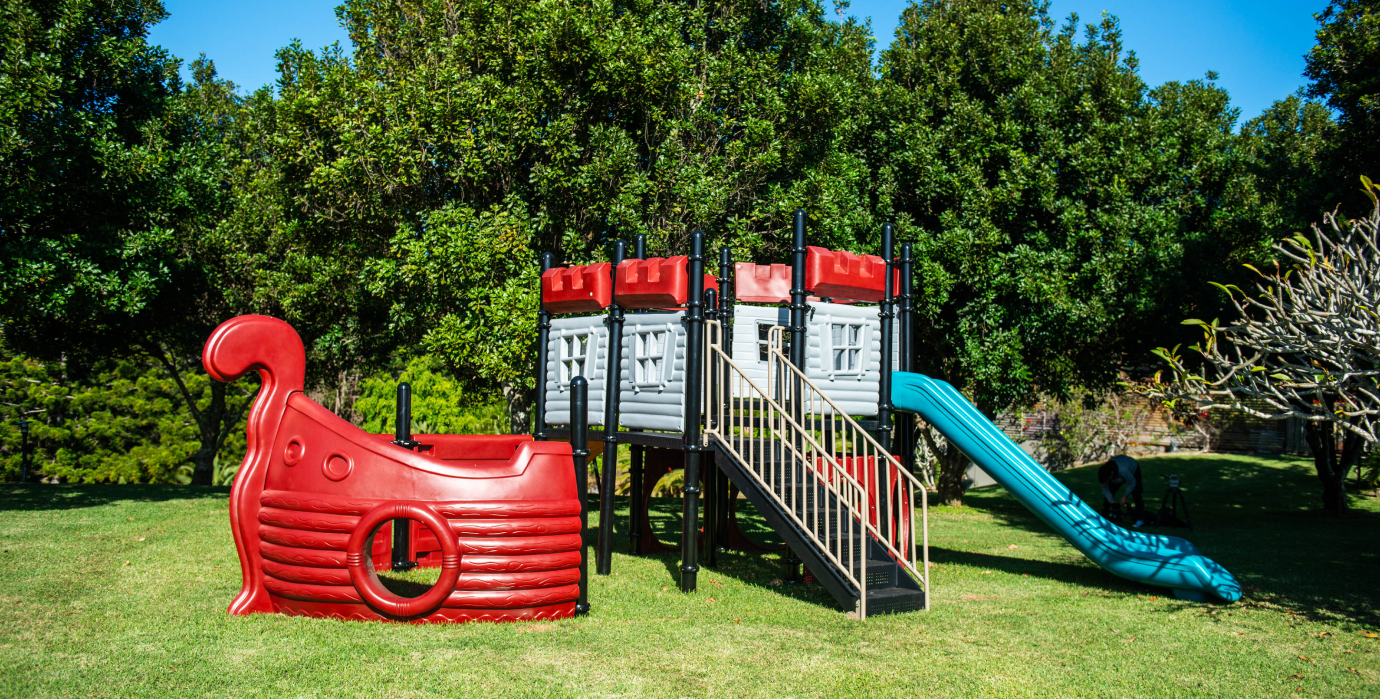






If you’re responsible for a playground in Australia — whether you’re a school principal, council officer, childcare director, or property manager — you need to understand the safety standards that govern playground design, equipment, and surfacing. Getting it wrong isn’t just a legal risk; it’s a risk to children’s lives.
This guide breaks down the three key Australian playground safety standards: AS 4685 (playground equipment), AS/NZS 8124 (toy safety for playground equipment), and AS 4422 (playground surfacing). By the end, you’ll understand exactly what each standard covers, what they require of you, and how to keep your playground compliant.
Australia has some of the most rigorous playground safety standards in the world, and for good reason. Each year, thousands of children present to emergency departments with playground-related injuries. Most of these injuries are preventable — and the standards exist precisely to prevent them.
Australian playground standards are developed by Standards Australia, often in alignment with international standards (particularly European standards like EN 1176). They provide the technical benchmarks that manufacturers, designers, installers, and operators must meet to ensure playgrounds are as safe as possible while still being genuinely engaging and age-appropriate for children.
It’s important to understand that Australian playground standards are not legislation — they are voluntary standards. However, they are widely referenced in legislation, regulations, insurance requirements, and duty of care frameworks, which means they are effectively mandatory for most operators. If a child is injured on your playground and you haven’t followed the relevant standards, you’ll find it very difficult to defend a negligence claim.
AS 4685 is the primary Australian standard for commercial playground equipment. It is a multi-part standard, with each part covering a different category of equipment.
The AS 4685 series includes the following parts:
The general requirements in AS 4685.0 form the backbone of playground safety. Key requirements include:
Every piece of playground equipment must have a designated fall zone — the area around and beneath the equipment where a child might land if they fall. The size of the fall zone depends on the equipment type and height. For most structures, the fall zone extends at least 1.5 metres beyond any point from which a child might fall.
For swings, the fall zone is calculated differently: it extends in front and behind the swing by twice the height of the pivot point, plus 1.75 metres.
The critical fall height is the maximum height from which a child could fall from a piece of equipment. This measurement determines what type of surfacing is required and how deep that surfacing must be. The CFH must be clearly identified for every piece of equipment.
AS 4685 sets out strict rules about openings in playground equipment to prevent children’s heads and limbs from becoming trapped. Openings must either be small enough to prevent a child’s head from entering (less than 89mm in any dimension) or large enough that a child could not become trapped (greater than 230mm). The “in-between” zone (89–230mm) is prohibited because it represents a strangulation risk.
All equipment must be free of sharp edges, protrusions, and splinters. Bolt ends must be capped or recessed. Timber components must be splinter-free. Metal components must have smooth, rounded edges.
Equipment must be designed to withstand the loads placed on it by children at play, including dynamic loads from swinging, bouncing, and climbing. AS 4685.0 specifies test loads that equipment must withstand without failure or permanent deformation.
AS 4685 distinguishes between equipment designed for different age groups:
AS/NZS 8124 is the Australian/New Zealand standard for toy safety and applies to certain types of playground equipment, particularly smaller equipment and components. While it’s primarily a toy standard, it’s referenced for playground equipment in some contexts.
The standard is divided into several parts:
For most commercial playground equipment in Australia, AS 4685 is the primary standard. AS/NZS 8124 is more relevant for home-use play equipment and smaller educational play materials. However, some childcare operators and schools mistakenly reference AS/NZS 8124 when they should be referencing AS 4685.
AS 4422 is the Australian standard for playground surfacing. It sets out the requirements for impact-attenuating surfacing materials used in playgrounds — that is, the materials that go under and around playground equipment to cushion the impact of a fall.
Head injuries from falls are the most serious type of playground injury. The right surfacing can dramatically reduce the severity of these injuries. AS 4422 exists to ensure that playground surfacing actually performs as intended — that it absorbs enough impact energy to protect children’s heads and bodies.
Impact attenuation refers to the ability of a surface to absorb the energy of a fall. AS 4422 sets out performance requirements for impact attenuation, expressed through two key measurements:
The depth of impact-attenuating surfacing required depends on the critical fall height of the equipment. AS 4422 provides tables specifying the minimum depth of various surfacing materials required to achieve compliant HIC and Gmax values at different critical fall heights.
For example, loose-fill materials like bark chips, wood fibre, and rubber mulch require greater depths at higher critical fall heights. The standard specifies that surfacing performance must be maintained over the life of the installation — which means regular maintenance to ensure loose-fill materials haven’t compacted or been displaced.
AS 4422 covers a wide range of surfacing types:
AS 4422 requires that surfacing be tested to verify compliance. There are two types of testing:
Site testing is particularly important because a material that passes type testing in a laboratory may not perform the same way when installed in the field, especially if it’s been poorly installed, has compacted over time, or has been exposed to extreme weather conditions.
Understanding who bears responsibility for playground safety compliance is critical. The responsibility is shared — but it’s ultimately the operator (the school, council, childcare centre, or property owner) who must ensure the playground is safe.
Manufacturers and suppliers of playground equipment must ensure their products comply with AS 4685. Reputable suppliers will provide compliance documentation, test reports, and installation guidelines as part of their supply. At Kidzspace, with over 10 years in the industry and more than 1,000 projects completed across Australia, we provide full compliance documentation for all equipment we supply.
Playground designers and installers must design and install playgrounds in accordance with the relevant standards. This includes ensuring adequate fall zones, correct surfacing depths, and proper installation of equipment.
Operators and owners are responsible for ongoing compliance. This means:
Australian playground standards are largely aligned with European standards, particularly EN 1176 (playground equipment and surfacing). This alignment means that equipment that complies with EN 1176 will generally also comply with AS 4685, although there are some differences. Australian playground operators should always verify compliance with AS 4685 specifically, rather than assuming EN 1176 compliance is sufficient.
Standards Australia periodically reviews and updates playground standards to reflect new research, incident data, and international developments. It’s important to ensure you’re working with the current versions of the standards, as older versions may no longer be current.
Key recent developments include:
Here’s what you need to do to ensure your playground complies with Australian standards:
If you’re inheriting an existing playground or haven’t reviewed compliance recently, start with a comprehensive compliance audit. A qualified playground inspector will assess your equipment against AS 4685, check your surfacing against AS 4422, and provide a written report identifying any non-compliances and recommending remediation.
Many playground operators are surprised to find their surfacing is non-compliant — particularly if the playground has been in place for several years. Loose-fill materials compact over time, reducing their impact-attenuating performance. Check your surfacing depth against the requirements in AS 4422 for the critical fall height of your equipment.
Fall zones are one of the most common areas of non-compliance. Check that your fall zones are the correct size for each piece of equipment and that compliant surfacing extends throughout the fall zone.
Australian Standards recommend three levels of inspection:
Maintain a log of all inspections, any hazards identified, and remediation work carried out. If a child is injured on your playground, your inspection records will be critical in demonstrating that you fulfilled your duty of care.
When purchasing new equipment or surfacing, work with suppliers who can provide full compliance documentation. Ask for test reports, compliance certificates, and installation guidelines. Be wary of suppliers who cannot provide this documentation.
Based on our experience across 1,000+ playground projects Australia-wide, here are the most common compliance issues we see:
Australian playground safety standards — AS 4685, AS/NZS 8124, and AS 4422 — exist to protect children from serious injury. While they are technically voluntary, any playground operator who fails to comply with these standards and whose negligence leads to a child being injured will face serious legal and financial consequences.
More importantly, compliance is simply the right thing to do. Children deserve playgrounds that are safe, well-maintained, and designed to Australian standards. With the right equipment, the right surfacing, and the right maintenance regime, you can provide an engaging, challenging, and genuinely safe play environment for the children in your care.
At Kidzspace, our team of experienced playground designers and equipment specialists works with schools, councils, childcare centres, and commercial operators across Australia to design and deliver playgrounds that meet and exceed Australian safety standards. With over 10 years in the industry and more than 1,000 projects completed, we understand what compliance looks like in practice — not just on paper.
Talk to the Kidzspace team about your playground project. We’ll help you navigate the standards, design a compliant space, and deliver a playground that children will love for years to come.
Ready to Build Your Playground?
Explore our full range of commercial playground equipment — from play systems and swings to soft fall surfacing and fitness stations.


Copyright © Kidzspace. All Rights Reserved.
Copyright © Kidzspace. All Rights Reserved.