






If you’ve ever read a playground inspection report, reviewed a compliance certificate, or received a quote for playground surfacing, you’ve almost certainly encountered the term critical fall height (CFH). It’s one of the most fundamental concepts in Australian playground safety — yet it’s often misunderstood or oversimplified.
This guide explains exactly what critical fall height means, how it’s measured, why it matters, and what it means for your playground’s surfacing requirements.
Critical fall height is defined in Australian Standard AS 4685.0 as the maximum height from which a child could fall from a piece of playground equipment. More precisely, it is the vertical distance between the highest accessible point on a piece of equipment from which a child could fall, and the surface beneath it.
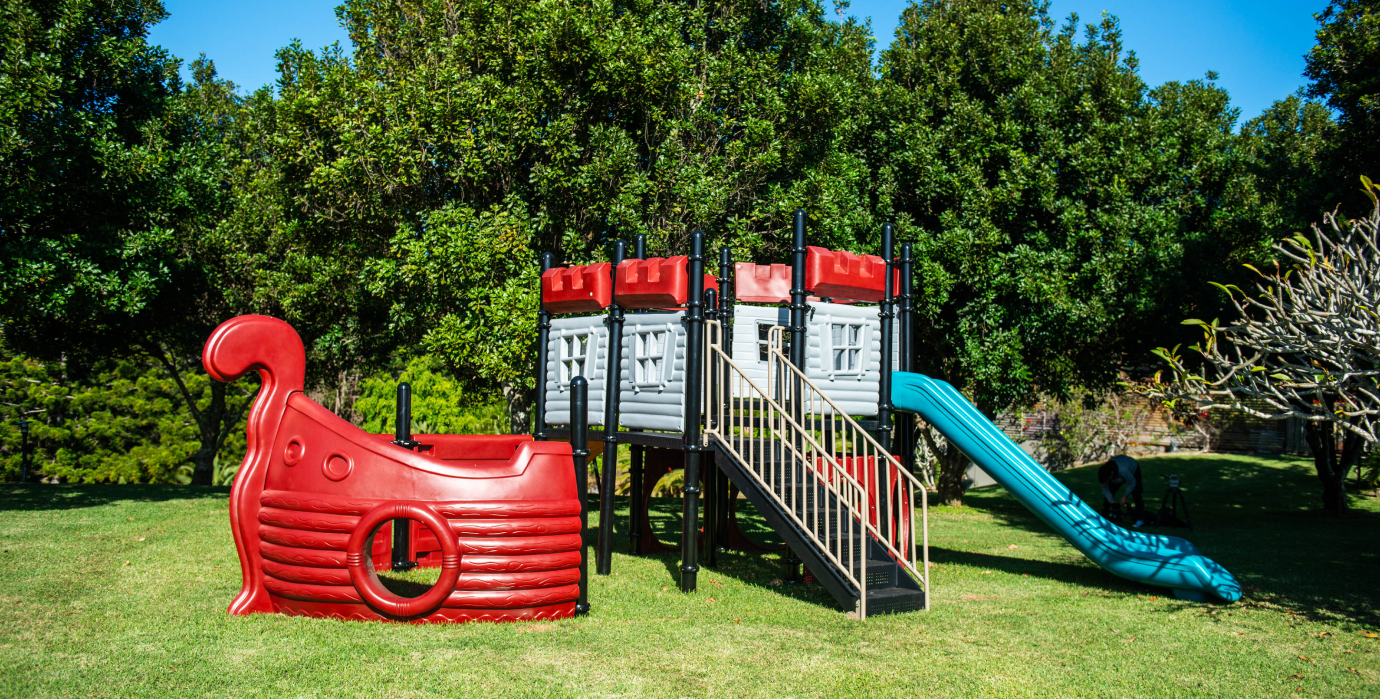
The critical fall height is not the overall height of the equipment — it’s the height of the highest point from which a child is likely to fall. For a climbing frame, for example, the critical fall height would typically be the height of the highest platform or handhold that a child could use. For a slide, it would be the height of the top of the slide platform.
In practical terms, the critical fall height of a piece of equipment determines:
Critical fall height is measured as a vertical distance — specifically, the vertical drop from the highest accessible point on the equipment to the ground surface below. This measurement must be taken carefully, because the surface beneath equipment may not be perfectly level.
When measuring critical fall height:
For pieces of equipment that overhang (such as swings at the height of their swing arc), the critical fall height is measured at the highest accessible point in the swing arc, not just the resting position.
The critical fall height matters because it directly determines what surfacing you need to protect children from serious head injury.
When a child falls from playground equipment and hits the ground, the impact force can cause traumatic brain injury if the surface is too hard. Impact-attenuating surfacing — the soft materials placed under playground equipment — absorbs energy from the fall and reduces the peak deceleration experienced by the child’s head.
Under Australian Standard AS 4422 (Playground Surfacing — Specifications, Requirements, and Test Methods), surfacing must be tested to ensure it keeps the Head Injury Criterion (HIC) below 1,000 and the Gmax below 200g when tested at the equipment’s critical fall height.
Here’s the critical point: the higher the critical fall height, the deeper or more impact-resistant the surfacing must be. A piece of equipment with a critical fall height of 1.0 metre requires much less surfacing depth than one with a critical fall height of 3.0 metres.
Australian Standard AS 4685 sets out maximum critical fall height limits depending on the age group the equipment is intended for:
These limits represent the maximum heights permitted under the standard — not recommended heights. In practice, well-designed playgrounds often have equipment at lower heights, particularly in areas used by younger children.
The relationship between critical fall height and required surfacing depth is set out in AS 4422. The required depth varies by surfacing material. Here are some general guidelines (these are indicative — always refer to current AS 4422 tables and manufacturer’s data for your specific surfacing material):
Note: These are loose-fill materials. Their impact-attenuating performance degrades as they compact over time, so regular depth checks and top-ups are essential for ongoing compliance.
Wet pour rubber is tested as a complete system (wear layer plus base layer). The required depth depends on the specific product’s test data. Many wet pour systems can achieve compliance at critical fall heights of up to 3.0 metres with total depths of 60–100mm, depending on the product specification.
The critical fall height also influences the size of the fall zone — the area around a piece of equipment that must be covered with compliant impact-attenuating surfacing.
Under AS 4685, the fall zone for most equipment extends at least 1.5 metres beyond any accessible point from which a child might fall. However, for equipment with higher critical fall heights, greater fall zone distances may be required.
For swing equipment, the fall zone calculation is more complex: it extends to a distance equal to twice the pivot height, plus 1.75 metres, in the direction of swing (forward and backward).
This is one of the most common misconceptions. The CFH is specifically the height of the highest accessible point from which a child could fall — not the overall height of the structure. The distinction matters because equipment often has portions that extend higher than the highest accessible point (for example, an arch or a decorative element).
HIC testing must be conducted at the relevant critical fall height. Surfacing that passes testing at 1.5 metres may not pass at 2.5 metres. Always ensure that your surfacing is tested at (or beyond) the critical fall height of your equipment.
The critical fall height can change if the surrounding ground level changes. Erosion, landscaping works, or changes to surfacing depth can all affect the effective critical fall height. Regular inspections should verify that the actual CFH hasn’t changed from the original design specification.
At Kidzspace, with over 10 years in the industry and 1,000+ playground projects across Australia, we calculate critical fall height as a fundamental part of every playground design. Our design process includes:
If you’re unsure about the critical fall height of your existing equipment, or if you’re planning a new playground and need expert guidance, our team is here to help.
The Kidzspace team can assess your existing playground’s critical fall heights and surfacing compliance, or help you design a new playground that meets Australian standards from the ground up.
Ready to Build Your Playground?
Explore our full range of commercial playground equipment — from play systems and swings to soft fall surfacing and fitness stations.


Copyright © Kidzspace. All Rights Reserved.
Copyright © Kidzspace. All Rights Reserved.