



Outdoor fitness is about so much more than just swapping a gym for a park. It's a fundamental shift in how we approach exercise, blending physical activity with fresh air, nature, and, most importantly, community. Across Australia, we're seeing this become a cornerstone of public health, offering free, accessible, and genuinely engaging ways for people of all ages to get active.
This isn't about simply moving a workout outdoors; it's about embracing a more well-rounded sense of wellbeing that nurtures our physical, mental, and social health all at once.
The move towards outdoor fitness isn't just a passing fad. It’s a powerful response to a real change in how we think about health and community life. The days of fitness being stuck behind four walls are well and truly over. Today, communities are actively looking for ways to weave physical activity into their daily lives in a way that feels natural and brings people together.
What's the big appeal? For a start, it breaks down the most common barriers to exercise. There are no pricey gym memberships to worry about and no restrictive opening hours. The local park with its own fitness stations becomes a welcoming space where anyone, regardless of age or fitness level, can work out when it suits them. This kind of accessibility is a massive win for community-wide health.
We have to remember that this movement is driven just as much by a need for human connection as it is for physical fitness. When you exercise outdoors, you create these wonderful, spontaneous opportunities for social interaction. A solo workout can easily turn into a shared experience.
I see it all the time: parents getting a quick workout while their kids are on the playground, or neighbours stopping for a chat and encouraging each other. This simple act builds stronger community bonds and helps combat feelings of isolation. And let's not forget the mental health boost. Being in a natural setting—even a small urban park—is proven to lower stress, lift your mood, and clear your head.
The real magic of outdoor fitness is how it merges physical health with social connection and mental clarity. It’s not just about building stronger bodies; it’s about building more resilient, connected communities from the ground up.
This cultural shift is backed by some serious numbers. The Australian sports and fitness goods market is set to climb to an incredible USD 2,502.2 million by 2026—that’s a projected growth of 64.7%. This boom is being fuelled by everyday Australians demanding more accessible, community-focused fitness options that feel good for the body and the mind.
For local councils, schools, and childcare centres, the message is loud and clear. Investing in quality outdoor fitness equipment isn't a gamble; it's a direct response to what your community is asking for. It's a tangible, practical commitment to public health that pays dividends for years to come. Digging into the specific advantages of outdoor fitness stations will show you just how significant the return on this kind of community investment can be.
So, you're ready to create an outdoor fitness space. Where do you begin?
From my experience, the most successful projects aren't just about picking out equipment. They start with a solid plan—one that really gets to the heart of your site, your users, and what you want to achieve in the long run. Getting this foundation right is what turns a patch of grass into a buzzing community hub that people genuinely want to use.
Let's start with the site itself. The first instinct is often to find an empty spot and fill it, but a proper site assessment goes much deeper. You need to think like someone who will actually use the space. Is it tucked away and hard to find, or is it visible from a main school path, a community walking track, or a nearby playground?
Visibility is a huge factor. It not only encourages people to give the equipment a try but also adds a layer of passive supervision and safety.
Then you have the practicals. The ground needs to be flat and stable, that's a given. But in Australia, we absolutely have to think about the sun. A fitness zone without shade is a fitness zone that won't get used for half the year. Look for spots with established trees or make sure your plan includes a purpose-built shade structure. It’s a non-negotiable for comfort and safety.
Once you have a potential location in mind, the next question is the most important one: who will be using it? The needs of a five-year-old at a childcare centre are worlds apart from a teenager in high school or a senior looking for gentle exercise.
Taking the time to build a clear picture of your users will guide every single decision you make.
A truly great outdoor gym isn't designed for a generic 'user'; it's designed for the specific people in your community. When you understand their needs, routines, and abilities, you can create a space that feels like it was made just for them.
This user-first approach lines up perfectly with where the fitness industry is heading. It’s less about isolated workouts and more about connection, community, and overall wellbeing.
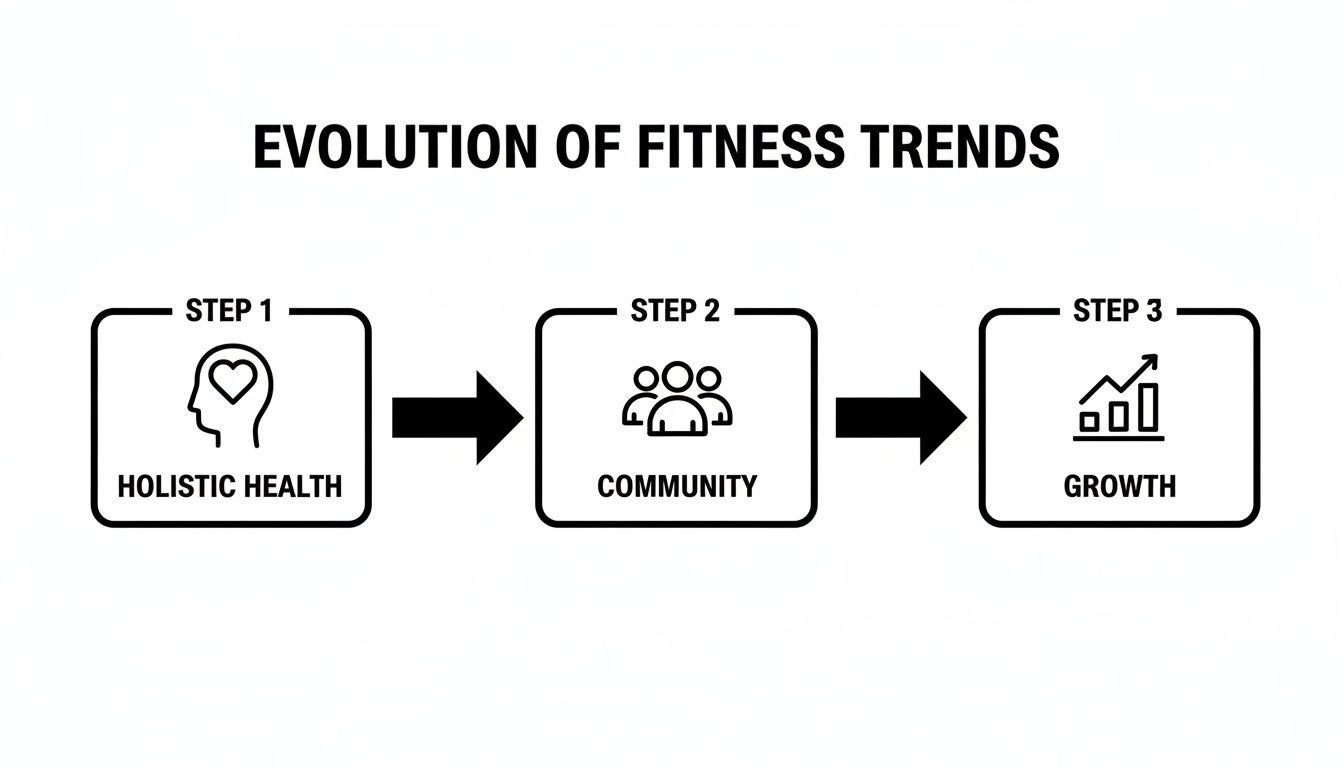
As you can see, the trend is moving towards community and growth. This shows that modern fitness is just as much about social connection as it is about physical effort.
To help you put all this into action, I’ve put together a checklist based on countless real-world projects I’ve been involved in. Thinking through these points now will save you from some major headaches down the line. A little extra planning makes all the difference. For a deeper dive, you can also explore our full guide on how to build an outdoor fitness station.
Use this table to walk through your potential site and make sure you haven't missed anything critical.
| Assessment Factor | Key Considerations | Ideal Outcome |
|---|---|---|
| Visibility & Foot Traffic | Is the area easily seen from main paths? Is it near other community hubs? | A highly visible location that encourages spontaneous use and enhances passive supervision. |
| Surface & Ground Condition | Is the ground level? Does it drain well after rain? Is it suitable for safety surfacing? | A flat, stable, and well-draining base that can easily accommodate compliant soft-fall surfacing. |
| Accessibility | Are there clear, accessible pathways to and around the site for all users, including those with mobility aids? | A barrier-free environment with wide, smooth paths connecting all equipment and entry points. |
| Shade & Weather Protection | Is there natural shade from trees? Is there space for a built shade structure? | Ample shade coverage during peak sun hours to ensure the space is usable and comfortable year-round. |
| Proximity to Amenities | Is the site near water fountains, toilets, or seating areas? | Close and convenient access to essential amenities that encourages longer stays and enhances user comfort. |
Working through this checklist will give you a clear, systematic way to compare your options and find the perfect home for your new fitness zone.
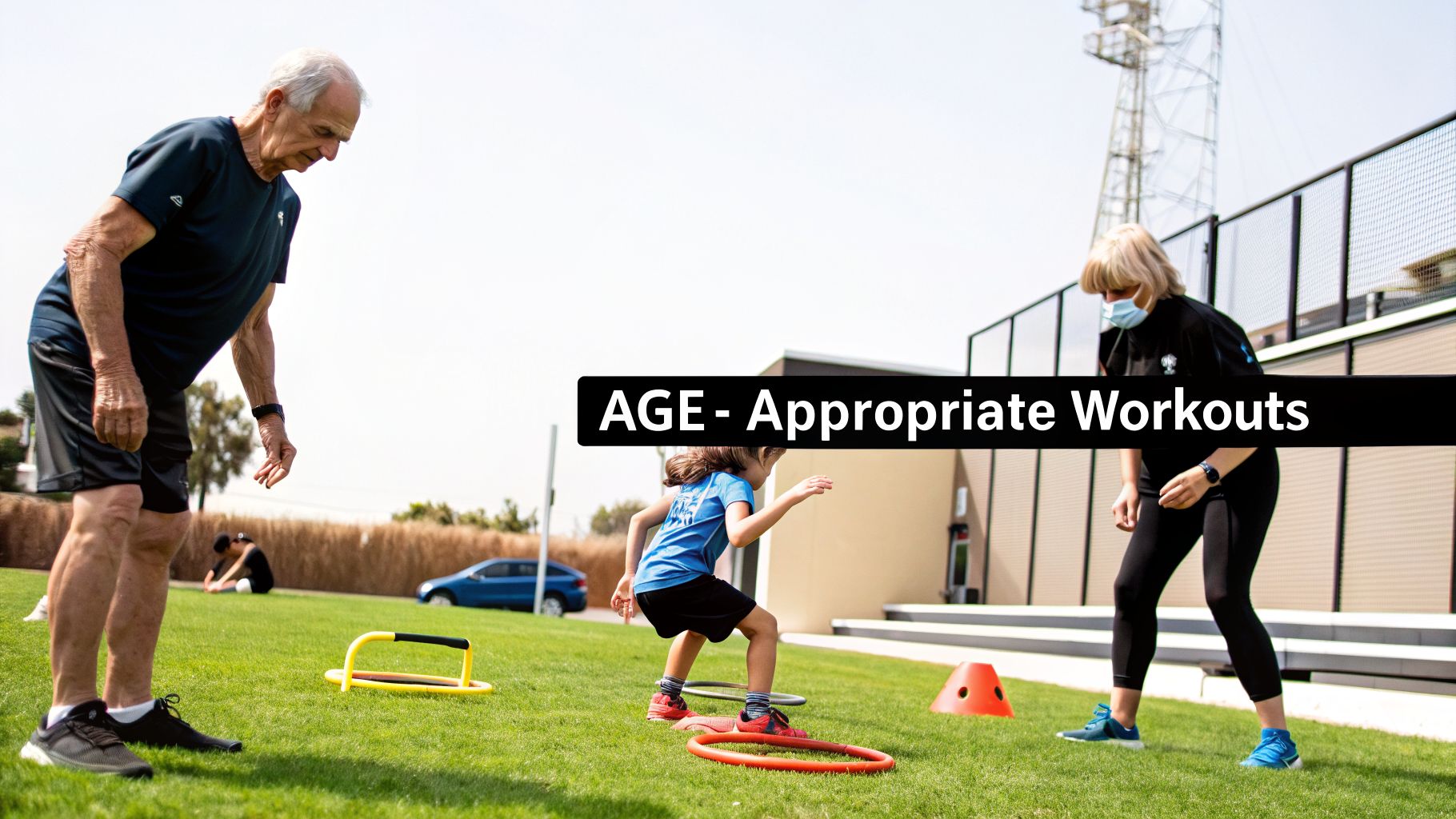
So, you’ve installed a brilliant new outdoor fitness space. That’s a huge first step, but I’ve seen far too many of these spaces sit empty. The real magic happens when you pair great equipment with thoughtful programming. Without a plan, it's just a missed opportunity.
This is where we get practical and turn that static equipment into a bustling hub of activity. The trick is to create outdoor fitness workouts that feel intuitive and fun for each specific age group. What works for a teenager will be totally different from what engages a five-year-old.
Let's dig into what that looks like on the ground for early learning centres, schools, and the wider community.
Forget "exercise" when it comes to little ones. For this age group, it's all about play-based movement. Our goal isn't reps and sets; it's about helping them discover what their bodies can do while building coordination, motor skills, and confidence.
Think of your fitness stations as a "movement playground." The equipment becomes a prop for imagination and adventure.
With a little imagination, a balance beam is no longer just a beam—it's a narrow bridge over a deep canyon. It's this kind of creative spark that builds a foundation of physical literacy for life.
Once kids hit primary and secondary school, you can introduce a bit more structure, but the fun element is still non-negotiable. The aim here is to introduce fitness concepts without it feeling like a chore. I’ve found that a blend of guided activity and friendly competition works wonders.
Circuit training is your best friend here. It’s efficient, keeps everyone engaged, and can be easily modified for different fitness levels.
The real win with school-aged kids is turning fitness into a social activity. When they're encouraging each other and working in teams, the focus shifts from the 'work' of the workout to the fun of the challenge.
A solid session can be broken into three parts.
The Warm-Up (5-10 minutes)
First things first, get the body ready to move and minimise the risk of injury.
The Main Circuit (15-20 minutes)
Set up 4-6 stations using the equipment you have. Have students spend about 45-60 seconds at each station before rotating to the next.
The Cool-Down (5 minutes)
This is just as important as the warm-up. It helps the body recover and improves flexibility over time.
This simple framework gives teachers a complete, easy-to-manage workout that students actually enjoy.
For council parks and public spaces, your programming needs a different approach. You won't always have a trainer on hand, so the environment itself has to do the teaching. It’s all about creating a self-guided, inclusive experience.
Clear, high-quality instructional signage is your most powerful tool. This is non-negotiable. You need diagrams showing various exercises for each piece of equipment, complete with modifications for beginner, intermediate, and advanced users.
To really build momentum and engagement, try these ideas:
Ultimately, the goal for every age group is to make movement a positive, natural part of their day. When you match the program to the person, you guarantee your outdoor fitness space becomes a genuine asset for the entire community.
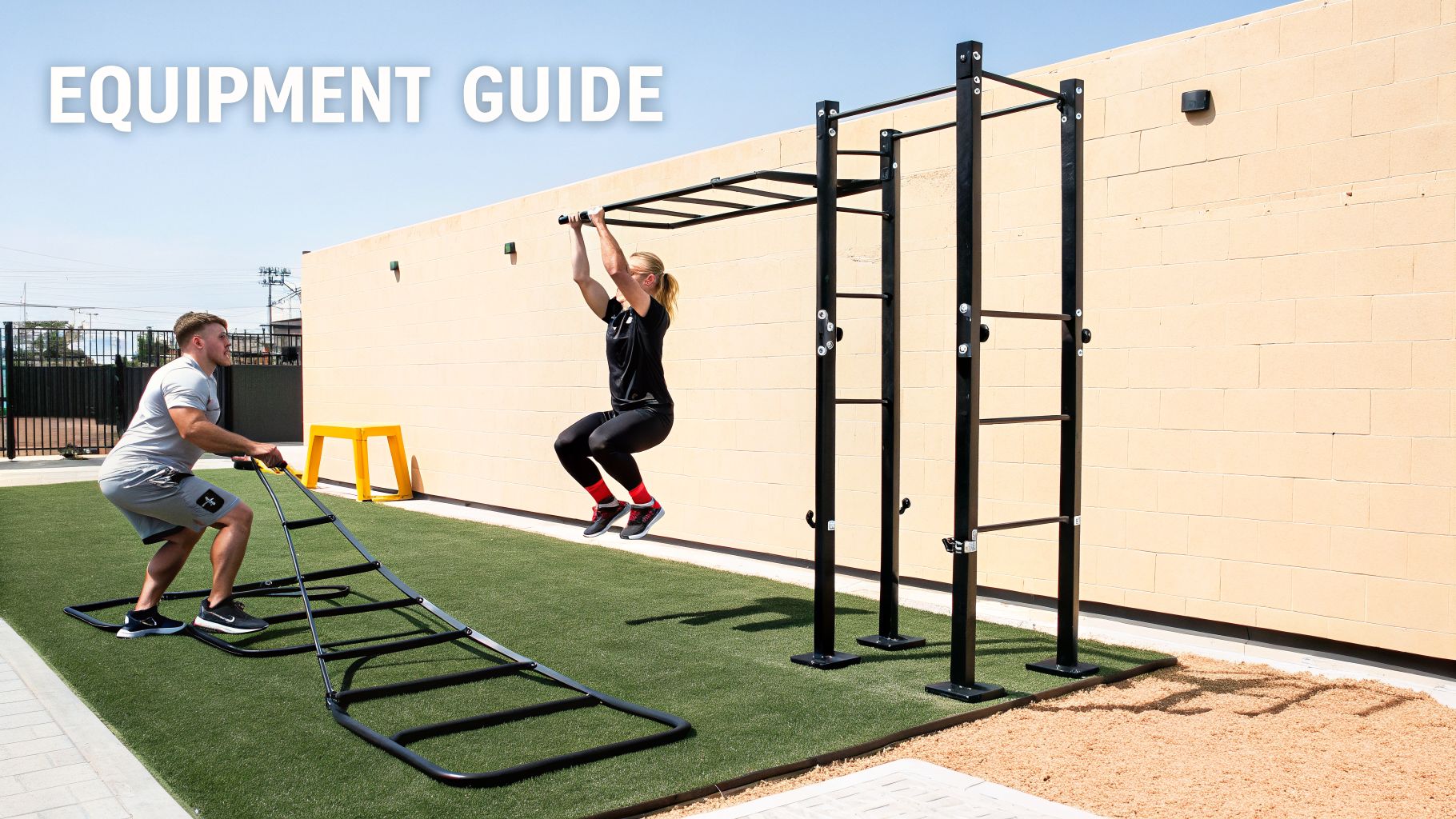
This is where the magic really happens—connecting your workout plans to the actual equipment on the ground. A piece of outdoor fitness equipment is so much more than a single-use station. I've seen countless spaces where a pull-up bar is only used by the fittest few, but its true value lies in its versatility.
Thinking beyond the most obvious exercise is key. When you can show how one station offers a whole menu of movements for different fitness levels, you’re not just installing equipment; you’re creating a dynamic and inclusive community hub. Let’s look at a few common stations and map out some outdoor fitness workouts to get your creative juices flowing.
The combo pull-up and dip station is an absolute powerhouse for building upper-body and core strength. It can look intimidating, but with a bit of know-how, it becomes one of the most adaptable pieces in your arsenal.
For someone just starting out or for younger students:
For your more advanced or intermediate users:
The secret is to reframe the question. Instead of asking, "Can you do a pull-up?" ask, "How can we use this bar to make you stronger today?" This simple shift opens up a world of possibilities for everyone.
To make planning even easier, mapping specific exercises to each piece of equipment is a game-changer for instructors and users. It turns a static fitness station into a dynamic part of your programming. Here’s a sample map using some popular Kidzspace stations.
| Kidzspace Station | Primary User Group | Sample Exercise | Fitness Benefit |
|---|---|---|---|
| Parallel Bars | Teens, Adults | Dip Holds / Inverted Rows | Upper Body & Core Strength |
| Leg Press | All Ages, Seniors | Single-Leg Presses | Lower Body Strength, Balance |
| Aerobic Walker | Seniors, Rehab Users | High-Knee Intervals | Low-Impact Cardio, Mobility |
| Plyometric Boxes | Students, Athletes | Alternating Step-Ups | Coordination, Leg Power |
| Horizontal Ladder | Kids, Teens | Scapular Pulls (mini pulls) | Grip Strength, Back Activation |
This kind of map empowers everyone to walk up to a piece of equipment and know exactly what to do, no matter their fitness level. It ensures your investment gets used to its full potential day in and day out.
The seated leg press is one of the friendliest pieces of outdoor equipment. Its guided motion feels safe and stable, making it a fantastic starting point for seniors wanting to maintain mobility or students looking to build explosive power for sports.
Here’s how to mix it up:
A great outdoor gym isn't just a collection of strength stations. Equipment that gets the heart rate up and challenges coordination is just as important for creating well-rounded fitness routines. Think about aerobic walkers, agility trainers, or even simple plyometric boxes.
An Aerobic Walker (or Air Walker) is a perfect example. It's incredibly low-impact, making it a go-to for anyone with sensitive joints.
With Plyometric Boxes at different heights, the possibilities are nearly endless.
When you start to see each station as a multi-tool, you give your instructors, teachers, and community members the creative licence to build truly effective and engaging workouts. This mindset ensures your space serves everyone—from the first-timer to the seasoned pro—for years to come.
A great outdoor fitness space is so much more than a collection of equipment. It’s a community asset that needs to be safe, welcoming, and vibrant. When you get these fundamentals right—safety, accessibility, and community connection—you transform a set of steel frames into a place that genuinely boosts local wellbeing.
Getting these elements right from the very beginning is what makes or breaks your investment. It's the difference between a space that’s merely available and one that is truly embraced by everyone it’s meant for. Let's walk through how to make your outdoor fitness workouts safe, inclusive, and a genuine social hub.
When you're installing equipment for public use, there's absolutely no room for error on safety. In Australia, any outdoor fitness equipment has to meet the strict requirements of AS 16630:2021. This isn't just a guideline; it's the benchmark for protecting users.
The standard covers everything from the structural integrity of the gear to the specific dimensions needed to prevent entrapment hazards. It also sets out what’s required for clear instructional signs and the right kind of impact-absorbing surfaces.
Your first step is to work with a manufacturer who can provide certification of compliance. The second, equally crucial part, is professional installation. An expert team ensures every piece is anchored correctly and that all surrounding fall zones are up to code, giving you complete peace of mind.
A space that feels safe encourages people to use it. When parents, teachers, and community members see that equipment is well-maintained and professionally installed, they build a sense of trust that is fundamental to the success of your outdoor fitness area.
This commitment to safety creates the secure foundation you need for every other activity you plan.
A truly successful public space is one that everyone can use and enjoy. For an outdoor fitness zone, accessibility goes far beyond just a ramp at the entrance. It’s about thoughtful design that accommodates people with a wide range of physical abilities and mobility needs.
This means planning for continuous, accessible pathways of the correct width and gradient. These paths should connect the car park or main entry to and between every single piece of equipment. Put yourself in the shoes of someone using a wheelchair, a walker, or pushing a pram—can they navigate the entire space without any trouble?
Your choice of equipment also plays a massive role here. Look for a diverse mix of stations that cater to different people:
Inclusive design sends a powerful message: this space belongs to everyone in our community.
At the end of the day, the best outdoor fitness workouts are the ones that bring people together. The equipment is just the tool; the real magic happens when you foster social connection and create a supportive environment. Modern fitness trends have shown us time and again that community is a huge motivator.
Research consistently shows that for many Australians, the social aspect is what keeps them coming back. In fact, one recent study revealed that 73% of members see community as essential for their fitness motivation and consistency. It seems people might join for their health, but they stay for the friendships. To see what else is driving fitness behaviours, you can read the full findings shaping modern fitness.
This insight is a game-changer for how you should program your outdoor space.
You can turn your fitness zone into a buzzing social hub with a few simple strategies:
By focusing on safety, accessibility, and community, you create far more than just a place to exercise. You build a destination that strengthens community bonds and supports the holistic health of everyone you serve.
When you're moving from a great idea to the nitty-gritty of planning a community fitness space, plenty of questions pop up. It’s one thing to see the potential of outdoor workouts, but quite another to feel sure your project will be a long-term success. Let's walk through some of the most common concerns we hear from schools, councils, and childcare centres.
Getting these details ironed out is the final piece of the puzzle, giving you the confidence to move forward and create a space that truly serves your community for years.
This is a big one. No one wants to install a fantastic new fitness area only to see it sit empty. In my experience, getting people to use the equipment consistently doesn't just happen on its own—it comes down to smart design mixed with a bit of proactive community building.
Visibility is your best friend here. If you can, place the equipment somewhere with high foot traffic. Think along a popular walking path, near a school oval, or right next to an existing playground. If people see it, they’re far more likely to use it.
But placement is only half the battle. You also need to build a culture around the space.
It's never just about installing the gear; it's about making that space a living, breathing part of your community's routine.
It’s always tempting to look at cheaper, non-compliant options to make the budget stretch, but this is almost always a false economy. The true value of quality equipment isn’t how it looks on day one, but how it holds up after years—even decades—of public use.
Properly certified equipment is engineered to withstand the tough Australian climate and constant, heavy use. It’s made from durable, corrosion-resistant materials and designed to meet strict national safety standards. This means lower maintenance costs, fewer repair callouts, and a massive reduction in your liability risk over the equipment's lifespan.
Investing in quality is an investment in safety, longevity, and peace of mind. Cheaper alternatives often degrade quickly, leading to safety hazards and the need for premature replacement, erasing any initial savings.
The real return on your investment comes from creating a safe, reliable, and functional asset that your community can depend on for years, not just a single season. The durability of quality equipment is also a major factor when you ask whether outdoor gym equipment really works to get people results.
Building a truly inclusive space all comes down to variety and thoughtful design. The aim is to create an environment where a grandparent can enjoy a gentle workout just metres away from a teenager working on their calisthenics. That's where the real community magic happens.
Diversity in your equipment choices is the first step. You want a balanced mix that covers the different elements of fitness.
Beyond the equipment itself, the layout is crucial. Make sure you have wide, accessible pathways connecting all the stations, with enough room for a wheelchair user to move around and exercise comfortably. A genuinely inclusive space is one where every single person feels not just allowed, but actively welcomed.
At Kidzspace, we partner with schools and councils to create outdoor fitness spaces that are safe, engaging, and built to last. Our team can help you design a solution that meets your community's unique needs.
Ready to start planning? Get in touch for a free consultation today!


Copyright © Kidzspace. All Rights Reserved.
Copyright © Kidzspace. All Rights Reserved.