




A familiar brief lands on the desk. A council is renewing a local park. A school is replacing ageing equipment after an audit. An early learning centre wants a swing bay for younger children but needs confidence that the specification will stand up to compliance review, heavy use, and Australian weather.
The infant swing seat often looks like a small decision inside a larger project. It is not. That single item sits at the intersection of child safety, standards compliance, inclusive access, maintenance workload, and public liability.
The difficulty is that much of the advice circulating online comes from US guidance. That creates a practical gap for Australian buyers. Local projects do not get assessed against generic overseas advice. They get judged against Australian standards, site conditions, and the quality of the installation.
A facilities manager recently described the problem well. The catalogue pages all looked reassuring. Every seat claimed to be commercial grade. Every supplier used the language of safety. What was missing was a clear answer to the question that matters most in an Australian public setting. Will this infant swing seat comply on my site, and will it remain safe after years of use?
That concern is justified. Existing content on infant swing seats leans heavily on US CPSC and ASTM F1487 guidance, while Australian playground equipment must comply with AS 4685. That gap matters because PlaySafe Australia reporting cited in this discussion of infant swing guidance notes that 15% of swing-related injuries in NSW public parks involved infants under 2, often linked to non-compliant seats lacking features needed for Australian conditions.
An infant seat is not just a moulded bucket on chains. It is a safety-critical assembly. The seat profile, leg openings, support height, restraint approach, chain coating, hanger detail, surfacing below, clearance around the bay, and exposure to sun and salt air all affect whether the equipment performs as intended.
The most common problem is not bad intent. It is incomplete specification.
A team may choose a seat based on price or appearance, then discover later that:
In practice, a good specification balances four things at once:
A compliant infant swing seat is not the one with the longest feature list. It is the one that suits the users, matches the site, and arrives with clear evidence for installation and inspection.
That is the lens councils, schools, and ELC operators should use. Not “Which seat is cheapest?” but “Which seat reduces risk, fits the standard, and lowers future maintenance friction?”
Not every infant swing seat suits every site. The right choice depends on who will use it, how closely the area will be supervised, and whether the swing bay needs to support broader inclusion goals.
For many council parks and school junior areas, the full bucket seat is the default commercial option. It provides enclosed lower-body support and is familiar to maintenance teams, inspectors, and parents.
This type works well when the brief is straightforward. You need a durable infant swing seat for younger children, predictable operation, and simple replacement parts.
Its strengths are practical:
Its limitations are also clear. A standard bucket design may not offer enough upper-body support for the youngest users in a high-traffic public setting. It may also be too generic if your brief includes children with additional physical support needs.
A high-back infant swing seat is usually the better specification when the site serves very young children, including ELCs, family-heavy parks, and spaces where carers expect stronger postural support.
The practical benefit is not cosmetic. Better upper-body support helps with positioning and reduces the chance of poor seating posture during use. High-back options with a restraint feature also improve confidence for supervisors.
This guide to buying the right swing for your playground is useful if you are comparing bay layouts and age groups at the same time.
An adaptive swing belongs in the conversation whenever the project brief includes inclusive play, universal design, or support for children who need more than a standard infant bucket can offer. Many projects become too narrow at this point, assuming the infant swing bay is only for typical early-years users. In reality, some children need additional support, a different seating profile, or a more considered transfer and access arrangement.
Adaptive options can be the right choice when:
The mistake I see most often is over-specifying the seat and under-specifying the bay. A premium seat on a poorly planned site still creates risk.
Use this as a working filter:
| Site context | Usually the better fit | Main reason |
|---|---|---|
| Standard public park | Full bucket seat | Durable, familiar, easy to maintain |
| Early learning centre | High-back seat | Better support for younger users |
| Inclusive playground or specialist setting | Adaptive swing | Better alignment with broader access needs |
Choose the seat type after you define the likely user, supervision pattern, and site exposure. Doing it in the reverse order usually creates compromises later.
A council signs off on a new infant swing bay. The seat arrives with a compliance statement, the frame is already in the ground, and the surfacing contractor installs to a standard detail from another site. On paper, everything looks fine. On inspection, the chain set is not the one tested with the seat, the fall zone is tight against a path, and the softfall depth does not match the actual free height of fall. That is how avoidable risk gets built in.
For Australian projects, compliance has to be checked as a full system under AS 4685, not as a seat purchase.
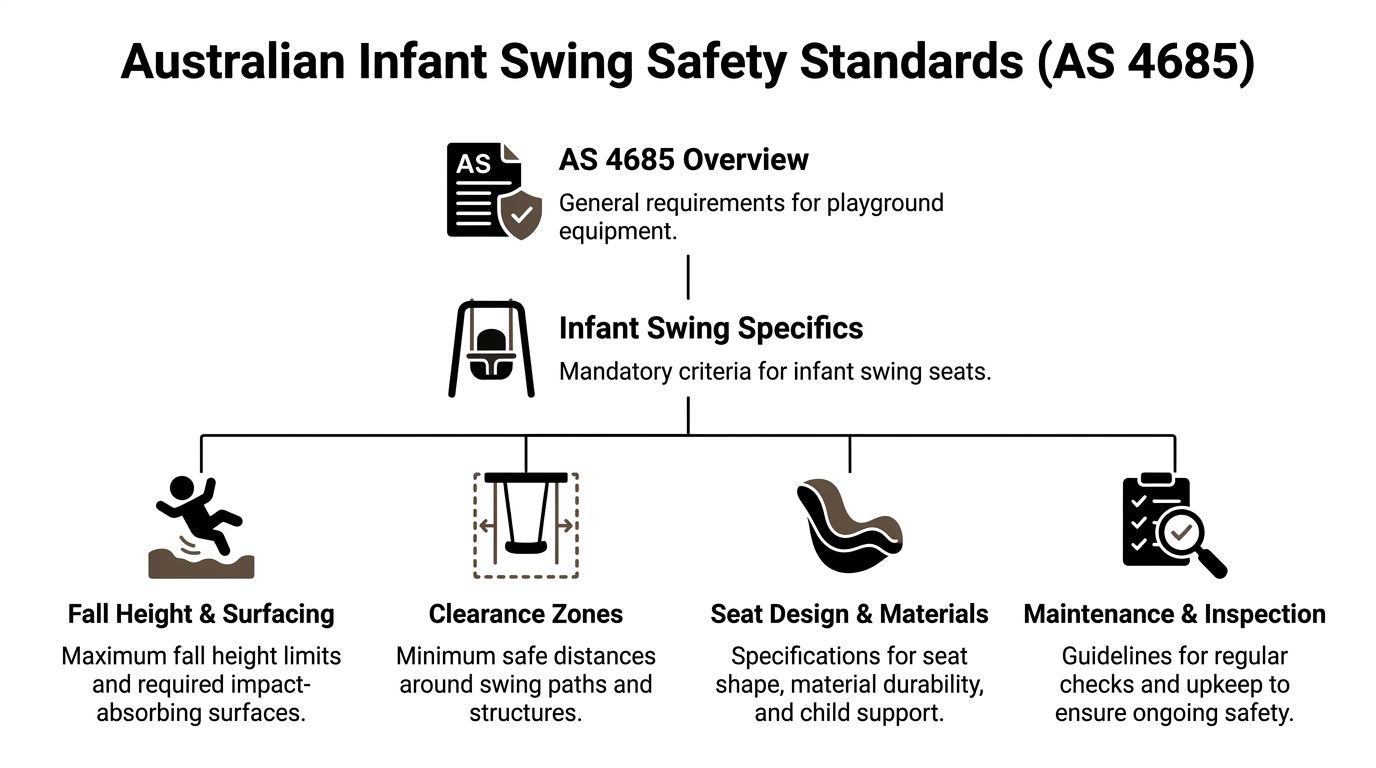
A lot of online swing advice is written for US products, US terminology, and US liability settings. That causes problems on Australian sites. Local specifiers need to match the infant seat, suspension, frame, clearance, and impact area to the Australian standard and to the conditions on the ground.
That second part matters more than many procurement teams expect.
AS 4685 does not reward a box-ticking approach. It asks whether the installed swing bay, in its final condition, manages foreseeable risk. On a flat metropolitan school site, that may be straightforward. On a coastal reserve, a sloping park, or a school with irregular access paths and mixed supervision patterns, the same seat can become a different compliance exercise.
Two technical terms regularly appear in surfacing reports.
Head Injury Criterion, or HIC, measures the severity of a head impact in a fall.
g-max measures peak deceleration on impact.
For infant swing bays, these figures matter because the user group has less ability to brace, twist, or break a fall. If the surfacing certificate does not match the installed fall height, the finished bay can look compliant while exposing the client to unnecessary risk.
This is one of the first checks I make during design review. I want to see the nominated surface, the tested fall height, the finished levels, and the actual swing configuration lined up in one package. If those documents sit in separate contractor folders, errors slip through.
Seat selection should be reviewed against four practical questions before the project reaches procurement.
For public Australian playgrounds, infant seats should be specified in materials suited to repeated impact, weather exposure, and heavy use. Older rigid seat forms created predictable injury issues. Current commercial practice in Australia has shifted toward softer, impact-conscious seat construction for good reason.
Material choice affects more than comfort. It affects injury severity, replacement frequency, and how well the seat performs after years of UV exposure.
A seat can be made from the right material and still be the wrong choice. The profile has to hold the child securely during normal swinging motion, with support appropriate to the intended age group and level of supervision.
In practical terms, that means reviewing leg openings, front restraint arrangement, torso support, and how easily carers can place and remove the child without awkward lifting. I advise councils and schools to treat containment as a safety item, not a styling preference.
Many specification failures sit above the seat. Chain gauge, shackle type, hanger compatibility, bearing performance, and chain length all affect how the swing travels and how the seat sits in use.
Clearances need the same attention. The bay has to allow for the full movement envelope of the seat, not an idealised catalogue diagram. On constrained sites, especially retrofit school projects, this is often the point where a standard bay layout stops working.
Request evidence for:
For education projects, school playground safety standards in Australia provides a useful local overview of the broader compliance setting.
If a supplier cannot produce clear, product-specific compliance documentation, the risk moves to the client, superintendent, and installer.
Ask for this before order placement, not after delivery:
| Compliance item | What to confirm |
|---|---|
| Product documentation | Suitability for Australian public playground use and intended age group |
| Surfacing test data | Surface performance matched to the installed free height of fall |
| Installation instructions | Bay spacing, chain length, hardware set-out, and frame compatibility |
| Maintenance guidance | Inspection intervals, wear components, and replacement procedure |
Marketing copy is not verification.
This is the part generic advice usually misses. The same infant swing seat can perform well on one site and poorly on another because Australian compliance sits at the intersection of product, installation, and environment.
A few examples come up repeatedly:
These are not edge cases. They are standard Australian project conditions, and they should be reflected in the specification.
A certified seat on the wrong chains is a problem. A correctly installed seat over surfacing tested for a different fall height is a problem. A compliant swing in a congested bay beside a hard edge is a problem.
AS 4685 pushes specifiers to assess the assembled system because infant users have a smaller margin for error. Good outcomes come from checking the full risk path, from seat selection through to site set-out, surfacing, inspection access, and long-term maintenance.
A council can install a fully compliant infant swing and still deliver a poor outcome for families if the bay only works for children who can transfer easily, tolerate a busy setting, and use a standard bucket seat without extra support. That gap shows up quickly in schools, early learning settings, and public parks where carers arrive with very different physical and developmental needs.
For Australian projects, inclusion has to be specified at the same time as compliance. AS 4685 helps control foreseeable hazards, but it does not decide whether the swing area is usable for the child, the carer, and the supervision model on that site. Councils and schools need to make those decisions in the brief.
Accessibility planning often focuses on school-age challenge play, ramps, and transfer systems. The early-years zone then gets treated as simple by comparison. In practice, it is often less forgiving because infants and toddlers rely on adult assistance, closer supervision, and more predictable movement.
The Australian Institute of Health and Welfare notes that developmental vulnerability at school entry remains a live policy issue in Australia, which is one reason early play settings should not assume a single developmental pathway will suit every child. An infant swing bay may need to accommodate children who require:
That changes the planning conversation. Availability is not the same as access.
A standard infant seat can be the right choice. It is familiar, durable, and suitable for many community settings. It is not a universal answer.
On some sites, the limiting factor is not the seat at all. It is the approach path that is too narrow for side-by-side assistance. It is the circulation space that forces carers to stand in the path of other users. It is the bay location beside a high-traffic spinner or a loud senior play element that makes the space harder for a child who needs a calmer sensory setting.
That is why I treat the swing bay as an access and supervision problem, not just a seat selection problem.
This overview of what to install in an inclusive playground is a useful reference when the brief extends beyond one infant swing and into the wider early-years play offer.
Councils and schools should be direct about what a standard infant swing seat can and cannot do.
It suits many younger users where the main requirement is contained seating under ordinary supervision. It becomes a compromise where children need greater trunk support, more secure positioning, or an experience aligned with broader developmental objectives agreed with the school, therapist, or community access team.
In those cases, a mixed offer usually performs better over time. That may mean keeping a standard infant seat for general use while specifying an adaptive option elsewhere in the play space, with enough circulation and carer access to make both choices practical.
Before approving an inclusive infant swing area, I ask clients to answer three points in plain terms:
Those answers usually settle the specification quickly. Some projects need a well-positioned standard infant swing within a quieter, better-planned bay. Others need a broader inclusive play response because one contained seat will not serve the user group the site is expected to welcome.
A council can approve the right infant swing seat, order compliant hardware, and still inherit a problem asset if the bay is set out badly on site. I see this most often when the swing is treated as a simple add-on late in the project. The seat is compliant on paper, but the installed bay ends up with poor clearance, unsuitable surfacing, or hardware that does not suit the local exposure conditions. Under AS 4685, those site decisions matter as much as the product selection.
Set out the swing bay first. Do not try to fit it into leftover space between other items, fencing, edging, or planting.
For infant swings, the working question is straightforward. Once the seat is moving through its full arc, is every required clearance still available, and does the surrounding area remain free of collision points? That check needs to happen against the actual site plan, nearby circulation routes, and the finished conditions on the ground. It cannot rely on a catalogue image or a generic detail copied from another project.
I reject more layouts for crowding than for seat selection.
Bay spacing also needs to reflect the full use pattern of the site. A school with high supervision and controlled access still needs compliant clearances. A public park with mixed ages, prams, and unpredictable circulation usually benefits from more breathing room around the bay, not less.
Surfacing failures often start at specification stage, not after opening. The nominated system may be suitable in principle, but the installed condition does not match the fall height, drainage profile, containment detail, or maintenance capacity of the site.
Loose-fill can perform well if depth is maintained and the bay is designed to keep material in place under the swing path. Unitary surfacing can perform well where consistent access and easier movement for carers are priorities. The trade-off is practical. Loose-fill usually has a lower initial cost but needs regular topping up and redistribution. Unitary systems can simplify access and daily use, but only if the base preparation, drainage, and installation quality are right.
Under AS 4685, the installed surface performance is what matters.
Australian projects need more than a generic imported hardware schedule. Coastal salt, strong UV, high rainfall, reactive soils, and cyclonic regions change what will last and what will not.
Chains, hangers, fixings, coatings, and bearings should be selected for the actual site classification and maintenance regime. I advise clients to ask a simple question before approval. If this site gets ordinary public use for years with the staff and budget currently available, will the assembly still perform safely without constant adjustment or premature replacement?
That question usually rules out the wrong hardware quickly.
Verify that the swing path and surrounding use zone are clear of posts, kerbs, bollards, seats, tree roots, drainage pits, and encroaching planting. Plan drawings can hide small conflicts that become obvious once the bay is pegged out.
Confirm depths, edge restraint, finished levels, transitions, drainage falls, and any displacement risks under the main traffic and impact areas. “Rubber” or “soft fall” is not enough detail for sign-off.
Imported replacement parts and substitute fittings create avoidable risk. Confirm that chains, connectors, seats, and hanger components are compatible as a system and suitable for the frame specified.
Informal chain adjustments on site can change the swing’s behaviour, clearances, and usability. Measure the finished condition. Do not assume the installer has matched the drawing.
The recurring failures are predictable because they usually come from site pressure, not technical complexity.
Each of those faults changes how the infant swing performs in daily use. On a busy school or council site, small installation compromises become repeat maintenance issues and, eventually, avoidable hazards.
Contractors need a brief that can be checked on site, not a vague direction to install to manufacturer recommendations.
| Installation item | What the contractor should verify |
|---|---|
| Bay layout | Use zone and spacing are set out clearly and can be measured on site |
| Surface system | Installed surface matches the specified performance requirement and finished detail |
| Frame and hangers | Correct hardware is fitted, aligned, and securely attached |
| Chain assembly | Chain length, seat orientation, and connection points match the approved specification |
| Final clearance | No encroachment from adjacent equipment, furniture, edging, or planting |
If the contractor has to infer the safe layout from a generic plan, the documentation is not ready for construction.
Councils and schools rarely manage one ideal site. They manage coastal reserves, shaded kinders, exposed school yards, and parks with very different drainage, wear patterns, and maintenance capacity. Installation should reflect that reality from the start.
A bay near the coast needs a stronger corrosion strategy. A site with limited maintenance staff should avoid details that rely on frequent topping up or fine adjustment. A heavily used public park should favour assemblies that are durable, simple to inspect, and easy to keep within specification.
The best infant swing installation is not the one that looks tidy on handover day. It is the one that still meets the intent of AS 4685 after weather, wear, and ordinary public use.
The infant swing seat that passes inspection on day one still needs a maintenance system. Public playgrounds fail gradually. Rubber hardens or cracks. Chains wear. Coatings break down. Surfacing migrates. Fittings loosen under repeated movement.
A written inspection routine keeps those issues small.
Routine checks are the front line. They are not technical audits. They are simple observations that pick up obvious hazards before the site opens or while it is in active use.
Look for changes that are easy to miss when a site is busy. Twisted chains. Damaged seat edges. Missing caps. Surface displacement under the swing path. Sharp wear points where hardware moves against hardware.
| Frequency | Check Point | What to Look For |
|---|---|---|
| Daily or weekly | Seat body | Splits, cracking, vandalism, deformation, sharp edges |
| Daily or weekly | Chains and connectors | Twisting, visible wear, damaged coating, unusual movement |
| Daily or weekly | Surfacing under bay | Displacement, compaction, pooling water, exposed hard base |
| Monthly or quarterly | Hangers and fixings | Looseness, wear, corrosion, noise during movement |
| Monthly or quarterly | Bay clearance | Encroaching objects, landscaping growth, trip hazards |
| Annual | Full system review | Wear trends, replacement needs, compliance condition, structural integrity |
These inspections should be more deliberate. The person carrying them out should understand how the swing assembly is meant to behave.
Focus on:
An annual review should not be treated as a paperwork exercise. It is the point where the operator decides whether the swing remains fit for public use without qualification.
That review should compare current condition against original specification, maintenance records, and any recurring repair pattern. If the same issue appears repeatedly, the problem may be design choice or site condition, not random wear.
Good maintenance records do more than support safety. They show that the operator has acted systematically, which matters when incidents are investigated.
In practice, the easiest swing bays to maintain have three features:
What does not work is a specification that assumes perfect upkeep forever. Public assets need forgiving details. If a system becomes non-compliant the moment one adjustment slips, it is too fragile for many real-world sites.
A council approves the lowest swing seat price in May. By the second summer, the seat is fading hard, replacement parts are on backorder, and the maintenance team is chasing paperwork to confirm that a like-for-like repair will still satisfy the original specification. That is how a small saving at purchase stage turns into a larger operating problem.
For infant swings, lifecycle cost should drive the decision from the start. Purchase price matters, but so do inspection time, parts availability, service life, downtime, and the quality of the compliance file you will rely on if an incident is reviewed.
Infant swing seats are a long-term public safety item, not a short-term consumable. In Australian conditions, weak materials and vague documentation show up quickly.
UV exposure is a common failure point. So is premature breakdown of coatings and connectors in coastal or high-humidity locations. In inland schools, heat and dust can be just as hard on moving assemblies. Under AS 4685, the core problem is not only wear. The problem is whether the seat still performs as specified, with clear evidence to support that position.
A better-made seat usually costs more because the moulding quality, reinforcement, fixings, and test documentation are stronger. That extra spend often reduces call-backs, avoids improvised repairs, and makes annual review easier for the operator.
Material choice changes how the asset behaves over five to ten years.
For local government and education clients, I look closely at four questions. Does the seat retain flexibility after long UV exposure? Are chains, shackles, and inserts suitable for the site classification? Can replacement parts be sourced without changing the compliance basis of the assembly? Is the manufacturer’s documentation clear enough that a new asset officer can understand it years later?
Those details affect budget control. They also affect legal defensibility. If a seat fails early and the paper trail is poor, staff time disappears into reactive maintenance, procurement exceptions, and incident response.
The return usually appears in ordinary operational tasks rather than dramatic one-off savings.
Seats selected for Australian exposure conditions tend to last longer before degradation forces replacement. That matters in parks and schools where a closed swing bay creates immediate complaints and lost play value.
Known components with clear manufacturer guidance reduce ambiguity for maintenance teams. Staff can inspect against a defined standard instead of making judgment calls on mixed or substituted parts.
A well-resolved specification can be used across multiple reserves, campuses, or upgrade stages. That improves procurement consistency and helps councils standardise parts, records, and maintenance procedures.
The seat is only part of the purchase. The supplier should also support set-out, compatibility, documentation, and replacement planning.
For Australian projects, that support matters most when site conditions are difficult or the swing forms part of a broader upgrade under AS 4685. A school may need to fit an infant seat into an existing bay with limited clearance margins. A coastal council may need higher-grade corrosion protection and a clearer replacement schedule from day one. In both cases, the safer decision comes from good technical advice before the order is placed.
Kidzspace provides playground design support, swing selection guidance, and installation support for Australian projects. That is useful where a council or school needs the infant swing seat specification to align with the rest of the play space, rather than treating it as an isolated item purchase.
Use these questions to test whether the proposal will hold up in service:
If those answers are vague, the low upfront price is usually misleading.
The best infant swing specifications solve two problems at once. They protect the child using the seat today, and they protect the operator responsible for keeping that asset compliant, serviceable, and defensible over time.
If you are planning a park, school, or early learning upgrade, Kidzspace can help you assess the right infant swing seat against Australian standards, site conditions, and the broader goals of your play space so the specification is practical from installation through long-term maintenance.


Copyright © Kidzspace. All Rights Reserved.
Copyright © Kidzspace. All Rights Reserved.