



You’re probably facing a familiar decision. A playground upgrade is on the agenda, the budget needs defending, and everyone agrees children need “something engaging” outdoors. The harder question is what that means when you’re choosing layouts, equipment, themes, surfacing, and priorities that will stay in place for years.
Imaginative play matters. Not as a soft extra. Not as a nice idea if funds allow. It matters because the outdoor environment shapes how children think, move, communicate, and relate to one another every day.
For schools, councils, and early learning centres, the primary issue isn’t whether children like pretending. Of course they do. The issue is whether the space gives them enough prompts, freedom, and challenge to turn that instinct into richer learning. The benefits of imaginative play in early childhood become far more practical when you connect them to site planning, equipment selection, supervision patterns, and the everyday life of a playground.
At morning break, one child climbs onto a low platform and announces that it’s a rescue boat. Two others gather bark chips in a bucket as “supplies”. A bench becomes the hospital. A tunnel becomes a cave. Before long, half the group is involved in a shared story that didn’t exist ten minutes earlier.
Adults sometimes look at scenes like this and see free time.
Educators see something else. Children are organising roles, making rules, solving disagreements, testing ideas, and building meaning from ordinary materials. They’re doing work that matters to development, even when it looks spontaneous and messy.
That’s why a plain playground and an imaginative playground don’t produce the same kind of play. A yard filled only with fixed, single-purpose equipment can still be active, but it may not invite rich storytelling or flexible thinking. A space with clues, loose meaning, and room for interpretation gives children more to do with their minds.
Practical rule: If children can only use a structure one way, adults have bought activity. If children can use it ten ways, adults have bought possibility.
This distinction matters when boards and councils assess value. The strongest outdoor spaces don’t just occupy children. They support development through open-ended experiences children return to again and again.
For anyone wanting a broader family or classroom view of how to develop imagination, it helps to think beyond toys and focus on environment, time, and permission to invent. Those same principles apply to playground planning. Children need places that invite stories, not just movement.
Imaginative play is play in which children represent something that isn't physically present. A stick becomes a fishing rod. A platform becomes a pirate ship. A child becomes a vet, a dragon, a shopkeeper, or a bus driver.
That sounds simple, but a lot happens underneath it. The child has to hold an idea in mind, act on it, often explain it to others, and keep the play going long enough for the story to develop. In practical terms, imaginative play works like a mental laboratory. Children test roles, social rules, cause and effect, and different outcomes without real-world risk.

A common point of confusion is this. People often assume imaginative play means dress-ups or indoor home corners. It can include those things, but on a playground it often looks different. It might be children turning stepping logs into crocodile crossings, using a cubby as a café, or treating climbing nets as a mountain expedition.
For a simple companion explanation of what is imaginative play, it helps to start with what children are trying to do. They aren’t just filling time. They’re building a shared idea and acting it out.
This is the earliest and most visible form. One object stands in for another.
On a playground, symbolic play often appears in small moments:
These substitutions matter because they show that children can separate the object from its literal function. That’s a major shift in thinking. It also explains why highly prescriptive equipment can limit play. If every item tells the child exactly what it is and how to use it, there’s less room for symbolic thinking.
Shared roles come into play. Children act together within a common story.
You’ll see this when a group creates a restaurant under a shade sail, when one child becomes the customer and another the cook, or when a small platform turns into an emergency station with assigned jobs. Sociodramatic play depends on cooperation. Children have to negotiate who is who, what’s happening, and what comes next.
That’s why this kind of play often breaks down in cramped or poorly zoned spaces. If there’s nowhere to gather, no “stage” to anchor the story, and no nearby props or prompts, the play can stay shallow.
A good imaginative space doesn’t hand children a script. It gives them a setting and enough freedom to write one.
Fantasy play goes beyond real-life imitation. Children invent worlds with their own rules.
A tower becomes a castle under attack. Rope bridges become jungle trails. Mounds become volcanoes. The key difference is that children aren’t copying daily life so much as transforming it into something larger.
Fantasy play thrives when the environment feels suggestive rather than fixed. Natural textures, unusual forms, lookout points, tunnels, bridges, and themed features can all help. The most effective settings offer just enough narrative to spark ideas, without closing down interpretation.
If you’re assessing whether a playground supports imaginative play, watch for these signs:
These are the behaviours that show imagination is active, not accidental.
The strongest argument for imaginative playgrounds isn’t aesthetic. It’s developmental. When children engage in pretend and role-play, they aren’t stepping away from learning. They’re practising core capacities that schools and early learning services already care about.
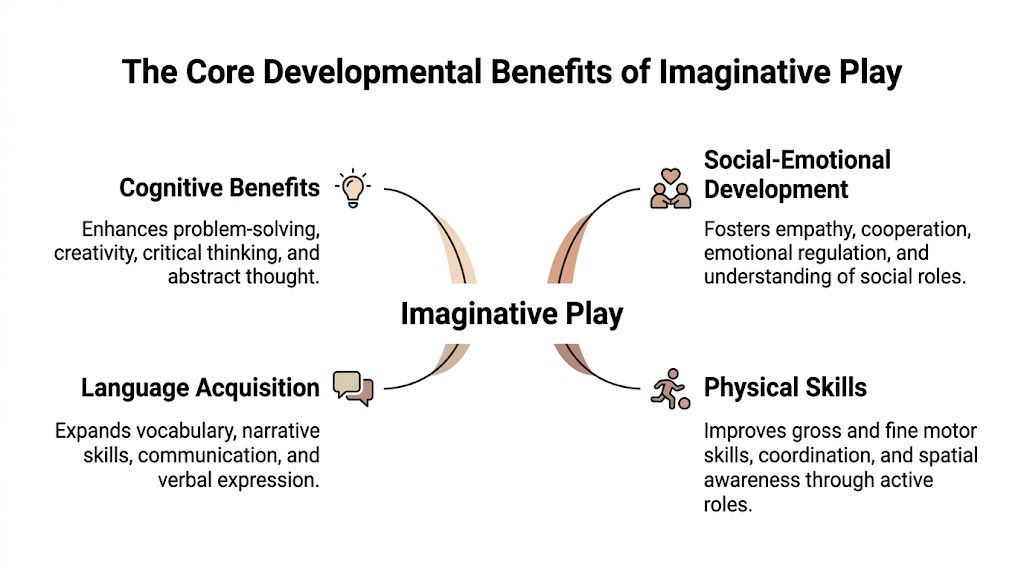
One Australian summary of the evidence is especially useful here. A Therapy Focus overview of imaginative play research reports that structured pretend play improved executive function in 85% of 3 to 5 year olds, while children in role-play showed a 40% increase in perspective-taking, used 50% more complex vocabulary during play, and improved gross motor coordination by 32% through activities such as imaginary galloping.
Those figures matter because they map neatly onto four areas that educators already monitor.
Cognitive development in imaginative play often starts with one simple act. A child decides that something ordinary now means something else.
That decision asks a lot of the brain. The child must hold an idea, inhibit the literal meaning of the object, and stay inside the pretend frame. When several children play together, the challenge increases. They need to plan, sequence events, remember roles, and adapt when the story changes.
The reported improvement in executive function for 85% of 3 to 5 year olds in structured pretend play gives school leaders a concrete reason to take this seriously. Executive function includes skills children rely on for classroom learning, such as attention control, flexible thinking, and managing impulses.
On a playground, these mental demands are easy to miss because they’re embedded in action. A child building a “camp” from movable parts isn’t only being creative. That child is making decisions, testing solutions, and adjusting plans when the structure doesn’t work or when peers want a different idea.
Imaginative play gives children a chance to step out of their own immediate viewpoint.
That’s one reason the reported 40% increase in perspective-taking stands out. When children pretend to be the parent, patient, shopkeeper, pilot, or baby, they have to consider how another person might speak, react, or feel. They’re not discussing empathy as an abstract concept. They’re rehearsing it in real time.
This matters on school grounds because many social conflicts begin with a narrow point of view. A child wants the same role as someone else. Another wants the story to go in a different direction. These tensions don’t make imaginative play less useful. They’re part of why it works. Children have to negotiate, wait, adapt, and recover.
A well-designed outdoor space can support this by offering enough room and enough “play anchors” for several narratives to happen at once. If every child must compete for one obvious feature, conflict rises quickly. If the setting includes platforms, nooks, pathways, and thematic cues, children can split, merge, and rebuild stories more easily.
Board-level takeaway: Social development doesn’t come from signage about kindness. It grows when children need one another to keep play alive.
Self-regulation also grows here. Children often need to stay in character, follow invented rules, and delay their own preferences for the sake of the group’s game. Those are small acts, but they build habits that matter across the school day.
A short explanation from practitioners can help bring this to life. The following video gives a clear overview of why pretend play supports children’s development.
Imaginative play is one of the most natural reasons children have to talk.
They name roles, explain actions, persuade others, give instructions, invent dialogue, and retell events. Unlike adult-led questioning, this language has a purpose the child cares about. They need words to keep the game going.
The Therapy Focus summary reports that children used 50% more complex vocabulary during play. That’s a powerful result for any board focused on oral language, literacy foundations, and communication confidence. It suggests that imaginative settings don’t merely entertain children. They generate richer speech.
On a playground, language expands when the environment supports shared scenarios. A simple shopfront, cubby, stage, vehicle-themed structure, or natural “camp site” can all trigger highly verbal interaction. Children ask for tickets, call for help, write menus in the air, warn of danger, negotiate whose turn it is, and tell one another what happens next.
The physical side of imaginative play is often overlooked because people separate movement from pretending. Children don’t.
A child who is “just running” may be escaping a volcano, delivering medicine, searching for treasure, or crossing a dangerous river. The story gives the movement purpose. That purpose often keeps children engaged longer and encourages a wider range of actions.
The reported 32% improvement in gross motor coordination through activities like imaginary galloping is useful because it links pretend scenarios to measurable physical outcomes. Children often move more dynamically when they have a narrative reason to climb, balance, crawl, leap, reach, carry, or chase.
Thoughtful design matters. Broad decks become stages. Balance elements become bridges. Mounds become lookout points. Ropes become jungle crossings. A playground that supports imaginative movement gives children more varied ways to develop coordination than one built only around queue-and-slide routines.
For boards and councils, the key message is practical. Imaginative play supports outcomes you already value:
| Development area | What children do in play | Why it matters on a playground |
|---|---|---|
| Cognitive | Plan, adapt, sequence, problem-solve | Supports flexible thinking through open-ended equipment |
| Social-emotional | Negotiate roles, share stories, manage frustration | Encourages cooperation and self-regulation |
| Language | Explain, narrate, persuade, role-play | Builds oral language in meaningful contexts |
| Physical | Climb, crawl, balance, run with purpose | Increases varied movement through story-led action |
The benefits of imaginative play in early childhood aren’t separate from playground planning. They are one of the strongest reasons to design outdoor spaces with more than basic activity in mind.
The most effective imaginative playgrounds don’t begin with a catalogue. They begin with a question. What kinds of stories should this space make possible?
That shift changes design decisions immediately. Instead of asking whether a piece looks exciting on its own, you ask whether it can hold multiple meanings, whether groups can gather around it, and whether children can transform it into different scenarios over time.
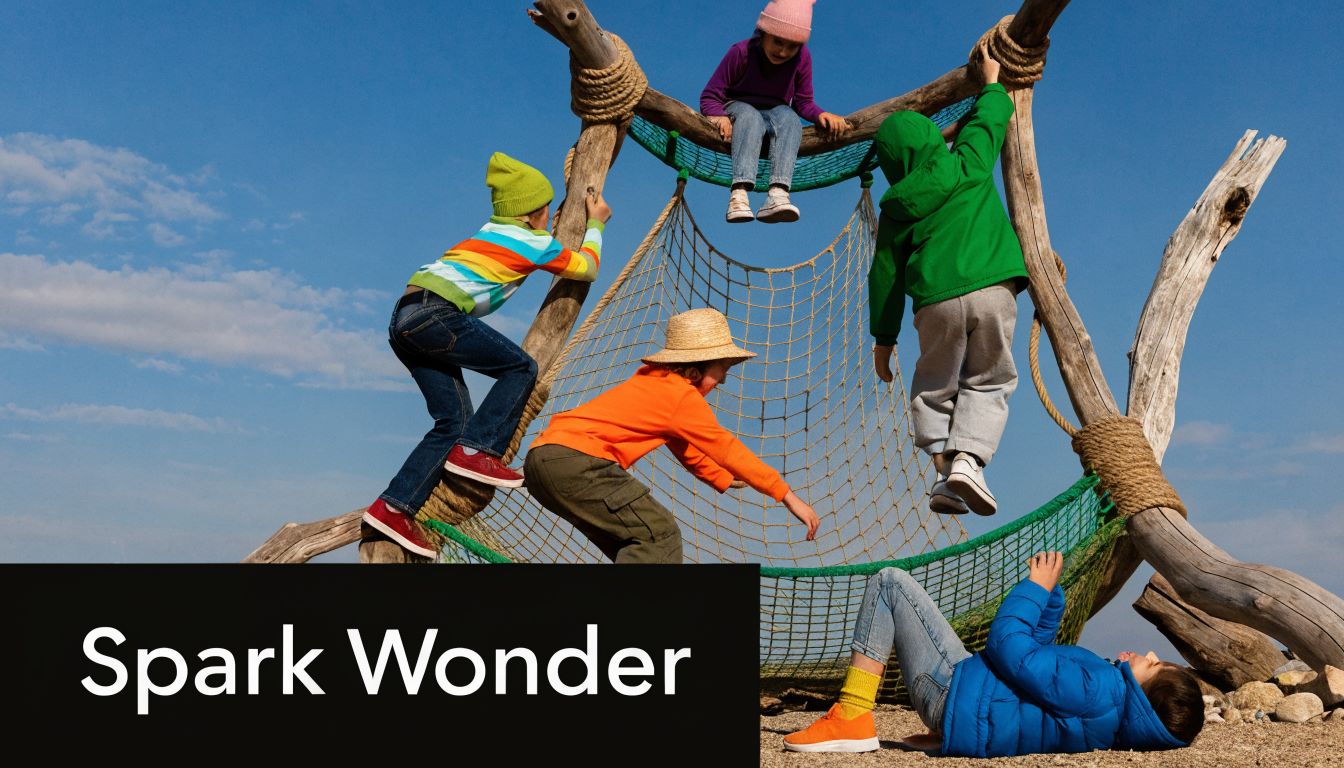
A good design often feels slightly unfinished in the best possible way. It gives children clues, but it leaves enough ambiguity for invention.
Many school and council sites make one common mistake. They put all the visual emphasis into one dominant structure and assume imagination will follow.
Children usually need more variety than that. Different forms of imaginative play need different conditions. Small-group role-play works best in semi-defined spaces. Fantasy adventures need routes, crossings, levels, and places to hide or observe. Symbolic play benefits from loose edges where objects and surfaces can take on new meaning.
A strong layout often includes:
This approach also helps supervision. Adults can observe more than one style of play without forcing every child into the same pattern.
Themes can be powerful, but they need restraint.
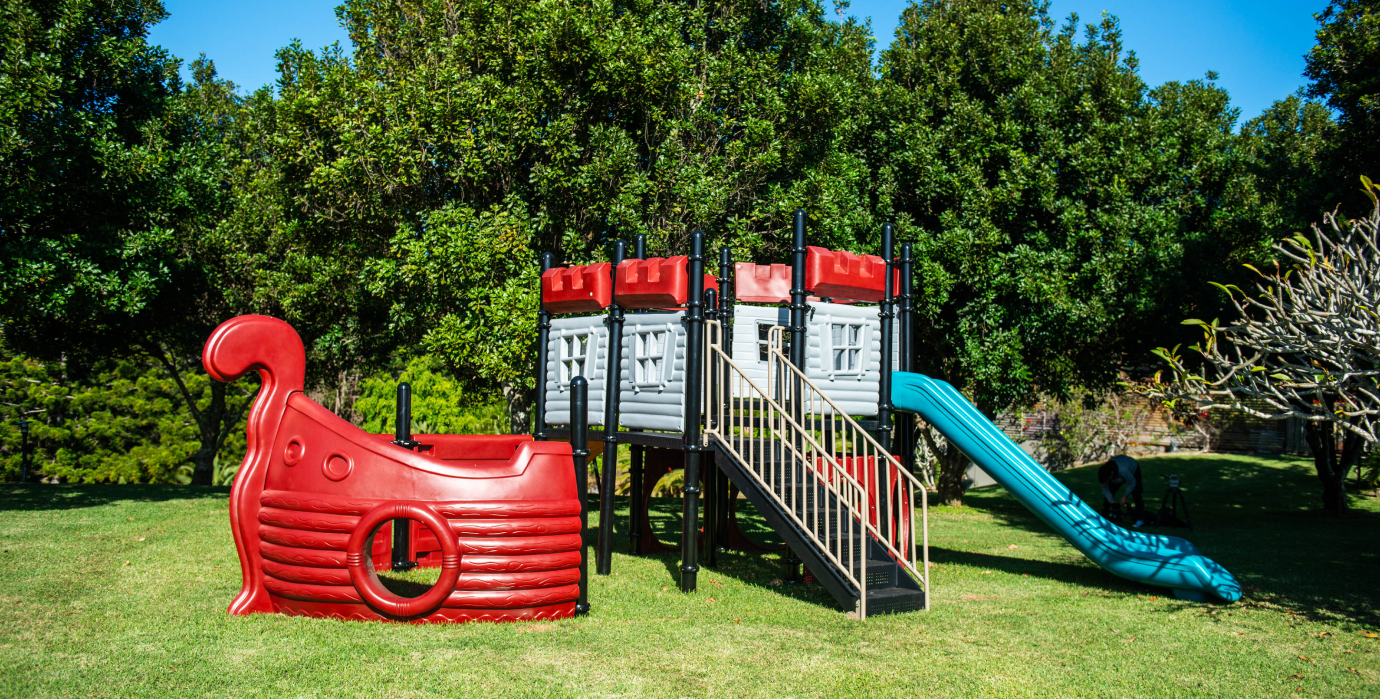
A pirate ship, forest camp, vehicle structure, market zone, or aircraft-inspired tower can all spark dramatic play. The risk comes when the theme becomes so literal that there’s only one story left to tell. Children get less from a fully scripted environment than from one that suggests a world and lets them fill the gaps.
That’s why thoughtful themed design works best when key elements remain open-ended. A ship can also become a research vessel, rescue station, floating café, or island fort. A forest setting can become a fairy trail, animal shelter, explorer base, or wizard school.
If you’re exploring practical examples, this guide to creating a themed playground is useful because it shows how theme can shape a site without locking children into one narrow use.
A theme should act like the opening line of a story, not the entire script.
Children often do more with a mound, a deck, a tunnel, or a net than with a piece that announces its purpose too loudly.
Non-prescriptive equipment gives broad cues rather than single instructions. Cubes, platforms, timber posts, climbing frames, bridges, boulders, and abstract forms invite interpretation. One day they’re a castle. The next day they’re a mountain station or a bus depot.
This doesn’t mean playgrounds should become vague or bland. It means the equipment should support multiple narratives across different ages and social groups. Open-ended forms also age better in school settings because older children can continue to reinterpret them rather than outgrowing a narrow theme.
Imaginative play deepens when children can feel the environment, not just move through it.
Timber textures, planting, sand, bark, mounds, rocks, shade changes, and sound-making surfaces all add atmosphere. They also provide the kind of detail children use in stories. A metal rail might be a train barrier. A patch of planting might be a jungle. Sand might become food, building material, treasure, or medicine.
You don’t need clutter to achieve this. In fact, overloading a site with features can reduce play quality by making every area visually noisy. It’s better to include a few strong materials and forms that children can return to and reinterpret.
The final test is simple. Will children use the space differently next week?
If the answer is no, the design may be too fixed. Imaginative playgrounds should keep offering new combinations. Children should be able to mix movement, role-play, social gathering, and quiet invention without needing constant adult setup.
That replay value is what turns a capital project into an educational asset.
When purchasing decisions begin, it helps to stop asking which equipment is most popular and start asking which equipment supports the richest range of play behaviours. A school board can defend that decision far more easily because the rationale is educational, not cosmetic.
Different equipment types tend to support different kinds of imaginative play. The table below can help align specification choices with the developmental outcomes you want to encourage.
| Type of Imaginative Play | Key Behaviours | Recommended Equipment (Examples) | Developmental Goal |
|---|---|---|---|
| Symbolic play | Substituting one object for another, assigning new meanings to spaces and materials | Abstract cubes, decks, stepping pods, timber logs, simple platforms, loose movable props where appropriate | Flexible thinking, creativity, early problem-solving |
| Sociodramatic play | Taking roles, negotiating turns, sustaining shared scenarios | Cubby houses, shopfronts, play kitchens, counters, small stages, sheltered gathering platforms | Cooperation, self-regulation, empathy, communication |
| Fantasy adventure play | Inventing worlds, quests, dangers, rescues, missions | Castle-like towers, rocket or vehicle-inspired structures, rope bridges, lookout points, tunnels | Narrative thinking, confidence, teamwork, purposeful movement |
| Small-world style outdoor play | Creating contained scenes and repeated story sequences | Sand areas, nature play pockets, table-height platforms, low landscape features | Concentration, storytelling, fine motor control |
| Sensory-rich imaginative play | Exploring texture, sound, movement, and material transformation within stories | Sand play, water-adjacent features where suitable, musical elements, planting zones, mud kitchen style setups | Language development, exploration, collaborative experimentation |
The main point isn’t that one item matches one outcome. It’s that equipment works best in combinations. A cubby on its own may trigger a short game. A cubby linked to a deck, stepping route, and open area can support a full sequence of play.
If you can’t build everything at once, prioritise equipment that does more than one job.
A platform with access points can support gathering, role-play, climbing, and observation. A rope bridge adds movement, challenge, and story potential. A cluster of abstract forms can become transport, animals, buildings, obstacles, or meeting points depending on the day.
In contrast, highly specialised pieces sometimes photograph well but offer fewer interpretations in practice. They can still have a place, but they shouldn’t dominate the design if imaginative play is a key goal.
Some buyers treat sensory play and imaginative play as separate categories. On the ground, they overlap constantly.
Sand becomes food, roads, treasure, medicine, or building material. Water becomes weather, danger, cleaning, magic potion, or river crossing. Texture and sound often become part of the narrative itself. That’s one reason this overview of the importance of sensory play is relevant when choosing imaginative play equipment. Sensory features often give children the raw material for richer stories.
The best purchasing question isn’t “What does this item do?” It’s “How many different things could children make it do?”
Before approving an item, ask four quick questions:
If the answer is yes across most of those questions, the item is more likely to justify its footprint and budget.
Once a new playground is installed, leaders usually hear broad feedback first. Children love it. Staff say it feels busier. Families mention that students talk about it at home. Those comments matter, but they’re not enough when boards need evidence for reporting, future upgrades, or grant applications.
A better approach is to observe play with a simple framework.
You don’t need a complicated assessment tool. A short observation sheet used consistently is often more useful than a lengthy template nobody completes.
Track visible indicators such as:
These observations can then be linked to EYLF-aligned outcomes such as identity, wellbeing, communication, and connectedness. That gives staff a clearer line between playground use and educational documentation.
A useful school process is to observe the old space for a short period before an upgrade, then repeat the same observations after children have settled into the new environment.
Look for qualitative changes such as:
| Observation area | Before upgrade | After upgrade |
|---|---|---|
| Play complexity | Short, repetitive actions | Longer story sequences with defined roles |
| Group interaction | Frequent crowding around one feature | Smaller groups spread across several play zones |
| Language in play | Brief instructions or disputes | Richer dialogue, negotiation, and role language |
| Movement choices | Limited routes and repeated patterns | More varied climbing, balancing, and exploratory movement |
That kind of comparison is often enough to show value without overstating certainty.
A broader health and engagement signal is also worth noting. Since the 2010 adoption of the National Quality Framework, imaginative-themed playgrounds have been linked to a 28% rise in daily playtime in NSW public schools and a 15% drop in obesity rates in play-active groups, as cited in the earlier Therapy Focus summary of a 2024 NSW Health report. In practical terms, that means themed and imaginative spaces may influence not only how children play, but how long they remain active.
Good reporting usually combines short notes, photographs collected with permission, and repeat observations from multiple staff members. Keep the language concrete. Record what children did, said, and sustained.
You can also frame the results in value terms. A playground isn’t only a capital item. It’s a daily-use learning environment. For teams building that case internally, this discussion of the ROI of school playground can help connect developmental observations with strategic planning and long-term site investment.
If you can describe the play clearly, you can usually justify the design clearly.
Children don’t separate play from development nearly as much as adults do. For them, pretending, moving, negotiating, building, talking, and problem-solving happen all at once. That’s why the benefits of imaginative play in early childhood are so important to playground decisions.
A well-designed imaginative playground gives children room to test ideas, take roles, use language with purpose, and move with intent. It also gives schools and councils something more valuable than a visually appealing outdoor area. It gives them a setting that supports daily learning without needing constant adult direction.
For decision-makers, that changes the standard. The question is no longer whether a playground looks impressive on opening day. The better question is whether it will keep generating rich play, stronger relationships, and better developmental opportunities long after the ribbon is cut.
When a site is planned around imagination, the investment keeps working.
If you’re planning a new school, council, or early learning playground, Kidzspace can help you turn developmental goals into a practical design. Their team offers free playground consultations to help clarify your site needs, budget, theme direction, and equipment options so you can build a space that supports active, imaginative, inclusive play for years to come.



Copyright © Kidzspace. All Rights Reserved.
Copyright © Kidzspace. All Rights Reserved.