




If you're on a school board, in a council parks team, or planning an upgrade for a shared recreation area, you're probably looking at the same problem most clients start with. You need more activity options, but you don't have endless land, endless budget, or much tolerance for a project that becomes a maintenance headache.
A well-planned multi sport court solves exactly that problem. It turns one footprint into a flexible, high-use asset that can serve PE classes, lunchtime play, after-school programs, community bookings, and informal weekend use. In Australia, the difference between a court that works for years and one that causes complaints usually comes down to early decisions about layout, surface, drainage, compliance, and how realistically the project team assesses local conditions.
The strongest projects aren't the ones with the most features. They're the ones that match the site, the users, and the operating budget from day one.
A multi sport court is the outdoor equivalent of a Swiss Army knife. One space handles several activities, which is why schools and councils often choose it over building separate areas for each sport.
That matters most on constrained sites. A primary school may need basketball for PE, a small-sided ball space for recess, and something usable for community programs after hours. A council reserve may need broad appeal across age groups rather than a single-code facility used by a narrow group. A multi sport court meets that brief because the same slab, fencing zone, and circulation space can support multiple uses across the week.
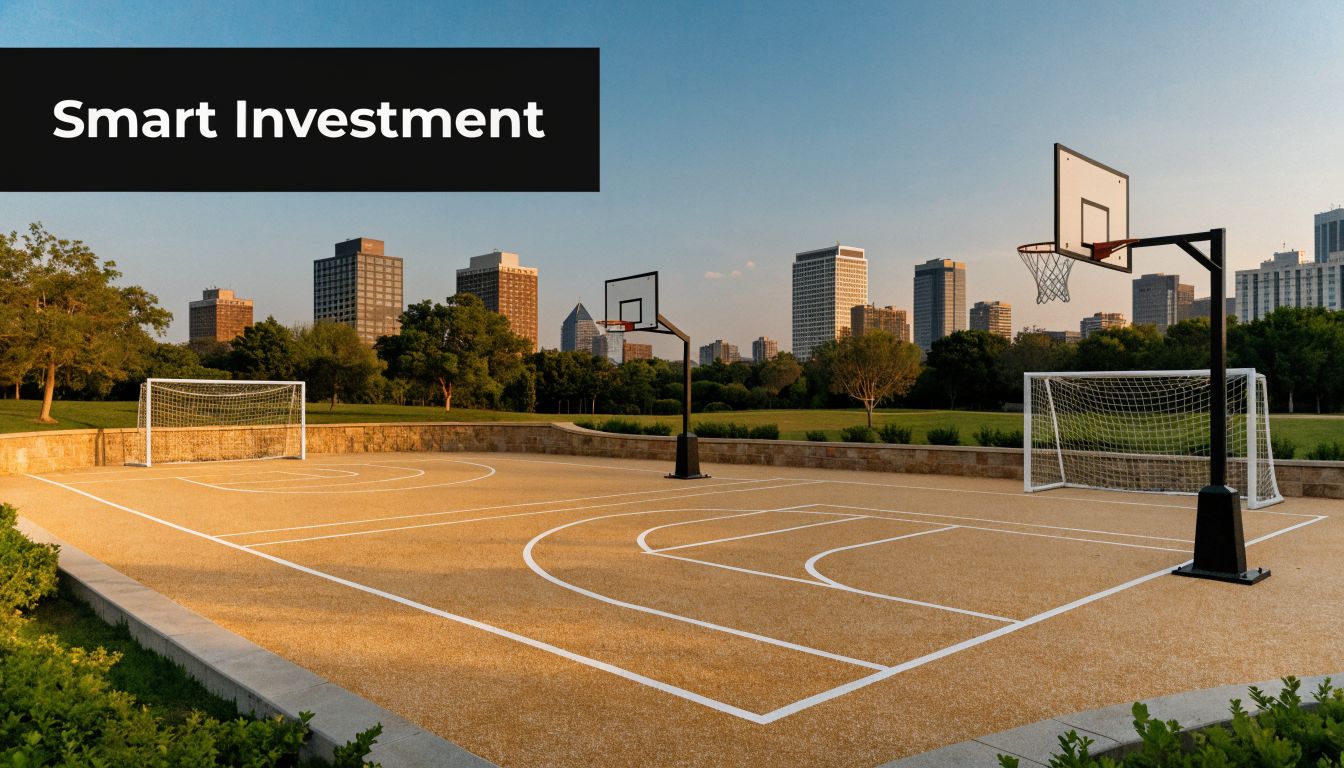
The biggest strategic advantage is land efficiency. Instead of carving up a site into separate, smaller facilities that each have their own clearances and access issues, you concentrate activity into one organised zone.
That usually improves supervision too. Staff can monitor one destination more easily than several disconnected play areas. For councils, it also simplifies maintenance planning because surface care, line marking, lighting, and equipment inspections are centralised.
A practical brief often includes:
The capital conversation shouldn't focus only on square metre rates. It should focus on how much usable activity you get from the site.
US-based figures suggest converting underused areas into multi-sport courts can deliver 30 to 50% cost savings compared with building separate single-purpose facilities, according to VersaCourt's cost comparison for multi-sport game courts. Australian-specific data is still developing, but the planning logic is already clear. Shared foundations, shared circulation, and shared infrastructure usually make more sense than duplicating everything.
Practical rule: If the site can't support multiple full-size single-sport spaces without compromising access, supervision, or safety clearances, a multi sport court is usually the better asset strategy.
The best courts aren't locked into formal competition dimensions alone. They support structured and unstructured movement. That's a major difference.
A rigid single-purpose court can sit empty when the scheduled sport isn't on. A multi sport court tends to stay active because users can adapt it. One group might use the hoops, another may run a modified futsal game, and teachers can set up movement circuits without bringing in temporary equipment for every session.
That versatility is what makes the investment defensible in board meetings and capital works reviews. You're not paying for one sport. You're funding a shared activity platform that keeps earning its place on the site.
The right layout starts with a blunt question. Who needs to use the court every week, and for what? If you skip that step and jump straight to dimensions, you'll end up with a court that technically fits the site but doesn't fit the users.
The activity mix drives everything. It affects the court size, line hierarchy, equipment placement, run-off zones, fencing, and whether the space feels intuitive or cluttered.
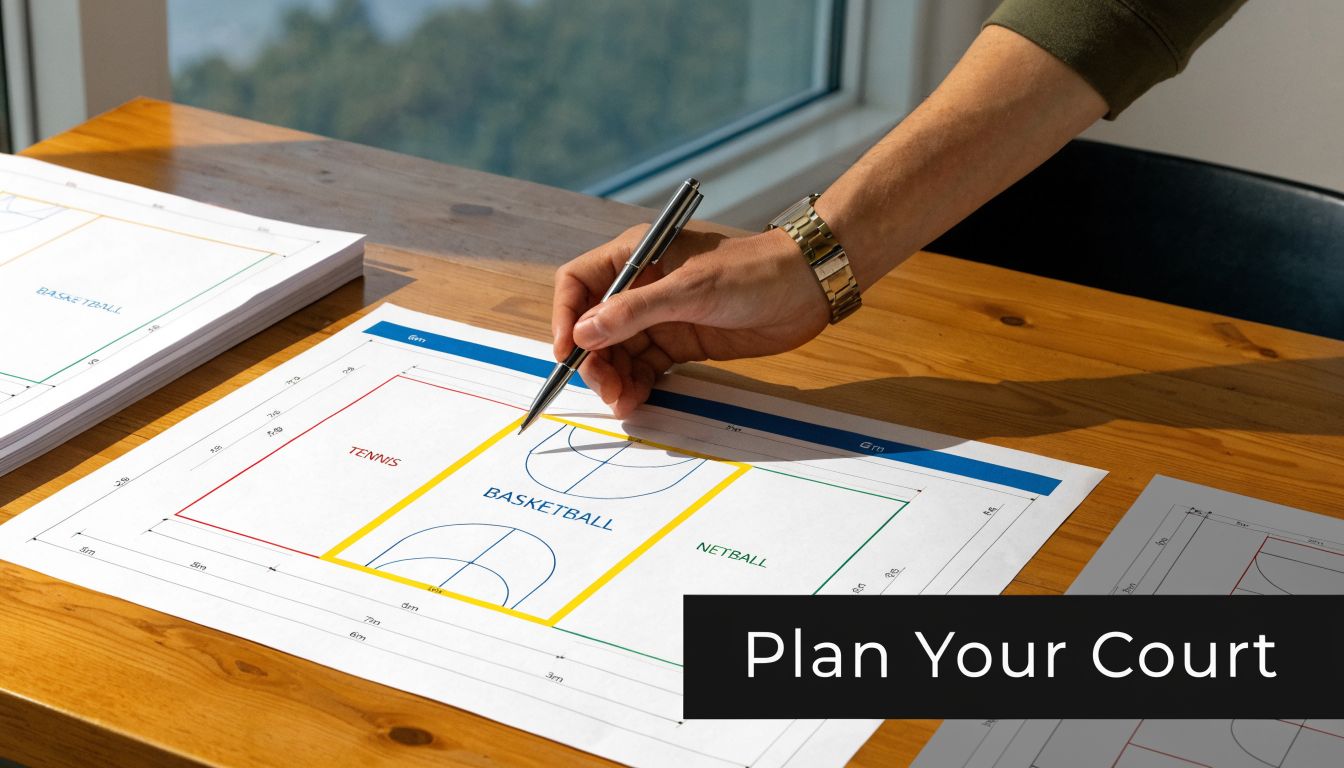
Every project has a temptation to include everything. Basketball, netball, futsal, volleyball, tennis, pickleball, fitness markings, scooter loops. On paper that sounds efficient. On site it often creates too many overlapping lines and too many compromises.
A better approach is to rank activities in three groups:
Primary use
The activity the court must handle well. For a school, that might be basketball and general PE. For a council, it may be broad community ball play.
Secondary use
Sports that share the space without undermining the primary game. These often work best when equipment is removable or markings are clearly differentiated.
Occasional use
Activities that can be supported with portable gear or program-based setup rather than permanent fixtures.
For Australian school projects, one practical benchmark is a 27m x 16m court for primary settings, using FIBA mini-basketball lines overlaid with Auskick soccer zones. The Australian guidance in the verified brief notes that this size can accommodate 20 to 30 children simultaneously while maintaining 1.5m run-off zones.
Some combinations are naturally compatible. Others create line confusion or equipment conflicts.
| Combination | Usually works well when | Common issue |
|---|---|---|
| Basketball and small-sided soccer | The court prioritises general play and school use | Goal placement can interfere with baseline activity |
| Basketball and volleyball | Posts are removable and storage is planned early | Fixed sleeves in the wrong place create trip points |
| Netball and basketball | User groups understand shared spaces and line colours are disciplined | Too many similar arcs and circles reduce readability |
| Futsal and general PE | Community use is broad rather than competition-focused | Ball containment and fencing become more important |
One useful design reference sits below. It shows how thinking in overlays helps avoid wasted space.
A lot of multi sport court projects still rely on a standard imported list of sports. That's a missed opportunity in Australian schools and public space design.
Research from the Australian Institute of Family Studies shows 78% of primary schools are seeking culturally responsive play features, yet only 12% currently include Indigenous elements, according to the AIFS discussion of Indigenous children and play. That gap matters if the goal is to build a court that reflects the local community rather than just replicating a generic template.
A court can support movement, identity, and learning at the same time if cultural inclusion is designed in early rather than added later as decoration.
This doesn't mean turning a sports court into a museum piece. It means designing practical markings and adjoining zones that support culturally relevant activities.
Useful options include:
What doesn't work is token linework with no teaching purpose, or culturally themed graphics placed across critical play lines. If you're going to include Indigenous play elements, treat them as part of the functional design brief.
Most court problems don't start with the hoop or the line marking. They start underfoot. If the surface is wrong for the site, everything else becomes more expensive to maintain and harder to defend when complaints start coming in.
Australian conditions are demanding. UV, heat, heavy rain events, expansion and contraction, and variable subgrades all put pressure on outdoor courts. That's why surface selection has to be based on performance over time, not just what looks good at handover.
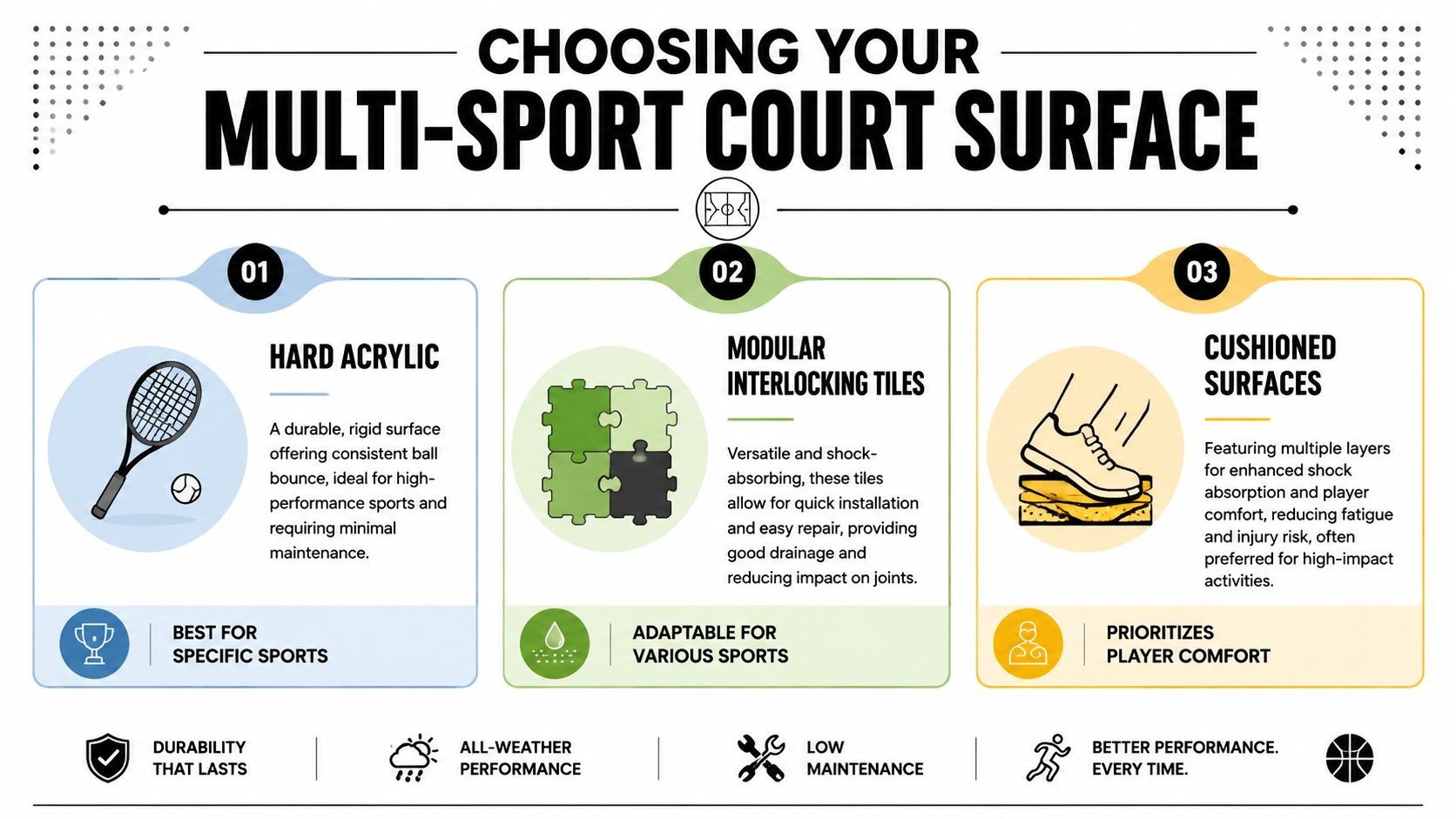
Most projects weigh up hard acrylic, modular interlocking tiles, and cushioned systems such as polyurethane-based builds. Each has a place. None is automatically right.
| Surface type | Strength | Trade-off | Best fit |
|---|---|---|---|
| Hard acrylic | Consistent ball response and familiar court feel | Less forgiving under sustained impact if the build-up is basic | Schools and councils prioritising ball sports and durable everyday use |
| Modular tiles | Replaceable sections and strong drainage performance | Surface feel differs from monolithic coatings and base quality still matters | Sites needing versatility and simpler localised repairs |
| Cushioned systems | Greater comfort and impact moderation | Higher specification expectations and tighter installation control | Projects prioritising user comfort and heavy repeat use |
The base remains critical no matter which surface goes on top. Even excellent coatings won't compensate for poor slab construction, weak drainage strategy, or unstable ground conditions. That's why teams reviewing slab options often benefit from reading outside sport-specific sources too. General construction guidance on expert commercial poured concrete is useful because the same fundamentals apply. Get the base wrong and the finish won't save you.
In Australian conditions, resilience isn't a buzzword. It's the difference between a court that reopens quickly after weather and one that sits unusable while repairs drag on.
Verified climate-related guidance in the brief notes that permeable acrylic systems may cost $120 to $180/m² upfront but can save up to 35% over 10 years by reducing repair costs. The same source notes that flooding damaged 40% of outdoor recreational facilities in NSW and QLD in 2025, based on Bureau of Meteorology-linked climate reporting in the verified data.
That doesn't mean every project should default to permeable acrylic. It means flood exposure, drainage path, and reopening expectations need to be discussed early.
Site reality matters more than brochure language. A surface that's perfect on a well-drained school site may be the wrong choice for a flood-prone reserve.
Australian technical guidance in the verified data highlights several practical details that often separate strong courts from fragile ones:
If you're assessing slip resistance and comfort products across adjacent play zones as well as the court itself, the guidance on non-slip flooring tiles for outdoor use is also worth reviewing because the same questions come up repeatedly. How does it behave when wet, how does it age, and how hard is it to keep safe?
For many school and community projects, the strongest outcome is not the softest surface or the cheapest one. It's the system that best matches expected use, local weather, and maintenance capacity.
Choose hard acrylic when you want crisp ball response and a straightforward, sport-first court. Choose modular systems when drainage and replaceable components are high priorities. Choose cushioned builds when comfort and impact moderation are central to the brief. Then make sure the slab, falls, drainage, and edging are designed to support that choice.
A court can look excellent in concept drawings and still fail where it matters. Safety, compliance, and technical detailing don't sit in the background. They determine whether the space performs under daily school use, weekend wear, and wet-weather conditions.
For Australian projects, the mandatory starting point is compliance with the AS 4685 series for playground equipment and impact attenuating surfaces where relevant to the site context, together with sport-specific guidance from Sport Australia. That doesn't mean every court is a playground, but many school and community projects sit within broader play environments, which is exactly why technical coordination matters.
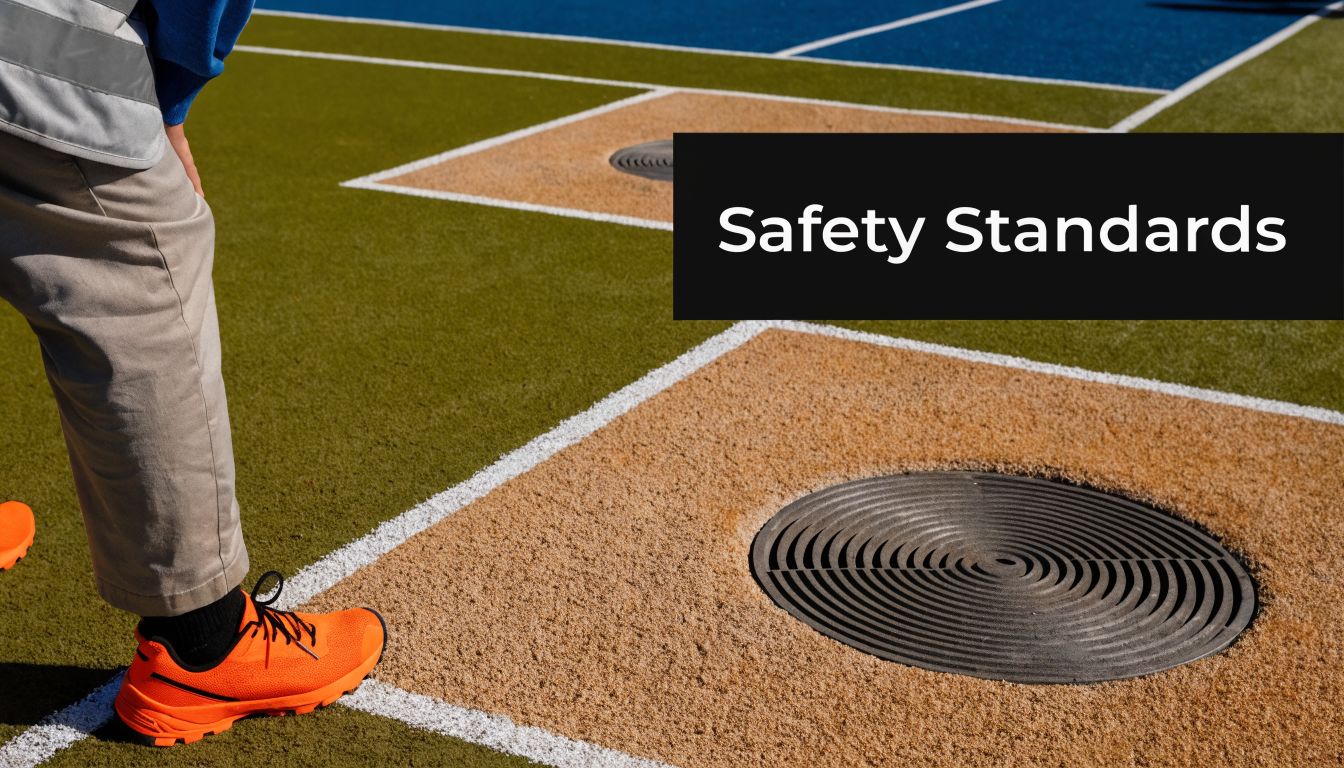
A multi sport court isn't just paint on concrete. The verified technical brief specifies a 100mm post-tensioned concrete slab with compliant reinforcement and notes that, when paired with a high-quality acrylic surface, the build can achieve 40 to 60% force reduction. It also states that a wet slip resistance value above SRT 45 can cut injury claims by up to 60% in Kidzspace case studies.
Those figures matter because they connect design choices to operational outcomes. Boards and committees often ask why one specification costs more than another. The answer is usually that better build-ups support safer use and fewer incidents.
A compliant slab and decent coating aren't enough on their own. Several smaller technical choices have an outsized effect.
If a contractor says the slab is "standard", ask what standard they mean. You want drawings, reinforcement details, falls, joints, and drainage all documented.
Line marking has a direct effect on usability. If players can't read the space quickly, the court becomes frustrating and supervision gets harder.
Australian guidance in the verified data recommends thermoplastic paints with a retro-reflective index above 0.5 cd/lx/m² and ISO 105-B02 UV resistance rated 7 to 8. That specification is designed to prevent 85% of fading compared with standard paints under harsh sun.
The practical takeaway is simple. Use a disciplined colour hierarchy and durable products from the start.
When reviewing tenders or concept documents, ask for these items in writing:
Slab specification
Confirm thickness, reinforcement approach, control of cracking, and edge detailing.
Slip resistance evidence
Require wet-condition testing information, not just a generic product brochure.
Drainage design
Look for falls, grate placement where relevant, sub-base water management, and discharge path.
Line marking schedule
The plan should identify which markings are primary, which are secondary, and how colours differ.
Equipment certification
Posts, goals, hoops, and lighting should align with the site's exposure and intended use.
For broader site governance, school playground safety standards guidance is a helpful companion reference because many committees are reviewing the whole active play environment, not only the court in isolation.
The irony of strong compliance work is that users barely notice it. The surface feels secure in the wet. The drainage does its job. The lines stay visible. Equipment doesn't rattle, loosen, or create awkward pinch points.
That outcome doesn't happen by accident. It comes from careful specification and from project teams treating technical design as part of the user experience, not just a box-ticking exercise.
The budget question usually arrives too late. By the time committees ask for a realistic total, the early concept has often fixed expectations around size, equipment, and finish quality.
A better method is to treat the budget as a whole-of-project exercise, not a surface-only exercise. The court coating is only one cost line, and it's rarely the line that causes the biggest surprise.
Start with site formation and base works. If excavation, spoil removal, retaining, drainage correction, or subgrade treatment are needed, those costs can reshape the project quickly. Then move upward through the build.
A practical budget stack looks like this:
Committees often focus on the slab and the surfacing, then treat line marking as minor. It isn't. If the lines fade early or become unreadable, the court loses function long before the rest of the structure fails.
The verified brief notes that Australian guidance recommends thermoplastic paints with a retro-reflective index above 0.5 cd/lx/m² and ISO UV resistance rated 7 to 8, which prevents 85% of fading compared with standard paints. That sort of specification should be visible in the tender documents, not left to installer preference.
Cheap line marking often becomes expensive line marking because it has to be redone before the surface should need major attention.
If your internal team isn't used to construction cost planning, it helps to borrow methods from contractors who handle complex scopes every day. Reviews of TruTec estimating software insights are useful because they show how experienced estimators break projects into traceable components rather than relying on broad assumptions.
That same discipline helps schools and councils compare quotes properly. If one price looks much lower, ask what's missing. It's often drainage, lighting allowances, edge works, or equipment quality.
For broader capital planning across active play spaces, this guide to commercial playground cost planning is also useful because many organisations are budgeting the court alongside adjacent playground or fitness upgrades.
A strong budget also includes what happens after opening:
The cheapest tender isn't always the lowest-cost asset. A realistic budget weighs initial outlay against maintenance burden, downtime risk, and how long the court stays attractive and safe in normal use.
A successful multi sport court project usually follows a steady, disciplined path. Trouble starts when teams rush from idea to quote without locking the brief, the site constraints, or the compliance expectations.
Start with a proper site review. That means levels, drainage behaviour, access constraints, surrounding uses, services, and likely user groups. If the site ponds after rain, bakes in full western sun, or sits beside classrooms that will hear every rebound, those facts should shape the brief before anyone draws a final layout.
Get internal stakeholders in the room early. For schools, that usually includes leadership, PE staff, maintenance, and whoever manages supervision and timetabling. For councils, include parks, capital works, asset management, and community engagement.
A usable brief does more than say "multi sport court required". It should state:
Many projects are managed with greater ease. A clear brief leads to clearer pricing and fewer assumptions hidden in contractor exclusions.
When quotes arrive, don't compare totals first. Compare scope.
Check whether each tenderer has addressed slab design, drainage, surfacing, line marking, equipment, edge conditions, and warranties in a consistent way. If one quote includes a robust specification and another assumes a thinner or simpler build-up, the numbers won't be directly comparable.
The most useful tender question is often, "What have you excluded?" Ask it early and in writing.
Look for evidence in the supplier's project history too. Outdoor courts for Australian schools and councils are exposed assets. You want to know how the system performs after heat, storms, heavy recess traffic, and routine maintenance.
Once a contractor is appointed, lock down the approval pathway. Who signs off on shop drawings, colour selections, equipment placement, and any site variations? Delays often come from unclear decisions rather than construction complexity.
Before handover, insist on a practical completion review that covers:
Surface finish quality
Check consistency, joins, curing outcome, and any visible defects.
Drainage performance
Confirm falls and water movement, especially around edges and grates.
Line clarity
Make sure the hierarchy is readable and that colours match the agreed plan.
Equipment operation
Test removable posts, goals, hoops, gates, and lighting controls.
Documentation
Collect maintenance instructions, warranties, compliance records, and inspection recommendations.
The best handovers are boring. No arguments over missing items. No confusion about maintenance. No surprises after the first heavy rain.
A well-procured court gives the owner confidence because the decision trail is clear from concept to completion.
Kidzspace helps schools, councils, and community organisations turn early ideas into practical outdoor spaces that are safe, durable, and designed for real Australian use. If you're planning a multi sport court or a broader active play upgrade, talk with Kidzspace about layout planning, inclusive design, and building a project scope that stands up to budget review and daily use.


Copyright © Kidzspace. All Rights Reserved.
Copyright © Kidzspace. All Rights Reserved.