




You're probably looking at a site plan, a budget draft, a few competing priorities, and a room full of people who all mean well but want different things. The school wants supervision to be simple. Council wants durability and compliance. Parents want somewhere children specifically ask to return to. Finance wants a project that won't become a maintenance headache in two years.
That's normal.
A successful family fun park isn't defined by how much equipment you can fit into a footprint. It's defined by how well the place works over time. That means clear project intent, disciplined site analysis, inclusive design, realistic budgeting, and an operating plan that survives weather, wear, staffing changes, and public scrutiny.
The projects that perform best aren't always the flashiest on opening day. They're the ones that still feel welcoming, organised, and well-used years later.
Most park problems start early. Not with construction, but with vague goals.
If one stakeholder thinks the project is a destination park, another thinks it's a neighbourhood playspace, and a third expects event revenue, the design will drift. You'll get expensive revisions, drawn-out approvals, and a result that tries to satisfy everyone but delights no one.
Start with a simple question. Why are we building this family fun park?
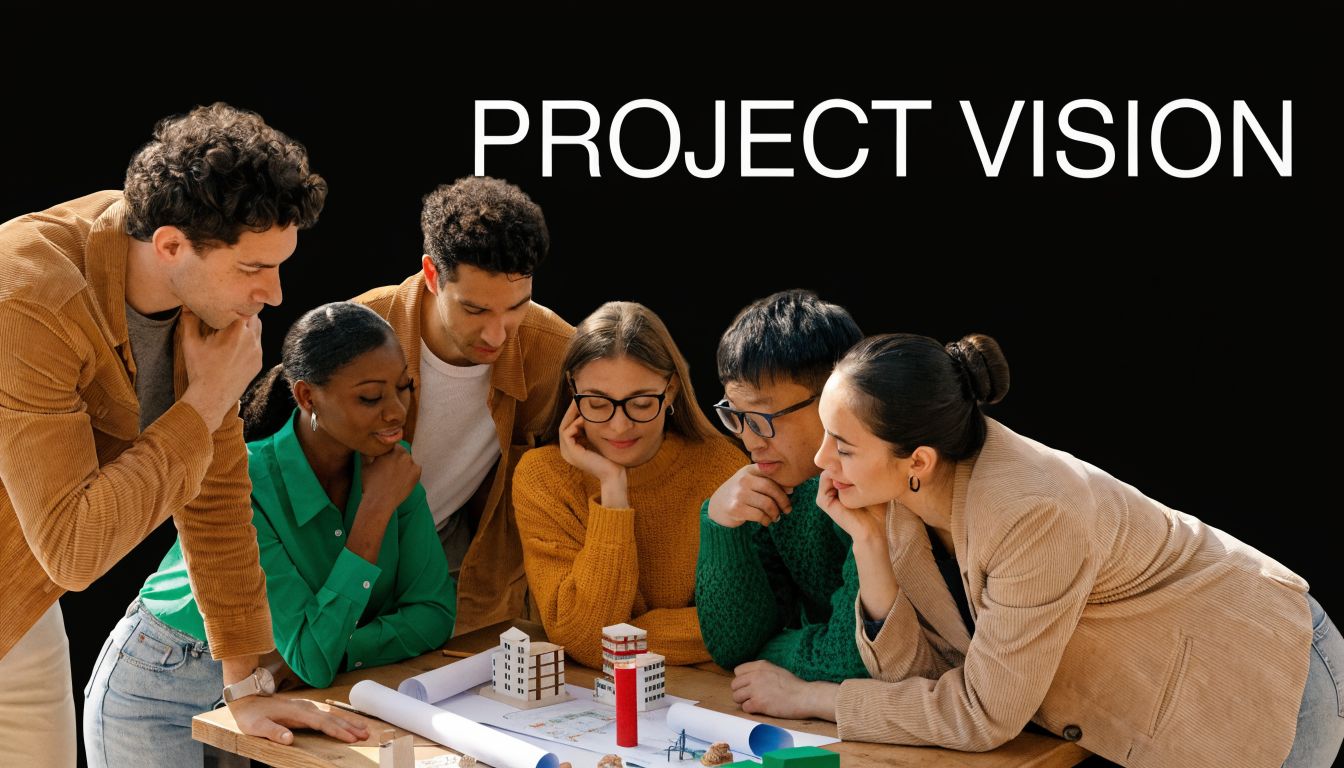
The first workshop shouldn't just include decision-makers. It should include the people who'll live with the outcome.
That usually means:
A park designed without maintenance input often looks good on paper and becomes difficult to run. A park designed without user input often misses the social patterns that matter most, such as where carers naturally gather, where older siblings hover, or where overstimulated children need retreat space.
Practical rule: If the people responsible for supervision, cleaning, or repairs aren't consulted early, the design is incomplete.
A good first workshop needs structure. Otherwise, it becomes a wishlist session.
Use a working format like this:
Define the users
Name the primary users first, then the secondary users. A school may prioritise junior primary children during the day and families after hours. A council site may need to serve toddlers, older children, grandparents, and community events in the same footprint.
Agree on the park's job
Is the site meant to maximise active play, support longer family stays, improve social inclusion, create a local landmark, or support paid programming? It can do several of these, but one should lead.
Set fixed requirements These aren't preferences. They're essential features such as shade retention, sightlines, accessible circulation, vandal-resistant finishes, fencing, after-hours use, or quiet zones.
List failure conditions
This is one of the most useful exercises. Ask what would make the project feel unsuccessful after opening. Common answers include congestion, poor supervision, constant repairs, noise conflict, inaccessible play, and weak community uptake.
By the end of the workshop, produce a short project brief. Not a glossy vision statement. A working document.
Include:
Keep it plain. If someone new joins the project later, they should understand the park's direction in a few minutes.
A clear brief also helps when reviewing concepts. You stop asking, “Do we like this?” and start asking, “Does this solve the job we agreed on?”
A family fun park can fail on a good site and succeed on a difficult one. The difference is usually in how accurately the site was assessed before design locked in.
Early enthusiasm tends to focus on what could go there. Feasibility work asks a harder question. What will this site allow without creating avoidable cost, delay, or operational friction?
A quick inspection won't tell you enough. Visit the site at different times, in different weather if possible, and with operations staff present.
Check the basics first:
Access and arrival
How do families arrive. On foot, by car, by bus, by bicycle? Is the entry obvious? Is there conflict between pedestrians, service vehicles, and drop-off traffic?
Topography and drainage
Slopes can add character, but they also affect circulation, retaining, surfacing transitions, and accessibility. Low points matter. If water sits after rain, it will continue to sit after construction unless drainage is addressed.
Utilities and services
Confirm existing services early. Power, water, sewer, stormwater, and irrigation all shape layout and cost. Unknown services are a classic source of redesign.
Shade and exposure
Existing trees, wind channels, western sun, and reflected heat from surrounding hardscape all affect comfort and dwell time.
Surveillance and adjacency
Consider where carers stand, where staff supervise from, and what neighbouring uses may create conflict. A toddler zone beside a loud, high-energy activity area often leads to complaints and poor user experience.
Project teams that want fewer disruptions during delivery should also look closely at logistics, fencing, and site access during works. A practical guide on how to prevent construction project delays is useful because many park programs slip for ordinary reasons, such as unsecured sites, material access issues, and avoidable disruptions.
A park that looks balanced in plan can still behave badly in use.
That's where movement analysis becomes valuable. Visitor flow analysis in Australian parks shows that 70% of visitors cluster around central play zones, and operators using GIS software and agent-based modelling can target a 20% improvement in throughput, while ancillary offers such as mobile food carts have lifted revenue by 15 to 25% in some Queensland parks according to visitor flow analysis in Australian parks.
That matters at concept stage because clustering changes everything. It affects queueing, supervision, seating, bin placement, food sales, shade demand, and where conflict points appear.
Don't treat the centre of the park as empty circulation space. In many layouts, it becomes the busiest and most contested zone.
The output shouldn't be a generic note saying the site is “suitable”. It should produce design consequences.
A useful feasibility summary includes:
| Feasibility item | What to confirm | Why it matters |
|---|---|---|
| Access pattern | Main arrival routes and pinch points | Shapes entry, wayfinding, and staffing |
| Ground condition | Drainage behaviour and level changes | Affects cost, accessibility, and maintenance |
| Service availability | Existing utility capacity and conflicts | Prevents redesign during documentation |
| Comfort factors | Shade, heat, wind, noise | Influences dwell time and user satisfaction |
| Flow behaviour | Likely congestion areas and pauses | Improves layout logic and commercial planning |
Early concept work often helps stakeholders understand these trade-offs more clearly than text alone. Even a simple playground drawing example can help a committee see how paths, activity nodes, and quiet spaces relate on the ground.
If the site only works with major compromise, say it early. It's cheaper to change direction before the brief hardens than after tenders come back.
Compliance isn't the same as inclusion.
A family fun park can meet technical requirements and still exclude children in practice. If the only accessible element is a path to the edge of the play area, or if the main experience depends on climbing confidence, fast movement, or high sensory tolerance, many families will read the message immediately. This park wasn't designed for us.
That's why the strongest parks use a design for all approach. They don't bolt accessibility on at the end. They shape the whole play experience around varied bodies, varied confidence levels, and varied ways of engaging.
The demand is already there. In Australia, only 22% of public playgrounds are fully accessible, and family fun parks risk losing up to 30% of potential visitors by failing to incorporate adaptive equipment, while NDIS funding for playspace grants has increased by 15% according to inclusive play demand in Australia.
That isn't just a social issue. It's a planning issue, an equity issue, and an attendance issue.
If stakeholders only ask whether a wheelchair can enter the site, they're asking the wrong question. Better questions are these:
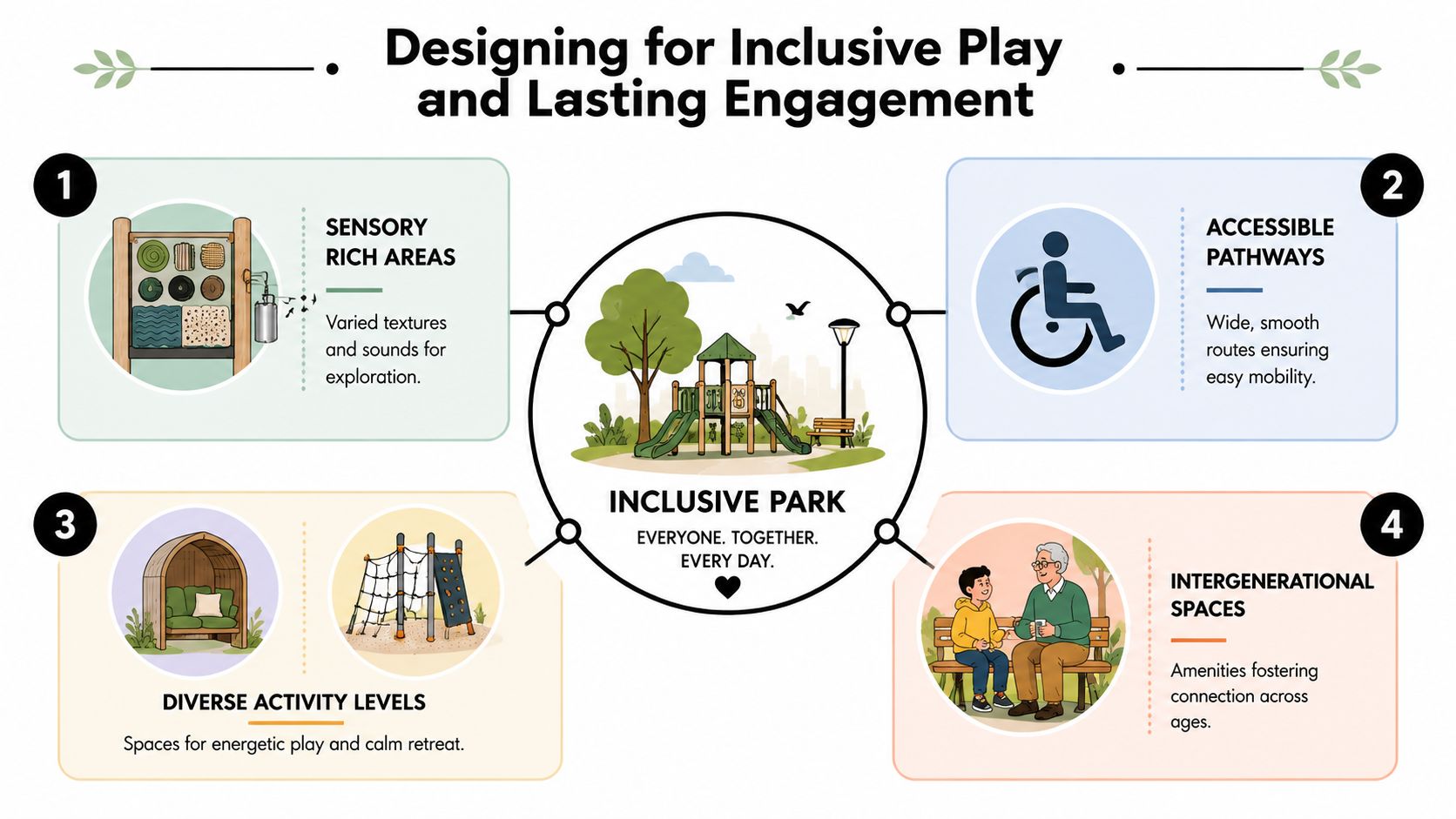
The best-performing family fun park layouts offer multiple forms of engagement within one coherent environment.
Consider these layers:
Arrival and orientation
Make entry intuitive. Families should know where to go, where to pause, and how to understand the site quickly.
High-energy core
This might include climbing, sliding, bouncing, or rotational play. Place it where supervision is strongest and circulation can absorb stopping and starting.
Mid-intensity social play
Think interactive panels, lower platforms, role-play settings, and shared equipment that allows children to join without committing to the most challenging element.
Low-stimulation retreat
Small nooks, shaded seating edges, quiet sensory activities, and refuge spaces support children who need a break without leaving the park entirely.
Intergenerational support spaces
Seating, shade, pram parking, and gathering points are part of the play ecosystem. If carers are uncomfortable, visits shorten.
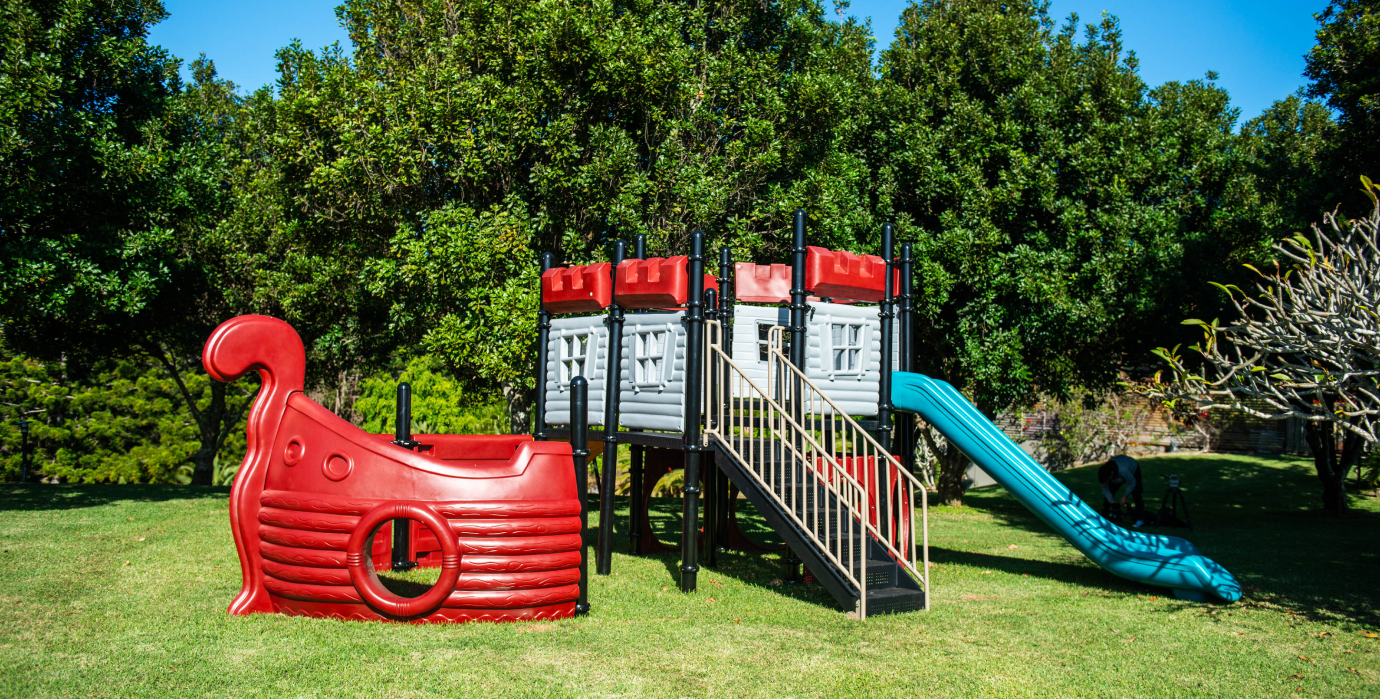
A good theme helps tie those layers together. Coastal towns might suit a pirate or marine concept. Regional settings often respond well to forest, animal, or nature-led themes. The theme should do more than decorate. It should organise the site, guide colour and material choices, and create identity that children remember.
Inclusive design works best when equipment variety is deliberate. One large hero structure can be exciting, but it rarely carries the whole park.
What tends to work:
What often fails:
For temporary programs while a permanent park is staged or upgraded, some councils and schools also use event-based play to test community response. Options like browse our selection of inflatable rentals can help activate a site for short-term events, but they shouldn't substitute for durable, everyday inclusive infrastructure.
A park becomes memorable when different children can use it in different ways at the same time, without anyone feeling pushed to the edge.
If your project team needs a stronger benchmark for what this looks like in practice, review examples of an all abilities play space approach and assess whether your concept supports participation, dignity, and repeat use for a broad community.
Safety work is often treated like a checklist at the end of design. That's too late.
In a well-run family fun park project, compliance decisions shape the design from the beginning. They affect equipment spacing, circulation, surfacing, material selection, drainage, supervision, and maintenance access. If those decisions are delayed, the project usually pays twice. Once in redesign, and again in long-term operational issues.
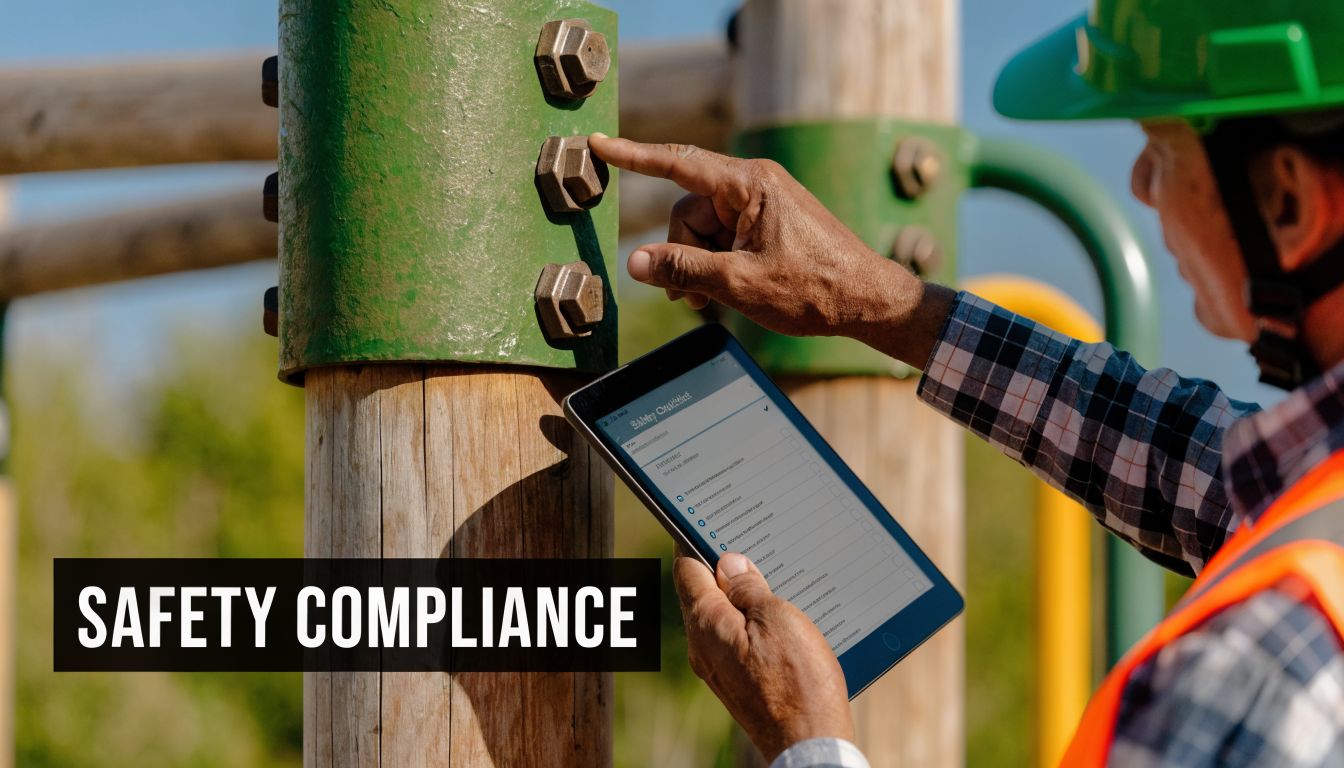
Standards such as AS 4685 matter because they translate into practical questions on site.
Ask these early:
Fall zones Is there enough clear space around moving or raised elements, and does the proposed surfacing suit the equipment type and intensity of use?
Entrapment and head clearance
Are openings, barriers, and transitions safe across age groups and user behaviours?
Material safety
Are finishes suitable for heavy public use, low-toxicity expectations, and local climate conditions?
Access for inspection and repair
Can staff reach fixings, joints, and hidden areas without dismantling half the structure?
Expert review matters in this context. A design can be technically compliant and still create avoidable risk if supervision is poor, sightlines are blocked, or energetic play routes cross toddler movement paths.
In Australian conditions, durability isn't separate from safety. It's part of it.
After the 2025 floods, 40% of NSW council playgrounds required repairs, and specifying UV-stabilised, fire-retardant materials that meet AS 2311 guidelines can cut lifecycle costs by 25% over 10 years by reducing weather-related repairs and closures according to climate-resilient playground equipment guidance.
That has direct design implications. Materials that degrade quickly under UV, corrode in wet conditions, or become unreliable after extreme weather create more closures, more hazards, and more reactive spending.
Useful questions to put to suppliers include:
Here's a helpful visual primer on the broader safety mindset involved in public play environments.
Before documentation is finalised, hold a formal safety and operations review. Include the designer, operator, maintenance representative, and whoever manages public risk.
Use the review to test:
| Review area | Key question |
|---|---|
| Supervision | Can carers and staff see the main activity zones clearly? |
| Separation | Are toddler, social, and high-energy spaces appropriately zoned? |
| Surface performance | Will the chosen surface remain safe under expected weather and wear? |
| Repairability | Can damaged parts be isolated and fixed without closing the whole site? |
A compliant park that closes frequently, overheats, floods, or wears unevenly isn't performing safely in practice. Long-term safety comes from combining standards, climate logic, and maintenance practicality into the same set of decisions.
Budget trouble usually starts when teams price the visible parts and ignore the enabling works.
People remember slides, towers, shade, and colour. They forget drainage upgrades, approvals, service relocation, access works, fencing, soft landscaping, seating, signage, consultant input, and contingency for site conditions. Then the tenders arrive, and the project either gets cut back badly or delayed while everyone reworks scope.
A sound family fun park budget is built from components, not assumptions.
Start by allocating the total budget across broad categories. The exact balance will vary by site, but this format helps stakeholders understand that the equipment package is only one part of the spend.
| Cost Category | Percentage of Total Budget | Key Considerations |
|---|---|---|
| Site preparation and civil works | 15% to 25% | Earthworks, drainage, retaining, access, service adjustments |
| Play equipment and structures | 30% to 40% | Main play elements, themed items, inclusive features, shade structures |
| Surfacing and fall zone treatment | 10% to 20% | Wet pour, synthetic turf interfaces, edging, drainage compatibility |
| Landscaping and site furniture | 5% to 15% | Planting, irrigation, seating, bins, fencing, shelters |
| Professional fees and approvals | 5% to 10% | Design, engineering, certifications, permits |
| Contingency and project risk | 5% to 10% | Unknown ground conditions, documentation changes, market movement |
This kind of breakdown keeps early conversations honest. It also helps funding bodies see that the budget has been considered as a full delivery plan, not just a shopping list.
Where the family fun park has a commercial or semi-commercial operating model, benchmark the project against practical KPI targets.
Successful Australian operators track Labour Cost per Visit below AUD $1.20, Average Revenue Per Capita of AUD $28 to $42, and EBITDA margins of 65% or higher, while 35% of operators miss payback targets when they fail to account for zoning or HVAC costs in retrofits according to Australian amusement park KPI benchmarks.
Those numbers matter because they force better questions. If staffing will be high because supervision zones are fragmented, the design may be the problem. If revenue assumptions depend on facilities the site can't comfortably support, the concept may be overstretched.
Budget discipline: Don't ask whether the park is affordable to build. Ask whether it's affordable to operate, inspect, repair, and refresh.
Phasing can be smart if it's planned from the start. It shouldn't feel like a stripped-back version of the “real” project.
A workable approach is:
Stage one builds the core experience
Deliver identity, inclusion, circulation, shade, and enough play value that the park feels complete on opening.
Stage two expands capacity or dwell time
Add secondary play, social spaces, greenery maturation, or ancillary offers once use patterns are proven.
Later stages sharpen the site
This might include event infrastructure, fitness add-ons, or additional seating and shelters.
If you're seeking grants or mixed funding, practical guidance on securing playground funding and grants can help shape a stronger business case and a more defensible staging strategy.
Phasing works best when underground services, circulation logic, and future interfaces are planned before stage one starts. Otherwise, later upgrades disrupt a park that had already begun building community trust.
Opening day isn't the finish line. It's the start of an asset management job.
The family fun park that still performs after years of use usually wasn't just designed well. It was set up to be maintained well. That requires clear responsibilities, documented routines, and material choices that reduce avoidable intervention.
A useful maintenance plan separates tasks by frequency and purpose.
Routine inspections are frequent visual checks. Staff look for obvious damage, litter, trip hazards, vandalism, loose components, drainage issues, and surfacing wear.
Preventative maintenance is scheduled technical work. This includes tightening fixings, checking moving parts, cleaning high-touch areas, monitoring coatings, and managing vegetation encroachment.
Corrective maintenance deals with faults found during inspection or reported by users. The key is response discipline. Small defects become closures when they're left too long.
A simple maintenance log should record:
Material selection in design has a direct effect on the maintenance budget.
Hot-dip galvanised steel, strong coatings, UV-stable components, durable fixings, and repairable modular parts generally make life easier for operators. So do layouts that leave room to inspect edges, clean under structures, and isolate damaged areas without shutting down the whole site.
Design choices that often create trouble later include hidden drainage points, tightly packed equipment clusters, difficult-to-reach connections, and decorative finishes that don't cope with hard public use.
Many maintenance problems aren't technical. They're organisational.
Before handover, confirm:
| Maintenance question | Who should answer it |
|---|---|
| Who performs daily or weekly checks? | Site operator or facilities team |
| Who authorises urgent repairs? | Asset owner or delegated manager |
| Where are manuals and inspection records stored? | Operations lead |
| How are faults reported by the public or staff? | Customer service or site management |
A durable park isn't the one that never needs work. It's the one designed so ordinary work stays ordinary.
If those answers are unclear, the asset will drift. Minor issues will sit unresolved, reporting lines will blur, and community confidence will drop faster than is commonly expected.
A family fun park only becomes valuable when people make it part of their routines.
That means the launch matters, but ongoing activation matters more. A ribbon cutting creates awareness. Repeated, positive use creates ownership.
If the park was designed for broad community use, the opening should show that. Include families, local groups, school representatives, accessibility advocates, and maintenance or operations staff who'll be looking after the space. Keep the event easy to get around, clearly supervised, and welcoming for people who don't usually attend civic launches.
Good activation doesn't have to be complicated. It just needs to be consistent.
A busy park isn't automatically a successful one. Look for signs that the space is working socially and operationally.
Are families staying comfortably? Are different age groups using the site together? Are quiet areas being used? Are there recurring supervision blind spots or wear points? Does the park feel looked after?
Those are the indicators that the project has moved beyond infrastructure and become a community asset.
If you're planning a new family fun park or upgrading an existing site, Kidzspace can help you turn early ideas into a practical, durable, and inclusive project. Their team works with schools, councils, and community organisations on playground design, equipment selection, and project support that stands up to real-world use across Australian conditions.



Copyright © Kidzspace. All Rights Reserved.
Copyright © Kidzspace. All Rights Reserved.