


A lot of committees reach the same point in a project at the same time. The play equipment is chosen. The layout works. The budget is close. Then someone asks a simple question that turns out not to be simple at all: what are we putting on the ground in the wet areas?
That question matters more than many teams expect. In public play spaces, the surface underfoot affects supervision, accessibility, maintenance workload, compliance, and the confidence families feel when they use the site after rain. If the hardscape is wrong, the playground can look excellent on handover day and still create daily problems for years.
For councils and schools in Australia, non slip flooring tiles aren't a decorative choice. They're part of the risk control strategy for a site that has children running, carers pushing prams, staff crossing quickly, and cleaners working in wet conditions. The right tile can support safe use through changing weather. The wrong one can leave you with slick entries, avoidable incidents, and procurement headaches when someone later discovers the product data never matched Australian requirements.
On a wet school morning, the first problem usually shows up before anyone mentions compliance. Children cut across the shortest path. Parents bunch at the gate with prams. Staff move quickly between amenities and supervision points. If the tiled surface at those pinch points loses grip, the risk is immediate.
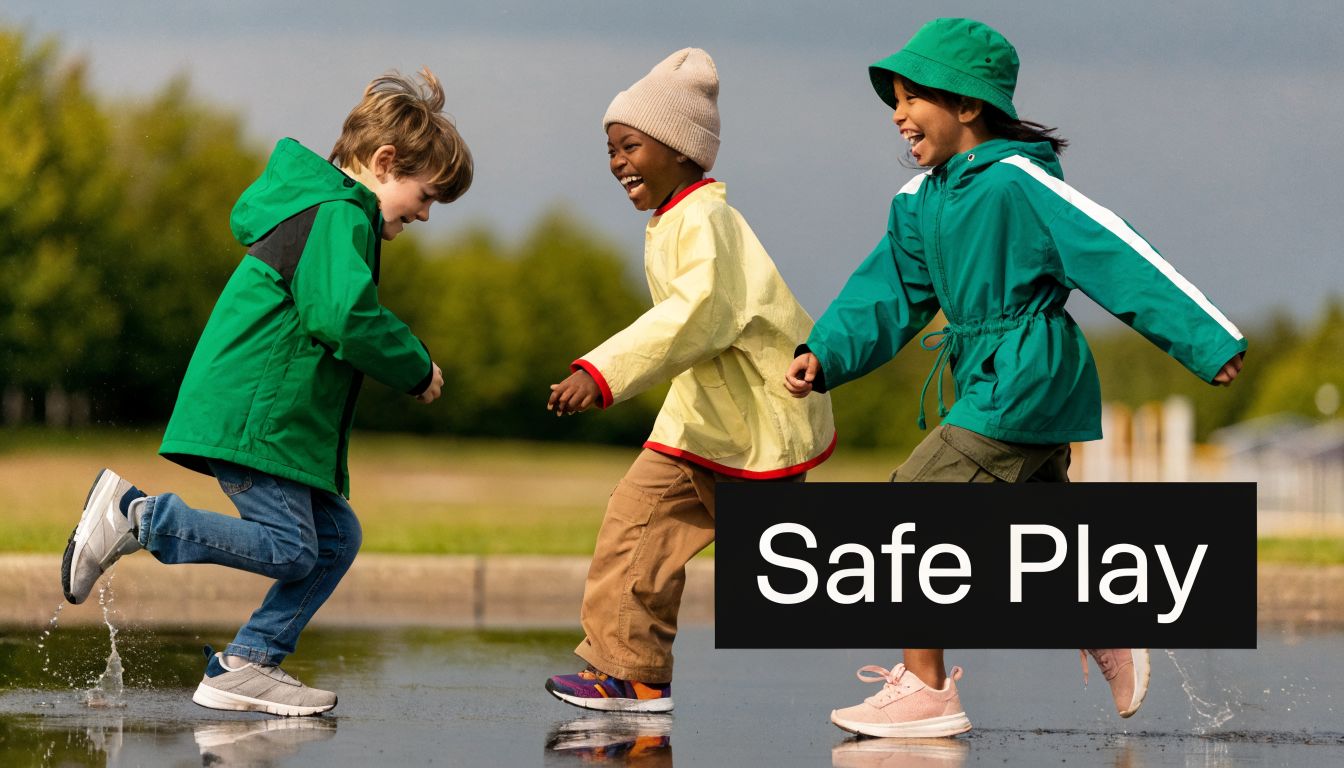
In public play settings, a slip incident rarely stays small. It can mean an injured child, a shaken teacher or parent, a maintenance response, and questions about whether the site was specified properly in the first place. The Australian Institute of Health and Welfare reports that falls made up 36.2% of injury hospitalisations in 2020-21, making them a major public safety issue across the country, as outlined in the AIHW overview of falls and injury hospitalisations. For councils and schools, that matters because wet hardscape around play spaces is one of the few risks that can be reduced early through better product selection and clearer procurement documents.
This is not only about avoiding accidents. It is also about keeping the space usable after rain, during cleaning, and through seasonal wear.
I see the same procurement mistake regularly. Committees scrutinise the play equipment schedule, then treat tiles and paved transitions as a finishes package to sort out later. In a public playground, that approach creates avoidable risk. Surface materials affect circulation, cleaning, accessibility, supervision routes, and whether the site still feels safe in real weather conditions.
For Australian councils and schools, non slip flooring tiles need to be assessed as part of the site safety system, alongside school playground safety standards and compliance requirements. That means asking practical questions early. Will the tile hold grip with water, sand, and leaf litter on it. Will the finish cope with UV exposure without polishing smooth. Can the supplier provide test results that suit the intended location, rather than generic brochure claims.
A sound tile specification should do four jobs well:
Public confidence starts underfoot. If carers, teachers, and students hesitate on a wet surface, the design has already lost part of its safety value.
No outdoor surface stays clean and dry. The standard for selection is different. The surface needs to perform after rain, under shade, near water play, and through years of use by children who run, pivot, and change direction without warning. That is why non slip tiles belong in the core specification, not at the end of it.
“Non-slip” isn't a specification. It’s a marketing phrase. If you're reviewing tile submissions for a school or council project, you need test data that maps to Australian use conditions, especially for outdoor and wet areas.
The two ratings most committees encounter are the Pendulum Test Value, often shortened to PTV, and the R-rating from the ramp test. Both matter, but they don't tell you the same thing.
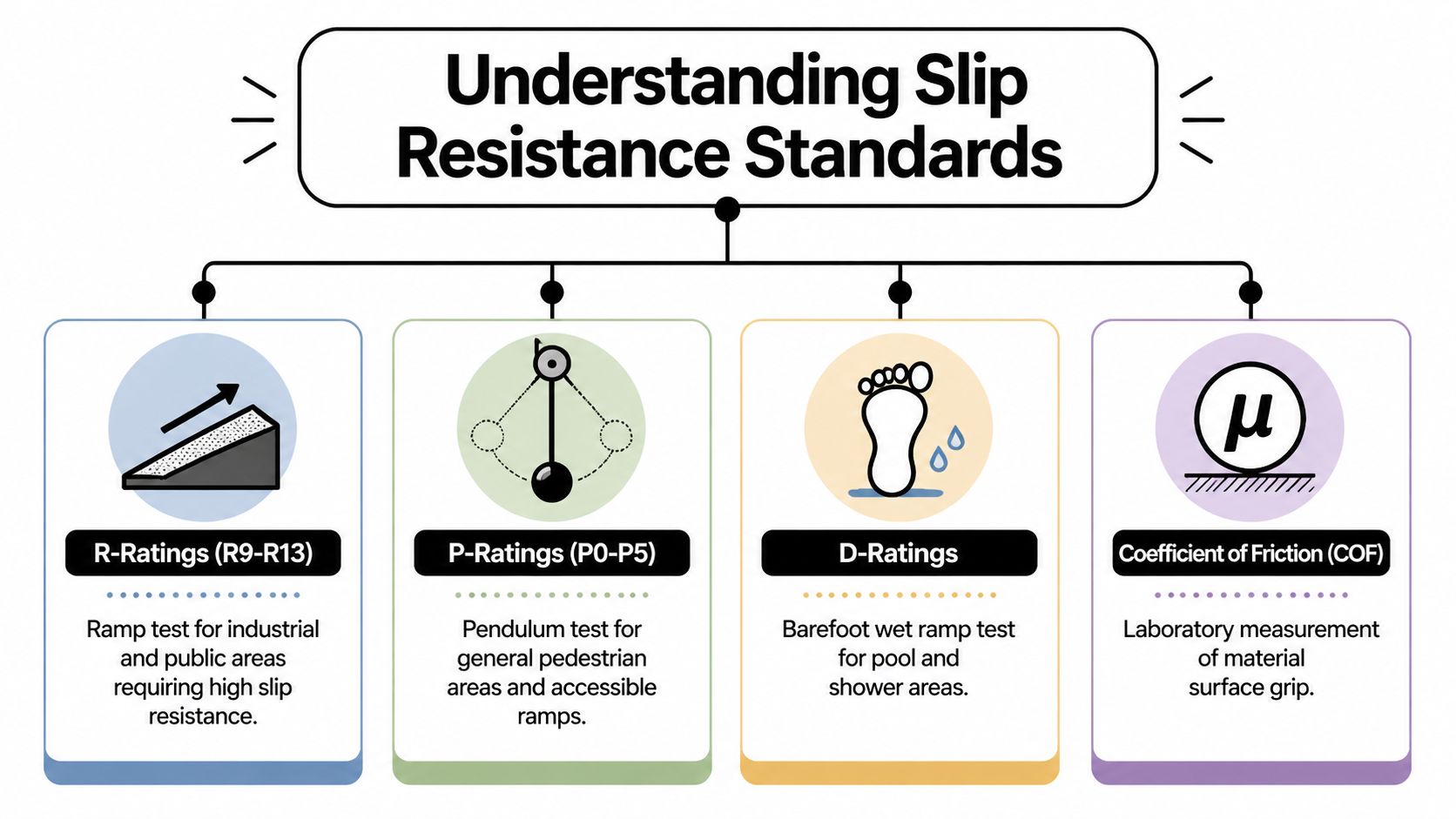
For high-risk playground and public outdoor areas in Australia, the most useful benchmark is the wet pendulum result. Verified guidance states that slip-resistant flooring tiles for these settings should achieve a PTV of 40+ using Slider 96 (4S rubber) for wet conditions, which indicates low slip potential and aligns with AS 4586:2013, where PTV 39+ corresponds to Class V for external wet or barefoot areas, as set out in the Johnson Tiles HSE slip resistance guidelines. The same verified source notes that tiles meeting this level can reduce fall rates by up to 50% in wet conditions.
That’s the threshold many committees should anchor to when they’re dealing with splash pads, wet decks, entries to amenities, or external paved areas where children are moving quickly.
The pendulum test is the number I look for first in wet outdoor public work. It gives a direct indicator of slip potential under a wet test condition and is easier to relate to real use than broad marketing labels.
A practical way to read it is:
For barefoot or wet external zones, this matters because children don't move with the caution adults use in commercial foyers. They run, pivot, and change direction suddenly. The tile has to cope with that behaviour.
The R-rating comes from an oil-wet ramp test. It’s useful, especially when comparing textured tile surfaces, but it should not be the only thing you rely on for Australian outdoor public play spaces.
In practice, I treat R-ratings as a supporting indicator of surface texture and grip potential:
That distinction catches a lot of teams out. Some suppliers provide European or US-style performance language, but they never map it properly to the Australian classification your project needs.
Practical rule: If the technical sheet doesn't clearly show wet pendulum results relevant to Australian standards, don't assume the product is suitable just because the brochure says “anti-slip”.
A supplier gives you a technical data sheet with a clear R-rating, basic material description, and evidence the product is designed for external use.
That’s a start, but not enough for a public playground tender.
The supplier provides the wet pendulum result, states the test conditions, and identifies whether the tile is appropriate for external wet or barefoot areas under Australian practice.
That lets you compare products on a meaningful basis.
The submission includes wet pendulum classification, supporting ramp data, wear performance, and a clear statement that the nominated tile is suitable for the exact zone you're building, such as splash pad perimeter, amenities approach, or external circulation route. It also lines up with broader school playground safety standards rather than treating flooring as a standalone item.
When I review tile packs for public work, these are the common problems:
The safest procurement habit is simple. Read the test sheet, not the brochure headline.
A council signs off a product that looks fine in the sample box. Six months after opening, the shaded route beside the drink fountain stays damp, leaf litter sits in the surface profile, and the maintenance team is pressure washing the area more often than planned. That is usually not a tile failure alone. It is a material selection failure.
For public play spaces, material choice has to match the exact duty of each zone. In Australian projects, I assess three things together. AS 4586 slip resistance for the intended use, durability in UV and wet weather, and how easily the surface can be maintained by a school or council works crew over years, not just at handover.
The main options in play projects are usually soft-fall rubber tiles or wet-pour, textured porcelain or ceramic tiles, and wood-plastic composite decking tiles. All three have a place. They do different jobs, and trouble starts when the specification treats them as interchangeable.
Rubber usually belongs where fall attenuation drives the decision. Textured porcelain or ceramic is often the better hard surface for entries, circulation routes, shelter areas, amenities approaches, and wet play perimeters where you need reliable grip, wash-down practicality, and a firm accessible finish. Composite decking can suit picnic decks, decorative paths, or short transition areas, but I treat it cautiously in damp, shaded, or debris-prone locations.
Good public play design uses more than one surface type because the risks are different from zone to zone.
| Material | Slip Resistance (Wet) | Durability & Lifespan | Fall Attenuation | Maintenance | Typical Cost |
|---|---|---|---|---|---|
| Textured porcelain or ceramic tiles | Good option if the exact product is tested and specified for Australian external wet use | Usually durable under heavy public traffic when the substrate, joints, and finish are properly detailed | Usually not used as the primary impact-attenuating surface under equipment | Straightforward wash-down, but grout lines, joints, and residue still need routine attention | Often sits in the mid-range for hardscape finishes, with cost varying by tile class, base build-up, and installation detail |
| Wet-pour rubber or rubber tile systems | Often provides good underfoot grip, but performance changes with texture, wear, and contamination | Can fade, mark, and age at different rates depending on formulation and sun exposure | Often selected where impact attenuation is required | Local patching is possible, though colour match and wear variation can remain visible | Usually higher than standard hard tile installations, especially where thickness increases for critical fall height |
| Wood-plastic composite decking tiles | Variable. Needs careful review for wet, shaded, or leaf-prone settings | Can perform well in garden areas or low-intensity seating zones, but is not always suited to high-abuse circulation routes | Not usually selected for fall attenuation under equipment | Grooves and joints can hold debris and moisture, increasing cleaning time | Cost varies widely by board quality, framing, fixing method, and access requirements |
For councils and schools, textured porcelain is often the safest starting point for hard surface zones. It gives a consistent finish across larger sites, stands up well to prams, scooters, sand, and regular cleaning, and is usually simpler to replace in sections if the range remains available.
That does not make every textured tile suitable for a playground.
The specification still needs to confirm the product is intended for external wet conditions and that the finish supplied to site is the finish that was tested. In practice, I also look hard at edge detailing, movement joints, and replacement lead times. A tile that performs well on day one but is difficult to match three years later creates procurement and maintenance problems that should have been resolved before tender.
Rubber earns its place where head injury risk and impact attenuation are part of the design brief. Under and around equipment, that usually matters more than the visual neatness of a hard finish. It can also feel more forgiving for younger children and carers moving through active play zones.
The trade-off is long-term appearance and repair quality. Sun exposure, staining, wear paths, and patch repairs are more visible on many rubber systems than committees expect. I usually specify rubber where it solves a fall protection problem, then keep adjacent circulation routes in a harder wearing surface if that better suits cleaning and whole-of-life cost.
For a broader comparison of hard and soft-fall options, this guide to playground surfacing materials is a useful reference during concept design and tender review.
Composite products are often proposed for their warmer look. In the right setting, that can work well. A boardwalk connection between spaces or a quiet seating edge may suit the material.
Public play sites are rarely tidy, though. Sand, bark, food scraps, and leaf litter build up quickly, especially in schools and parks with mature trees. On profiled composite surfaces, that debris can sit in grooves and keep the surface damp for longer after rain or cleaning. For that reason, composite is rarely my first recommendation for high-traffic wet routes, accessible approaches, or busy play edges.
For wet external circulation, shelter areas, and gathering spaces, start by assessing textured porcelain or ceramic products with clear Australian slip test data and an external-use specification.
For equipment zones, start with impact attenuation and confirm the surface system also provides suitable underfoot grip in service.
For decorative decking or lower-traffic transition areas, review composite only after the team has accepted the cleaning burden, moisture behaviour, and replacement method.
A school can specify an AS 4586-tested tile, install it correctly, and still end up with a slippery play edge after the first heavy rain. I see that problem most often where water has nowhere reliable to go, debris washes across the paving, or a hard surface has been pushed too close to equipment that needs impact attenuation.
That is why this part of the design has to be reviewed as a system, not as a tile schedule. The tile, jointing, screed or slab, finished falls, drainage points, adjoining soft-fall, and maintenance access all affect whether the surface stays safe in service.
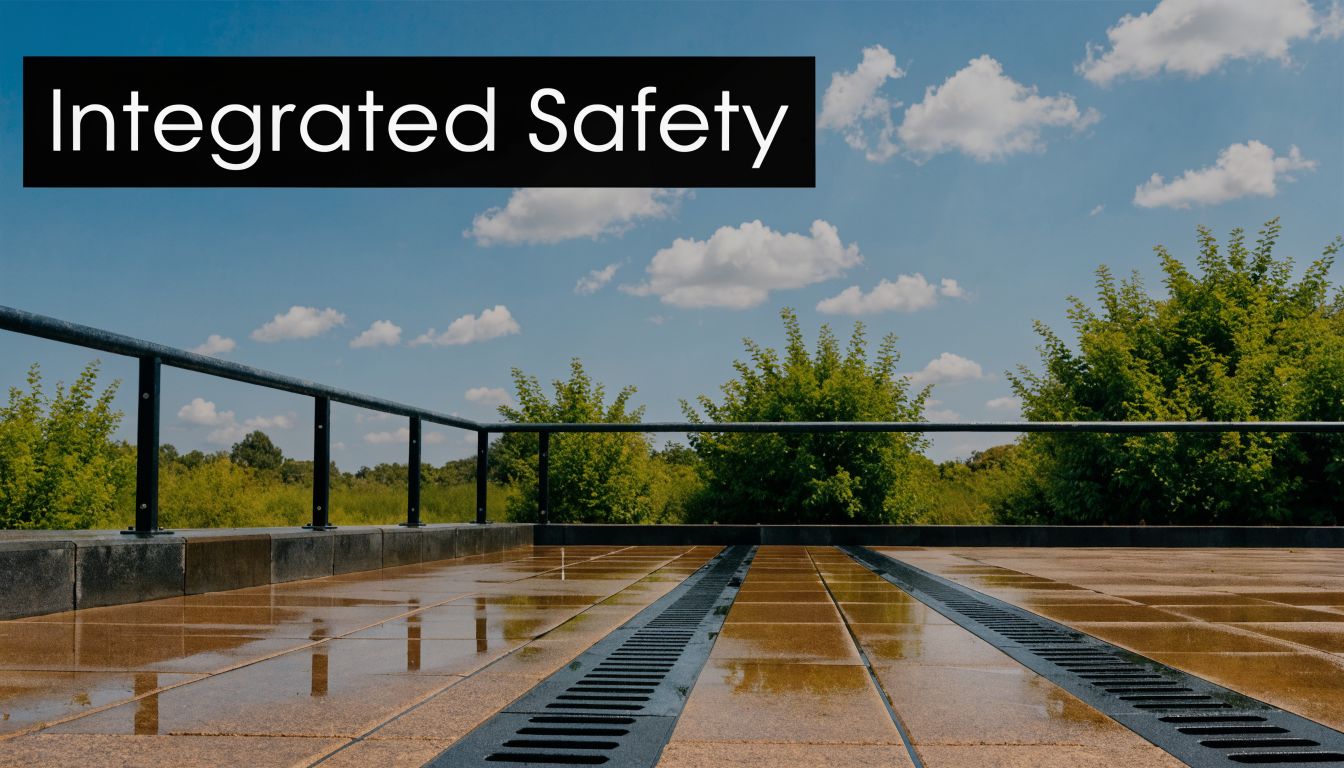
As noted earlier, falls are a major injury risk for children. In practical terms, that means councils and schools should treat slip resistance, drainage, and fall protection as linked decisions during design review and procurement, not as separate consultant items resolved late.
The first check is simple. Water should leave the paved surface quickly, and it should not cross the main walking line to do it.
Problems usually show up in predictable locations:
A tile can test well in controlled conditions and still underperform on site if the area holds residue, fine grit, or organic matter for days at a time. That is the trade-off committees need to understand. The slip rating matters, but the drainage layout often decides how much of that performance is still available six months after handover.
Hard non slip flooring tiles and impact-attenuating surfacing do different jobs. In equipment zones, the starting point is fall height, use pattern, and the required soft-fall response under the relevant playground standards. Grip underfoot still matters, but it does not replace impact performance.
For that reason, the better public projects define the boundary clearly. Use hard, slip-resistant paving for circulation, queuing, passive supervision areas, and shelter zones. Use compliant soft-fall where the equipment and fall zone require it. The transition should be easy to read, flush where accessibility demands it, and detailed so water does not sit at the junction.
If a surface has to deal with both wet conditions and fall risk, specify each function openly and detail the change between them properly.
Falls need to be established in the civil and paving package before finishes are locked in. Trying to solve ponding by changing tile late in the process rarely works. The water path has to be designed into the base build-up.
Sand, mulch, bark, and leaf litter move fast in active public spaces. If those materials are upslope from the paving, include edging, separation, and cleaning access from the start. Otherwise the specified surface is quickly masked by whatever the children carry or the wind blows across it.
The junction between tile and rubber, tile and concrete, or tile and drain grates deserves close review. Small lips, rocking units, and shallow depressions create more incidents than the field of tile itself. They also generate maintenance complaints early, especially on accessible routes.
If staff cannot sweep, inspect, hose, and clear drains without shifting furniture or working around awkward edges, standards drop fast. A simple inspection routine helps. This playground maintenance checklist for schools and councils is the kind of operational tool I like to see tied back to the design intent.
The best-performing sites are usually the ones where site design, civil, play, and maintenance teams resolved these details before tender. That usually produces cleaner drainage paths, clearer zoning between hardscape and soft-fall, and fewer defects at the base of equipment, shelters, and amenities.
Six months after opening, a play space often shows its real quality. The tile has been through summer heat, school traffic, leaf drop, pressure cleaning, and the kind of rushed maintenance every council and school knows well. That is when a surface either keeps doing its job or starts generating incident reports, cleaning complaints, and replacement costs.
For public projects, long-term performance is a procurement issue as much as a maintenance issue. A lower upfront price can disappear fast if the finish loses grip in exposed conditions, stains badly, or needs a cleaning method the onsite team will never follow consistently.
Australian sites are hard on external finishes. Open playgrounds, pool-adjacent areas, forecourts, and school entries all face strong UV, heat build-up, and repeated wet-dry cycles. A tile that performs well in a shaded display or indoor setting can age very differently in a public play environment.
Committees should ask a direct question at tender stage. Will this exact tile finish retain safe wet slip performance after years of sun and weather exposure, not just colour stability? Those are separate issues, and suppliers do not always present them separately unless the specification requires it.
That distinction matters on exposed sites.
The best-specified tile still fails in service if the upkeep is too fussy. I look for finishes that can be swept, washed, inspected, and spot-cleaned with standard site procedures. If a product only stays compliant when cleaned with special chemicals, special brushes, or unusually frequent labour, the risk sits with the asset owner after handover.
A practical maintenance plan for tiled public play areas usually includes:
Maintenance instructions should be specific. “Clean as required” is not enough for a public asset.
Maintenance check: If the supplier cannot explain how to clean the surface texture without affecting grip, the specification is still incomplete.
Slip retention, cleaning practicality, and replacement continuity drive the long-term result more than brochure language. Councils and schools should test each shortlisted product against the same practical questions:
Those questions usually expose weak options quickly. A tile can look convincing in a sample box and still be a poor fit for a school path, splash zone approach, or council play forecourt.
For day-to-day upkeep after handover, a site-based playground maintenance checklist for schools and councils helps teams pick up contamination, early wear, blocked drainage points, and cleaning gaps before they turn into safety defects.
The best results usually come from a textured external tile with clear Australian slip test evidence, a finish suited to UV exposure, and a cleaning regime the onsite team can consistently follow. The worst results tend to come from either extreme. An aggressive texture that traps grime in every recess becomes expensive to maintain, while a smoother-looking finish may be easier to wash but harder to keep compliant in wet conditions.
Public play spaces need balance. The surface has to stay safe after weather, after use, and after years of ordinary maintenance, not just on practical completion day.
Most procurement problems with non slip flooring tiles start before the tender is issued. The wording is vague, the wrong test data is requested, or the committee assumes “external tile” means “compliant for a wet public play setting”. It doesn’t.
Verified background data notes that many general resources fail to map US or EU ratings to Australian requirements, and that AS 4586-2013's wet PTV threshold of at least 36 is often missed, creating a risk of non-compliant tenders, especially as the same verified dataset references a 15% increase in rainfall events from 2024-2025 in the linked source context at Argelith anti-slip tile flooring. In procurement terms, the lesson is simple. Ask for the right proof at the start.
Terms like “safe”, “anti-slip”, and “suitable for outdoor use” don't protect a committee. They invite inconsistent submissions.
A stronger specification asks for:
This narrows the field to suppliers who can substantiate the product.
Don't procure all hardscape under one line item if the site has different risk conditions.
List zones such as:
Each zone should have its own performance requirement.
Request product-specific technical sheets for the nominated finish and size. If there are multiple finishes in the same range, make sure the tested finish is the one being ordered.
Good submissions usually make this easy. Weak submissions bury the critical data in marketing PDFs.
A lot of product literature is built for overseas markets. If the supplier provides DCOF, DIN ramp, or broad international classifications, ask them to map that information clearly to the Australian standard relevant to your use case.
If they can't, the risk sits with your organisation.
Some products perform adequately on residential patios and still aren't durable enough for school or council sites. Ask whether the finish is suitable for heavy traffic, repetitive cleaning, and contamination from sand and grit.
This is one of the quiet differences between a decorative tile and a public-use tile.
Initial slip resistance matters. Retained performance matters more. Require information on how the surface is expected to perform after exposure, wear, and routine cleaning.
That conversation often reveals whether the “non-slip” characteristic is integral to the tile or dependent on a treatment that may age poorly.
Strong procurement doesn't just ask, “Is it compliant on paper?” It asks, “Will it still perform after real use on our site?”
The tile may be appropriate and the installation still fail. Ask for details on:
A technically good tile can become a maintenance headache if replacement requires lifting half the area.
Committees often approve a loose sample that doesn't match the final installed batch. Tie sample approval to a product code, finish, and supplier declaration.
If there are colour or texture variations, make sure they are acceptable before ordering.
Public sites take damage. Vandalism, service trenching, settlement, and isolated breakage all happen eventually. A product with no reliable replacement pathway creates visual patching or full-area replacement pressure later.
For schools especially, holiday shutdowns and staged works make replacement timing a real issue.
Tile procurement should include installation competence, not just material supply. External public work needs teams who understand drainage, level transitions, and the difference between decorative paving and safety-critical circulation surfaces.
The cheapest install quote often becomes expensive if ponding, lipping, or drummy tiles appear after the first wet season.
The procurement process shouldn't end at practical completion. Build in final inspection steps that confirm the installed product and finish match the approved submission and that the site drains as designed.
Useful closeout checks include:
Some of the most useful questions are plain and direct:
Suppliers who know their product well can answer these clearly. Evasive answers usually signal future problems.
A defensible procurement decision isn't the cheapest quote or the most attractive sample. It's the option that gives the committee clear evidence of suitability for the exact site conditions, a realistic installation method, and a manageable maintenance path.
That protects users first. It also protects the organisation when decisions are reviewed later, which they often are after an incident, a complaint, or an audit of capital works outcomes.
The best public play spaces don't treat flooring as a finishing touch. They treat it as part of the safety system. That's the mindset that leads to better outcomes for children, better long-term value for public budgets, and fewer unpleasant surprises after handover.
For Australian councils and schools, specifying non slip flooring tiles properly means doing three things well. First, match the product to Australian slip resistance requirements rather than relying on generic claims. Second, choose materials based on how the site will be used, cleaned, and exposed to weather. Third, resolve the whole surface system, including drainage, transitions, and the boundary between hardscape and impact-attenuating areas.
A tile can be compliant in a test report and still fail on site if water ponds, debris builds up, or the finish degrades in sun. The reverse is also true. A well-chosen and well-installed tile can do its job for years, supporting safer movement, better accessibility, and easier maintenance without drawing attention to itself.
That’s usually the mark of a successful specification. The community notices the play experience, not the flooring problem that never happened.
If you're planning a new play space or upgrading an existing one, Kidzspace can help you align surfacing, play design, safety, and long-term maintenance from the start. Their team works with schools, councils, and community organisations to shape practical playground solutions that stand up to Australian conditions and day-to-day public use.


Copyright © Kidzspace. All Rights Reserved.
Copyright © Kidzspace. All Rights Reserved.