

At its core, play-based learning is an educational philosophy that sees play not as a break from learning, but as the very work of childhood. It’s an approach where children learn through exploration and discovery in a carefully prepared environment, with play acting as the main way they make sense of the world.
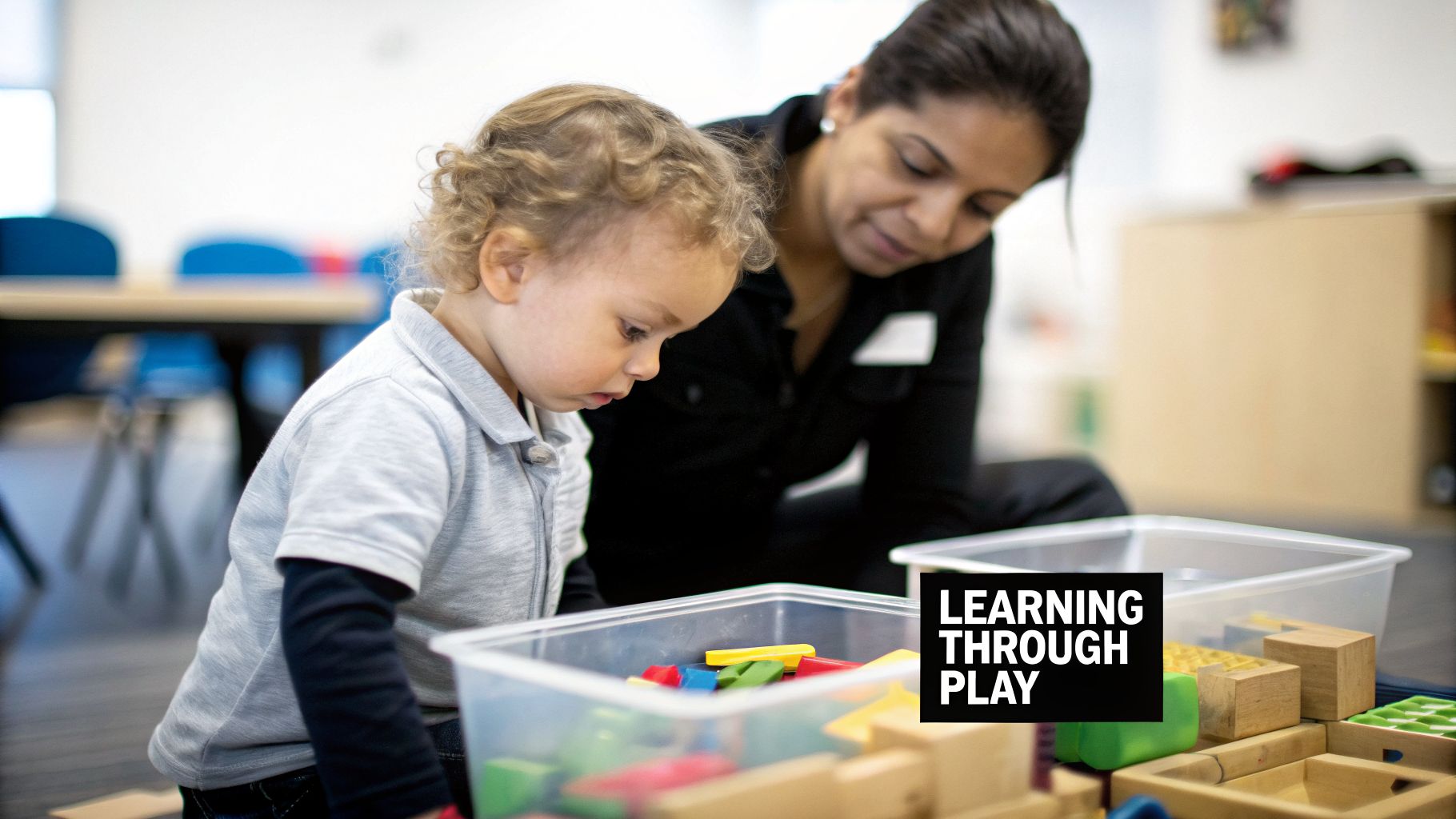
It’s easy to confuse play-based learning with just letting children run wild, but the real difference comes down to one word: intentionality. While unstructured free play has its own benefits, this is a thoughtful, structured approach where educators are active facilitators, not just passive supervisors.
Think of it like a chef in a kitchen. They don't just memorise recipes from a book; they experiment with high-quality ingredients to understand how flavours and textures work together. In the same way, children in a play-based setting are given the 'ingredients' for learning—engaging materials, stimulating spaces, and open-ended challenges—and are encouraged to create their own understanding.
To better understand this distinction, let's compare the two philosophies side-by-side.
| Aspect | Play-Based Learning | Traditional Instruction |
|---|---|---|
| Core Philosophy | Learning is a dynamic, integrated process driven by the child's curiosity. | Learning is a structured process of transmitting knowledge from teacher to student. |
| Child's Role | Active explorer and co-creator of knowledge. | Passive recipient of information. |
| Educator's Role | Facilitator, co-discoverer, and guide who scaffolds learning. | Instructor and primary source of knowledge. |
| Learning Outcomes | Focus on holistic development: social, emotional, cognitive, and physical skills. | Focus on academic benchmarks and content mastery. |
This table highlights the fundamental shift in mindset—from filling an empty vessel to nurturing a growing mind.
In a play-based model, the educator’s role changes from a "sage on the stage" to a "guide on the side." They observe, listen, and carefully interact by posing questions that spark deeper thinking.
For instance, if a child is building a tower that keeps toppling over, the educator might come alongside and wonder aloud, "I wonder what would happen if we used the wider blocks at the bottom?" This subtle prompt encourages the child to think critically and find a solution themselves, building genuine confidence and problem-solving skills.
Play-based learning is not a chaotic free-for-all. It is a highly organised and intentional environment where the 'play' is the work of the child, and the 'work' is the foundation for all future learning.
This approach acknowledges that children learn best when they are truly engaged and their own interests are steering the activity. It turns the classroom or playground into a vibrant laboratory for development.
Ultimately, play-based learning takes a child's natural instinct to explore and channels it into a powerful force for holistic growth. It is much more than just having fun; it’s a research-backed method that lays the groundwork for essential life skills.
Through purposeful play, children develop:
By making learning a joyful and meaningful experience, this method builds a positive and resilient foundation for a child's entire educational journey.
To really get to the heart of play-based learning, we need to see it for what it is: a thoughtful educational approach, not just supervised playtime. It’s built on a handful of powerful, interconnected ideas that turn a simple play area into a rich environment where children’s development flourishes naturally.
The whole approach hinges on child agency. Put simply, this is about letting children take the lead. It’s their ability to make choices, follow their instincts, and direct their own play. Imagine a child with a pile of large, modular blocks. They might decide to build a spaceship, a castle, or a den—the shape, size, and story are all theirs. They are the author of their own learning journey.
This sense of ownership is an incredible motivator. When kids follow their own curiosity, they are far more engaged, focused, and invested in what they're doing. And that's where the real magic happens.
While children are in the driver's seat, the educator’s role is absolutely crucial. They act as a skilled facilitator, not a director. Their job isn’t to give answers, but to spark deeper thinking through guided discovery. This means observing carefully and then asking great, open-ended questions.
Let’s go back to our spaceship builder. An educator practicing guided discovery might come alongside and wonder aloud:
Notice how none of these has a single right answer. They’re invitations for the child to problem-solve, imagine new possibilities, and test out solutions. Suddenly, a simple building game becomes a hands-on lesson in engineering, physics, and creative thinking.
The educator’s role is to be a co-discoverer, scaffolding learning by adding complexity and encouraging deeper inquiry without taking over. It's the art of nurturing curiosity, not just delivering information.
This supportive back-and-forth builds a child’s confidence and resilience. They learn that challenges are just puzzles to be solved and that their ideas have real value—a vital mindset for lifelong learning.
Another cornerstone is learning through exploration. Children are born scientists; they figure out the world by touching it, moving it, and seeing what happens. The best play-based environments are packed with different materials that invite this kind of hands-on discovery. You can dive deeper into this concept in our guide on the importance of sensory play.
Think about what this looks like in practice:
These experiences stick with a child in a way that being told facts from a book never could. The research backs this up convincingly. For instance, data from the Longitudinal Study of Australian Children (LSAC) shows that Australian children who engage in daily play-based activities have 18% stronger early literacy and numeracy skills by age five compared to peers in more formal settings. You can read more evidence on why more play benefits young children from Hechinger Report.
By weaving together child agency, guided discovery, and rich sensory exploration, play-based learning creates an incredibly effective framework for development. It respects how children naturally learn and gives them the creativity, resilience, and collaborative skills they need to thrive in school and in life.
Here is the rewritten section, crafted to sound human-written and natural, following all the specified requirements.
When we move away from rote instruction and towards guided discovery, something powerful happens. This isn't just about finding a "nicer" way to teach; it’s about embracing a method backed by solid science that nurtures the whole child. By understanding what play-based learning truly is, we give children the foundational tools they need for a lifetime of success, both in school and in the world.
These benefits aren't just abstract theories. They are real, tangible results we see on playgrounds and in early learning centres every single day. Let's look at what this growth actually looks like across the three core areas: cognitive, social-emotional, and physical development.
Cognitive development goes far beyond memorising the alphabet or counting to ten. It’s about wiring the brain for thinking, reasoning, and figuring things out. Play is the most natural and effective way to build these connections.
Think about a child tackling a climbing structure. This isn't just fun and games; it’s a high-stakes series of spatial calculations. Their brain is firing on all cylinders, processing distance, height, and balance to decide which handhold to grab next and how to shift their weight. It's a real-time lesson in physics and engineering, all driven by their own curiosity.
Play creates endless opportunities for this kind of mental workout:
Research backs up what we see with our own eyes. A landmark 2020 study from the Australian Institute of Family Studies (AIFS) followed 4,500 children aged 4-5 and found a powerful link. Children who had at least 60 minutes of unstructured outdoor play each day showed 22% higher scores in executive function skills, like problem-solving and self-regulation, compared to their peers. You can explore more of these developmental findings on PMC.
A well-designed play space is a child’s first real community. It’s a dynamic social laboratory where they learn the delicate art of getting along with others, forging social and emotional skills not through lectures, but through direct experience.
Imagine a group of children deciding a themed fort is now a pirate ship. This simple act of make-believe is a masterclass in collaboration.
One child might become the captain, another the lookout. This requires negotiation, compromise, and the ability to see the world from someone else’s point of view—all the building blocks of empathy and leadership.
When disagreements inevitably pop up—"Who gets to steer the ship?"—children have a safe, low-stakes chance to practise conflict resolution. A nearby educator can guide them to talk about their feelings and find a fair solution, building an emotional toolkit that will serve them for the rest of their lives.
The physical benefits of play are probably the most obvious, but that doesn't make them any less vital. In an age where sedentary habits are all too common, dynamic outdoor play is non-negotiable for building healthy bodies and minds.
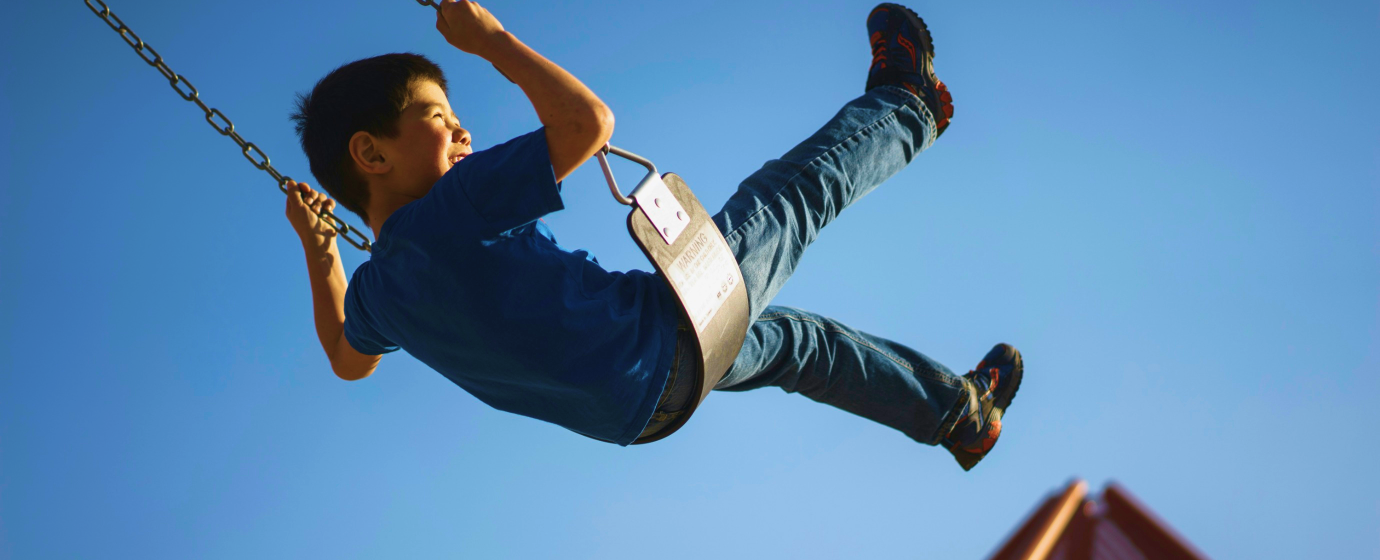
Active play is the heart of physical literacy—the confidence and skill to move in all sorts of different ways. Every time a child runs, jumps, climbs, or swings, they are developing these fundamental movement patterns.
You can see how different activities contribute:
By providing a rich and varied play environment, we’re doing more than just giving children a place to burn off energy. We are actively investing in their long-term health, coordination, and the confidence they have in their own physical abilities.
This is where all the theory behind play-based learning gets exciting—turning an outdoor area into a rich, engaging learning landscape. A great space is so much more than a collection of equipment; it’s an interactive world that pulls children in, encouraging them to explore, work together, and figure things out on their own. We're moving beyond just keeping kids busy and stepping into creating environments that truly support their whole development.
The secret lies in thinking about the space in terms of “play zones” and "versatile equipment." Instead of a one-size-fits-all yard, the best outdoor spaces offer a variety of experiences. This means creating a balance, with zones for loud, energetic play and separate, quiet nooks for calmer moments of focus. By zoning the space with intention, you can cater to different moods, learning styles, and social needs, all at the same time.
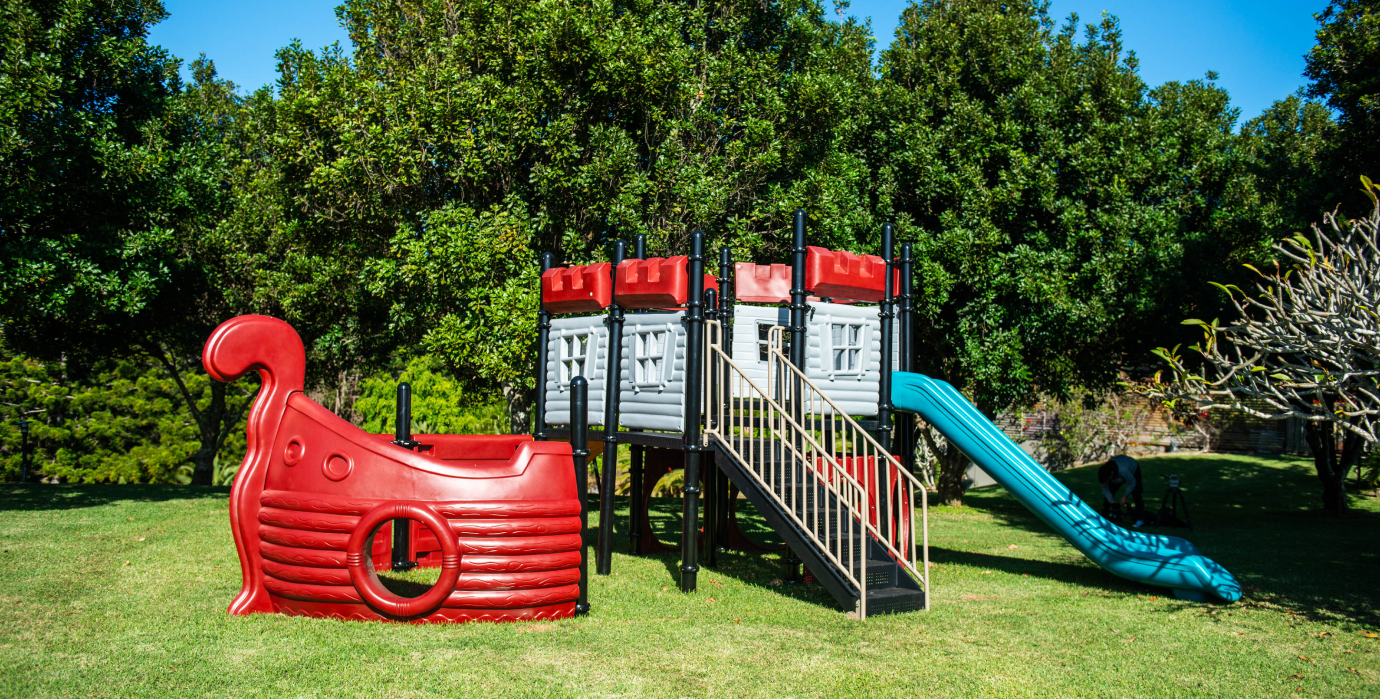
From what I’ve seen, the best play equipment is rarely the most obvious. Forget single-use items with a fixed purpose; the real magic happens with open-ended, multi-purpose pieces that can become anything a child imagines. A simple climbing frame isn’t just a climber—one day it’s a mountain to conquer, the next it’s a pirate ship on the high seas.
This kind of versatility is the heart and soul of play-based learning in early childhood. It gives the creative control back to the children, letting their games and stories evolve naturally.
Look for equipment that sparks these imaginative scenarios:
When you choose adaptable equipment, you’re creating an environment that never gets old. It encourages children to see new possibilities in the same old objects, day after day.
An outdoor space is the perfect laboratory for developing a child’s physical literacy—that blend of confidence, competence, and motivation to move their body in all sorts of ways. The goal is to design challenges that are thrilling but safe, gently pushing children to test their limits and build real confidence in what their bodies can do.
This means offering a whole menu of movement opportunities. A well-designed playground should have places to climb, balance, swing, and slide. This doesn't just build gross motor skills; it sharpens their spatial awareness and risk-assessment abilities, which are crucial cognitive functions. Every time a child figures out how to cross a tricky rope bridge, they learn to trust their body and their own judgement a little more.
This is how physical, cognitive, and social development all feed into one another.
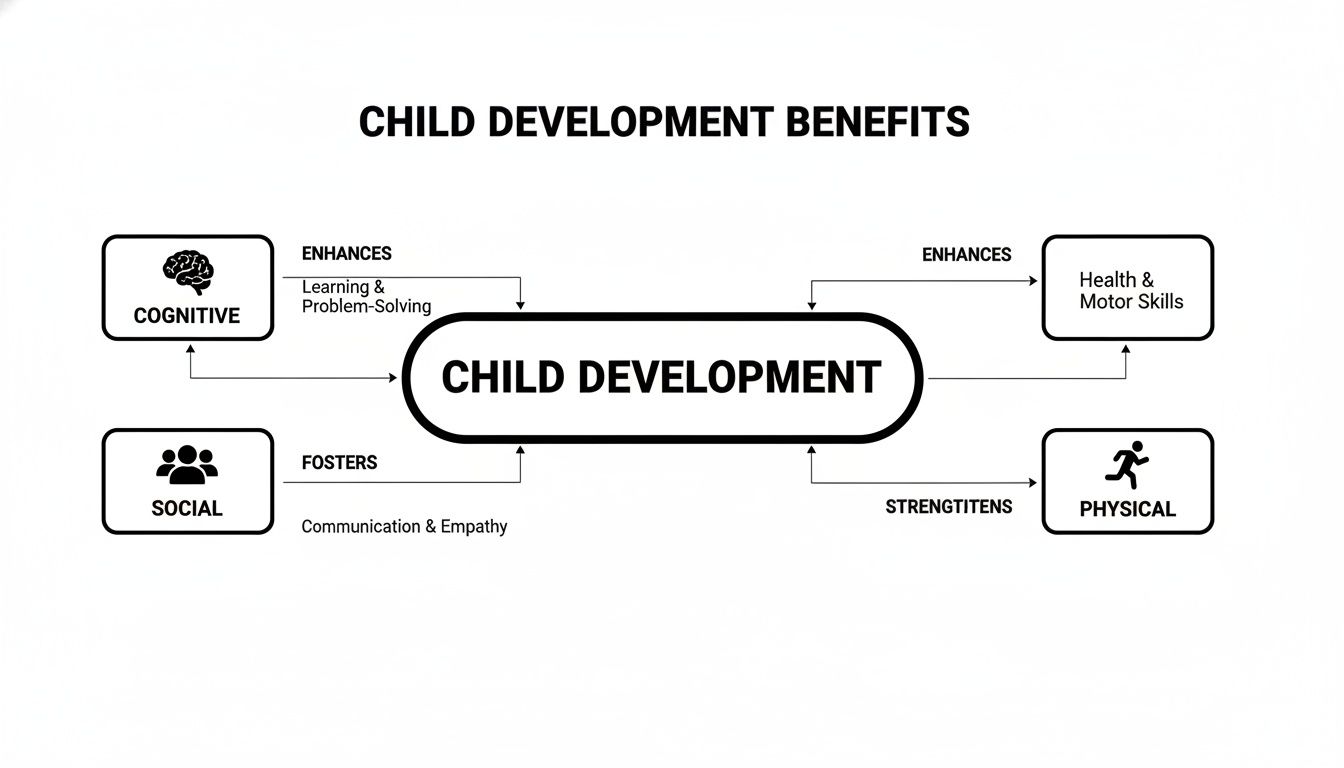
As you can see, these areas are deeply connected. A physical challenge directly fuels growth in other areas.
A thoughtfully designed playground naturally becomes a social hub. By creating specific zones that encourage group play, you give children a space to practise negotiation, empathy, and teamwork. These aren't just playground skills; they're the building blocks for school and for life.
The layout of a play space can either isolate children or bring them together. By intentionally creating shared spaces, we guide them toward cooperation and community.
Think about designing areas that require more than one child to work or that just naturally draw groups together.
Examples of Collaborative Play Zones
For councils, schools, and early learning centres, investing in a well-planned outdoor environment is a direct investment in children’s developmental outcomes. When a space is zoned for different needs and filled with versatile equipment, it stops being just a playground—it becomes a vibrant, outdoor classroom. If you're at the start of this process, exploring the principles of excellent playground design will help you create a space that delivers real, lasting value. By focusing on durability and adaptability, especially for tough Australian conditions, you’ll ensure your play space continues to inspire discovery for years to come.
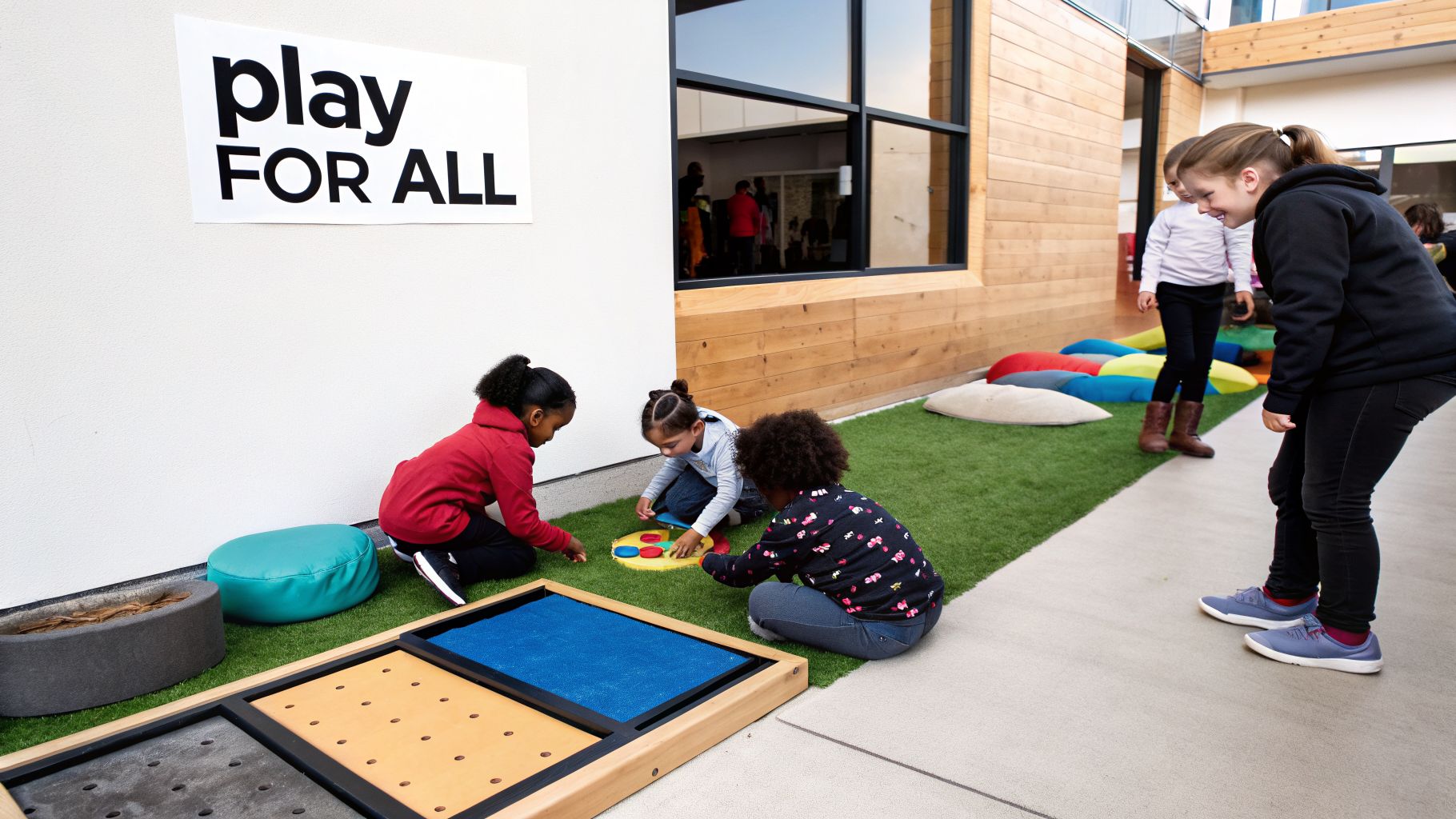
A truly great play space is one where every single child feels they belong. This goes so much further than just adding a ramp for basic access; it's about crafting an environment of genuine, thoughtful inclusion. Designing for inclusivity means we must learn to see the world through the eyes of all children—including those with physical disabilities, sensory processing differences, and a wide range of social and emotional needs.
The real aim is to build a welcoming community where every child feels seen, valued, and empowered to just be a kid and play. It all comes down to intentional design. Simple things, like using high-contrast colours on equipment, can make a world of difference for a child with a visual impairment. Placing a variety of engaging activities at ground level ensures that children with mobility challenges are right in the heart of the action, not watching from the sidelines.
For neurodiverse children, like those on the autism spectrum, the world can often feel like it's turned up to full volume. A loud, chaotic playground can quickly become overwhelming. Thoughtful, inclusive design anticipates this by carefully balancing high-energy zones with designated quiet nooks.
These quieter spaces aren't for isolating a child from play. Instead, they offer a spot to decompress and regulate, so they can rejoin the fun when they feel ready. Think of it as a cosy den or a bench tucked away under a shady tree—a safe harbour in a sea of activity.
Sensory-rich elements are just as vital. We've seen incredible results from incorporating a variety of textures, like smooth steel, rough-hewn timber, and soft sand. This tactile feedback can be incredibly calming for some children and stimulating for others.
An inclusive playground isn't just about providing access; it’s about providing meaningful choice. It acknowledges that children play in different ways and creates opportunities for all of them to thrive.
This approach also considers the social side of play. Some children are drawn to big, cooperative games, while others are more comfortable with parallel play—playing happily alongside their peers without direct interaction. A well-designed space supports both styles, ensuring everyone feels comfortable and confident.
When we get this right, the benefits are profound. Inclusive play spaces become powerful hubs for building social-emotional skills in all children, not just those with disabilities. They act as living, breathing lessons in empathy, cooperation, and what it means to celebrate our differences.
The research backs this up. A 2022 evaluation in the Australian Capital Territory (ACT) involving 1,500 early childhood participants found that play-based learning in inclusive outdoor settings led to a remarkable 27% improvement in social-emotional outcomes. Even more impressively, 89% of children were rated 'on-track' in key developmental areas after the program, a huge leap from just 65% beforehand. You can discover more insights about the power of play from Studies Weekly.
Building an inclusive space means weaving specific features into the very fabric of the design. Each element plays a crucial part in removing barriers and fostering that all-important sense of belonging. You can explore more practical ideas in our guide on what to install in an inclusive playground.
Here are some essential elements we always recommend:
By embracing these principles, we move beyond a simple accessibility checklist. We begin the vital work of creating environments where every child's right to play is not just recognised, but joyfully celebrated.
Bringing a new play space to life is a genuinely exciting journey. It's the process of taking that first spark of an idea and transforming it into a vibrant, well-loved asset for your community. This guide is designed to walk you through the entire project, demystifying the steps for school principals, council planners, and early learning centre directors alike.
We’ll tackle the real-world concerns—budgets, safety compliance, timelines, and getting true long-term value. Understanding what’s involved from the beginning is the key to a smooth process, right from that first chat to the final handover.
At its heart, any great playground project is a partnership. It all kicks off with an initial consultation where we sit down to really listen. We want to understand your specific goals, the community you serve, and what a successful outcome truly looks like for you.
Once we have a clear vision, the creative work can begin. This is where your ideas start becoming a tangible reality as our design team translates them into a detailed, customised plan. We don't just add equipment; we think about how the entire space will support play-based learning in early childhood, ensuring every element has a clear purpose.
This custom design phase carefully considers everything:
A huge part of this stage is making the design work for your budget without ever cutting corners on safety or quality. It’s a collaborative back-and-forth, refining the concept until it perfectly matches your aspirations and practical needs.
Let's be honest: for any organisation, safety is the one area that is completely non-negotiable. An experienced partner is crucial for navigating the complex web of Australian safety standards, especially the key one: AS 4685, which covers all playground equipment and surfacing. This isn't something you should have to figure out on your own.
A successful project isn’t just about creating a fun space; it’s about creating a safe and durable one. Expertise in materials and compliance protects your investment and, most importantly, the children who will enjoy the playground for years to come.
We ensure that every single component, from the structural steel right down to the final protective finish, is engineered to meet or exceed these strict guidelines. Our team helps you select robust, climate-appropriate materials built to withstand heavy use and the harsh Australian sun, guaranteeing the longevity and safety of your playground.
The final steps involve precise manufacturing and professional installation, all coordinated by our project managers to keep things on schedule with minimal disruption. From start to finish, our goal is to deliver a seamless experience that transforms your outdoor area into an engaging, high-value environment where children can learn, grow, and thrive.
It’s completely understandable that as play-based learning becomes more common, parents and educators have questions. After all, it looks quite different from the structured, desk-based learning many of us experienced. How does it actually work, and does it truly prepare children for what comes next?
Let’s clear up some of the most common queries to show how this thoughtful approach builds capable, curious, and resilient young minds.
Not at all. The real difference comes down to intentionality. While free, unstructured play is fantastic and absolutely vital for kids, play-based learning is a deliberate educational approach. Educators don't just step back; they purposefully design the environment and provide materials that are rich with learning potential.
Think of it this way: free play might be an empty paddock, which is great for running around. A play-based learning environment is more like a well-stocked workshop. The child leads the exploration—that's the 'play'—but an expert has carefully chosen the tools and is ready to step in with a thoughtful question or suggestion to deepen the discovery. The learning is always the goal, but the child’s natural curiosity is the engine.
This is a great question. Success isn't measured with A+ grades or standardised tests. Instead, it’s about skilled, ongoing observation. Educators are trained to spot the learning as it happens and document a child's developmental journey over time.
This progress is often mapped against well-regarded developmental milestones, like those in Australia's Early Years Learning Framework (EYLF). In practice, success looks like:
Absolutely. In fact, a quality play-based program is one of the best ways to get children ready for the structure of formal schooling. It goes far beyond memorising letters and numbers, focusing instead on developing the foundational skills that predict long-term academic success.
Research has shown time and again that play-based learning is brilliant for fostering self-regulation, curiosity, problem-solving, and social skills. Children aren't just taught what to think; they learn how to learn. They build a positive attitude toward challenges and discovery.
This means children arrive at school not just with some academic knowledge, but with the confidence and resilience to thrive in any classroom. It builds a strong foundation for their entire educational life.
At Kidzspace, we're passionate about bringing these principles to life. We design and build play environments where learning happens naturally. Our equipment is created to spark imagination, encourage teamwork, and support the growth of every child. Start exploring how we can help you create a world of discovery at https://kidzspace.com.au.



Copyright © Kidzspace. All Rights Reserved.
Copyright © Kidzspace. All Rights Reserved.