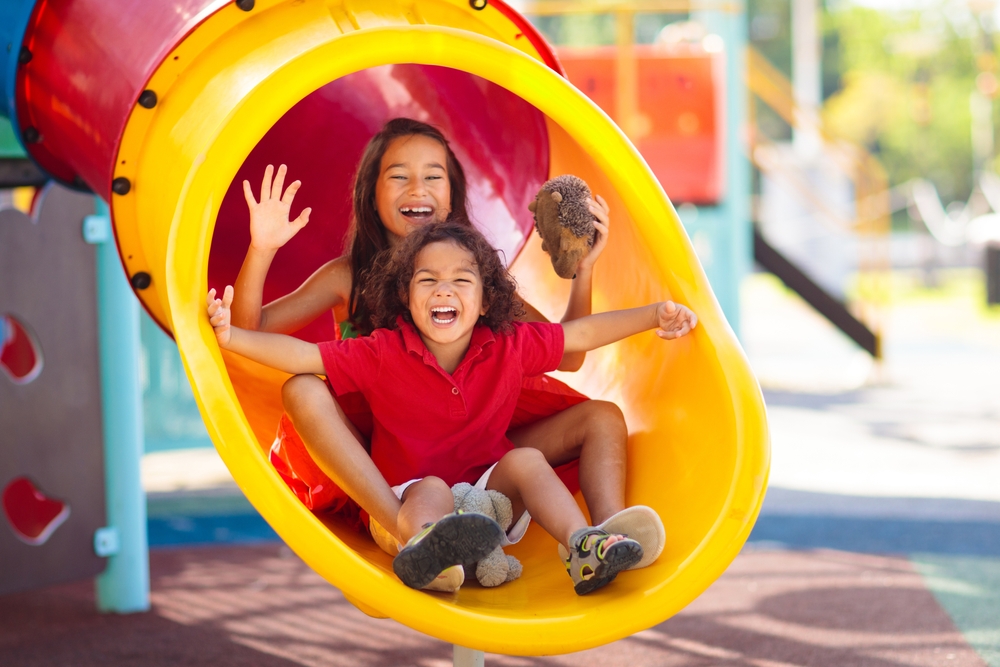
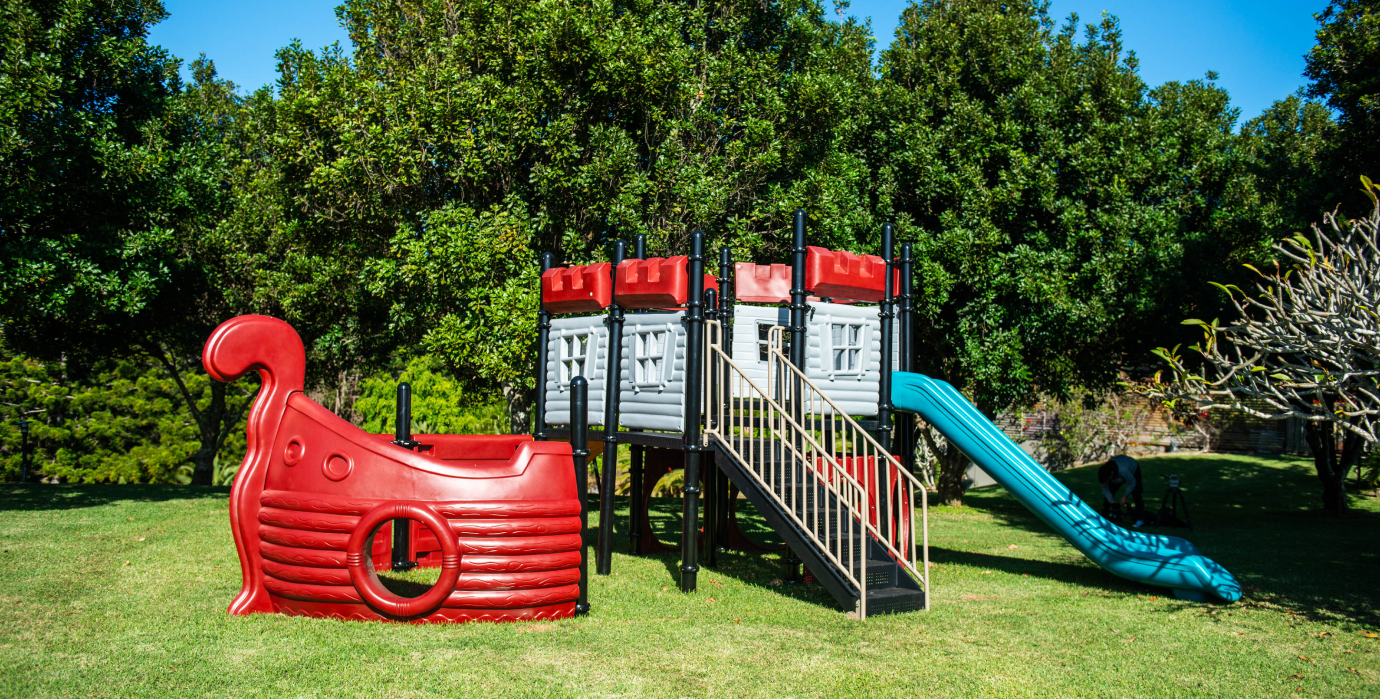





The joy of swinging—that weightless, wind-in-your-hair feeling—is something most of us remember from childhood. But for too many kids with disabilities, it's an experience they can only watch from the sidelines. A disability swing set changes that. It's not just another piece of playground equipment; it's a thoughtfully engineered structure that gives children of all abilities the support they need to swing safely and freely.
Think of it this way: what if your local library put all the best picture books on the top shelf, where only the tallest adults could reach them? That's what a playground without an accessible swing feels like for many families. It’s a space full of fun and laughter that has a built-in barrier to one of its best attractions.
For anyone planning a playground—whether for a school, a council park, or a new community—recognising this gap is the first step. A standard swing seat demands a level of balance, core strength, and motor control that many children simply don't have. Without the right support, the simple act of swinging can be risky, or even impossible.
When a child can't join in, the exclusion isn't just physical. It's social and developmental, too. They miss out on the shared giggles, the "push me higher!" moments, and the easy camaraderie that comes from playing alongside their peers. Play is how children learn and connect, and a disability swing is a vital tool for that work.
This isn't a niche issue. In Australia, more than 350,000 children—that’s around 6.5% of all kids under 15—are living with a disability. Yet, our public spaces often fall short. We constantly hear from families about their frustration with the lack of swings that offer proper back support, something crucial for children with low muscle tone or limited core strength.
Studies consistently show that swings are a favourite for all kids, but accessible options are still disappointingly rare. This highlights a real opportunity for designers and community leaders to make a meaningful difference. You can find more data on this topic in the Association for Children with Disability report.
Installing a disability swing isn't about ticking a compliance box. It’s a deliberate choice to create a community where every single child feels seen, valued, and able to just be a kid.
Picking the right accessible swing isn't about ticking a box. It's about understanding that different kids have different needs. Think of it less like picking from a catalogue and more like a specialist finding the perfect solution to unlock the pure joy of swinging for a child.
A one-size-fits-all approach just doesn't work here. A child who needs full-body support to sit upright has completely different requirements to a wheelchair user with great upper-body strength. Getting this right from the start is what turns a good intention into a truly life-changing piece of play equipment.
Imagine a swing that gives you a secure, reassuring hug. That’s the essence of a high-back supportive swing. These are designed specifically for children who need a lot of help with posture, balance, and core strength—often due to low muscle tone or physical disabilities that make a standard swing seat impossible.
These swings provide total stability. They feature a high backrest for head and neck support, a built-in pommel to stop a child from sliding forward, and usually a full safety harness. This cocoon-like security allows a child to finally relax and experience that simple, rhythmic motion without any fear of falling.
For many children who use wheelchairs, the biggest barrier to play is the transfer from their chair to the equipment. A wheelchair platform swing eliminates that hurdle completely. It’s a brilliant piece of engineering, featuring a flat, non-slip platform with a gentle ramp so a child can simply roll straight on.
Once aboard, locking mechanisms and safety gates hold the wheelchair securely in place. The child can then experience the full, exhilarating feeling of swinging, all while remaining comfortably in their own chair. It’s an incredibly empowering design that champions true independence.
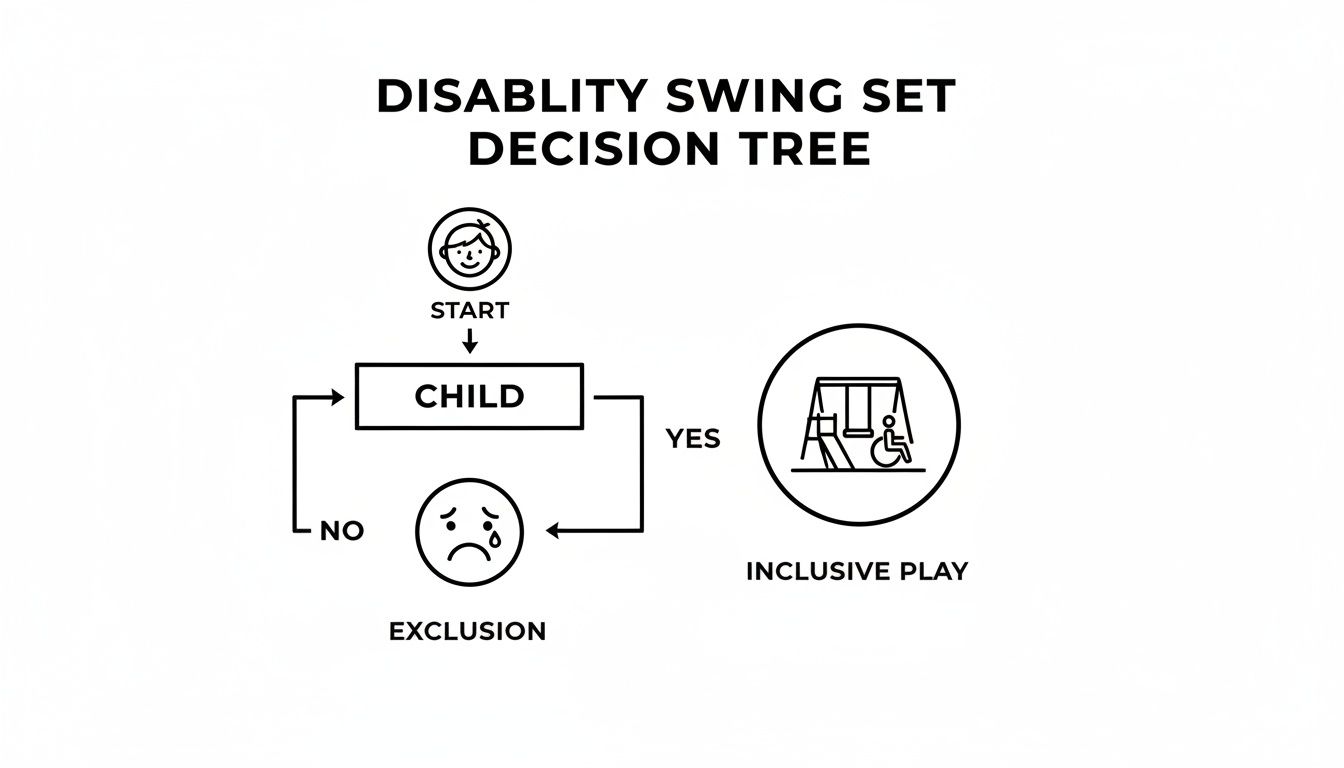
This simple diagram really gets to the heart of the decision you're making—the choice between creating a space for everyone or leaving some children on the sidelines.
If you’re looking for versatility, you can’t go past a basket or 'nest' swing. These large, round swings with a webbed or solid base are the social butterflies of the playground. They are fantastic for children who prefer to lie down while swinging or for those who want to swing alongside a caregiver or a group of friends.
This ability to share the experience is so important for social play and development. What’s more, the gentle, rocking motion provides calming vestibular input, which is particularly beneficial for children with sensory processing disorders like autism, helping them feel regulated and centred.
The goal isn't just to provide a swing; it's to provide the right swing. The most successful inclusive playgrounds offer a variety of options to cater for a wide spectrum of physical, sensory, and social needs.
To help you get a clearer picture, this quick-reference table breaks down the main options. It’s a great starting point for matching a swing to the children you have in mind.
| Swing Type | Primary User | Key Accessibility Feature | Main Play Benefit |
|---|---|---|---|
| High-Back Swing | Children needing full trunk and head support. | Moulded seat, high backrest, and safety harness. | Delivers exceptional postural stability and security. |
| Platform Swing | Children who use wheelchairs. | Roll-on ramp and secure wheelchair locking system. | Allows kids to swing without leaving their chair. |
| Basket/Nest Swing | Multiple users, including those who need to lie down. | Large, flat surface for lying, sitting, or social play. | Offers gentle sensory input and social interaction. |
Each of these designs serves a unique purpose, opening up the world of play in different ways. For a deeper dive into the specifics of frames, surfacing, and more, have a look at our comprehensive guide on how to buy the right swing for your playground.
Getting your head around playground compliance can feel like wading through a swamp of complex codes and technical jargon. But let's be clear: meeting Australian safety standards is about much more than just ticking boxes for an inspector. It’s about building a space that is genuinely safe for every child who uses it, day in and day out.
Think of it like building a house. You follow the building code not just to get a piece of paper, but to know the roof won't cave in and the foundations are solid. It's exactly the same for a disability swing set, where safety and true accessibility are two sides of the same coin.
The main document you'll be working with is AS 4685, the Australian Standard for playground equipment and surfacing. Don't see it as a hurdle; see it as a blueprint for good design that delivers long-term safety and peace of mind. For anyone managing a project like this, from a school principal to a landscape designer, understanding its core ideas is the key to making smart decisions.
You don’t need to become an expert on every clause, but you absolutely must get a handle on the critical requirements. These rules ensure the play space is safe not just in how it’s built, but in how it’s laid out and used—especially for kids with mobility challenges.
Here’s the reality on the ground: while inclusive design is getting more attention, the specific needs for accessible swings are often still an afterthought. Since the AS 4685 playground standards were updated in 2021, we've seen a fantastic push towards more inclusive designs across Australia. Yet, as noted in the Commonwealth's report on inclusive play spaces, families consistently say that while swings are a favourite, truly accessible options like a back-supported disability swing set are frustratingly rare.
When you're in the planning phase, three main areas need your focus.
Adequate Fall Zones: Every swing needs a clear perimeter around it. We call this the impact area or 'fall zone'. It's the designated space where a child might land if they fall. For a disability swing set, this zone is often bigger to account for the swing's motion and provide extra room.
Compliant Surfacing: What's under the swing is just as vital as the swing itself. The surface must absorb impact to cushion a fall from a specific height—a measure known as the 'critical fall height'.
Clear Access and Circulation: A usable swing is one you can actually get to. You have to plan for clear, wide, and unobstructed pathways leading to and around the equipment, so wheelchairs and other mobility aids can get through without a hitch.
So, how do we turn these standards into real-world results? When you're specifying a new disability swing set, your goal is to create a totally integrated and safe environment.
Let's start with the ground. For surfacing the impact area, loose-fill materials like bark or sand are a no-go for accessible routes—they're a nightmare for wheelchairs. The gold standard is a unitary surface, like poured-in-place rubber (what most people call 'soft-fall') or high-quality rubber tiles. These give you a firm, stable, and slip-resistant surface that meets all the fall height rules while allowing for smooth, easy movement.
Next, think about the layout. Australian Standards call for accessible pathways to be at least 1.5 metres wide. This gives enough room for a wheelchair to pass through and turn around easily. You must maintain this clear space around the swing's entry and exit points, ensuring a child can approach, transfer, or roll on and then leave without any hassle.
By prioritising compliant surfacing and generous circulation space from the very beginning, you’re not just meeting a standard. You are designing for dignity and independence. You are making sure every child can experience the simple joy of play without a struggle.
Ultimately, navigating these requirements is about being an informed client. When you understand these core principles, you can have confident conversations with suppliers and make certain the final installation is not only compliant but truly inclusive for everyone. To dig deeper into these topics, take a look at our complete guide covering all school playground safety standards.
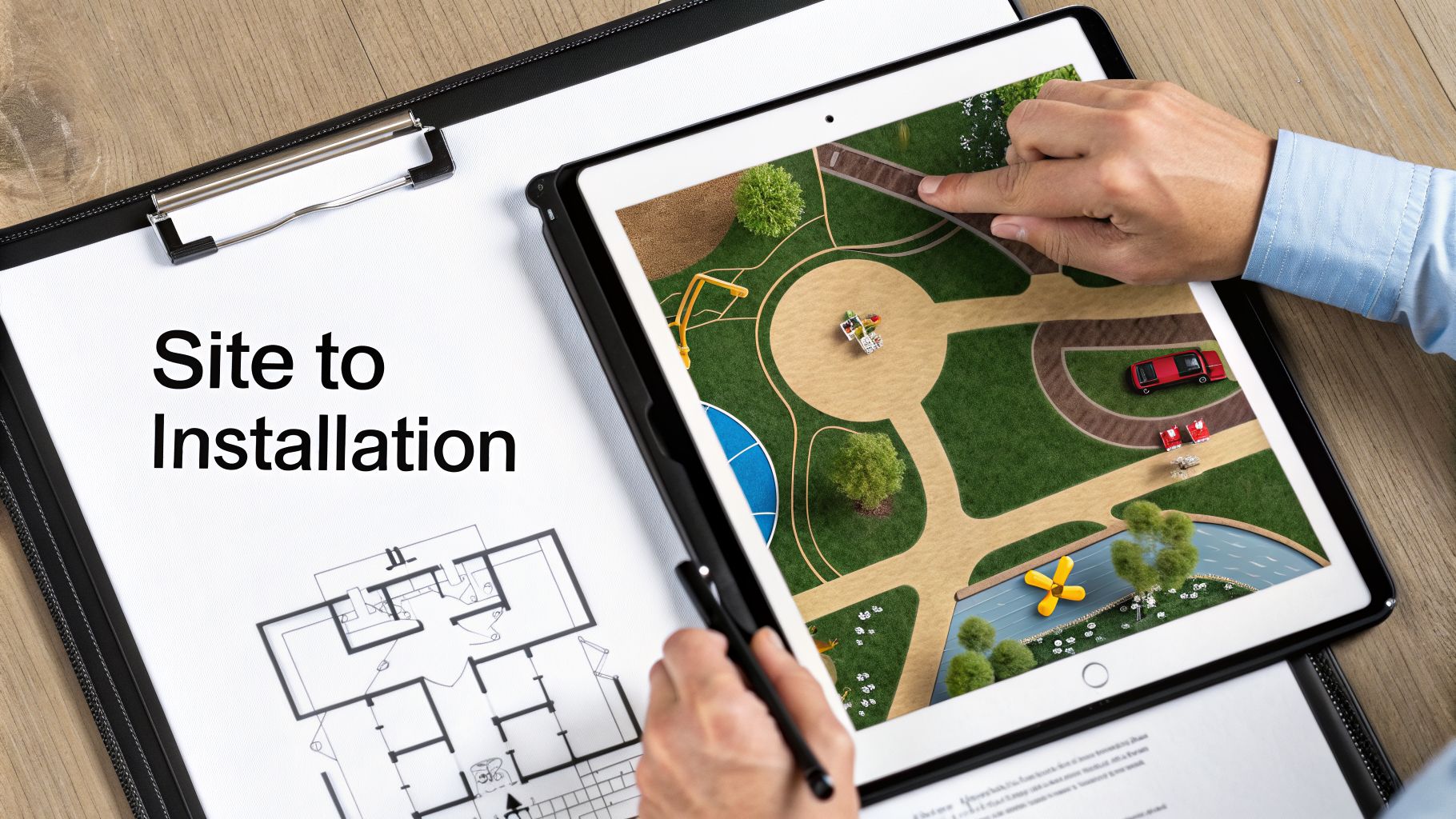
Getting an inclusive swing from an idea on paper to a real, functioning part of your community space is a detailed process. It's one thing to have the vision; it’s another to manage all the practical steps that ensure the final result is truly successful. This is our roadmap for getting it right.
The real work begins long before a single piece of equipment is ordered. It's the strategic planning that distinguishes a genuinely inclusive playspace from one that merely ticks a box. This is about deeply considering how people will arrive, move through, and experience the disability swing set and the entire area around it.
Frankly, where you put an accessible swing is just as crucial as the swing itself. The right spot makes it the heart of the playground; the wrong one can create frustrating new barriers. You need to look at your site not as just an empty space, but through the eyes of a child with mobility challenges or sensory sensitivities.
Here’s what to zero in on:
Once you've picked your spot, it's time to map out the physical layout. The goal here is simple: smooth, barrier-free movement for everyone. A good layout is generous with space, allowing children, parents, and caregivers to navigate the area without feeling cramped or hindered.
Think about the path to and from the swing. A child using a wheelchair needs a clear, wide path not just to get to the swing, but to easily manoeuvre around it. While a 1.5-metre wide path is the minimum standard, trust me, more is always better. If you're installing a platform swing, you absolutely must account for the level space needed for the ramp and for a user to get on and off without performing a difficult multi-point turn.
A generous layout is an investment in dignity. It empowers children with disabilities to move with independence and confidence, eliminating the frustration of navigating tight corners or uneven ground.
Now we get to the nuts and bolts. When you're writing a tender or a request for a quote, you need to be crystal clear. Your documents must explicitly state that all equipment and the final installation must comply with Australian Standard AS 4685.
Don't be shy about interrogating potential suppliers. Their ability to answer detailed questions is a great indicator of their expertise and commitment to doing the job properly.
Critical Questions for Suppliers:
A supplier who knows their stuff will welcome these questions. They should act as a partner, guiding you through the technical maze and helping you choose the perfect disability swing set for your community.
This is the final phase, where all your careful planning comes together on site. The work usually starts with preparing the ground, which can involve excavation and levelling to create a perfectly stable base for the swing's footings and the surrounding surface.
After the structure is assembled, the accessible surfacing goes in. The installation crew must create a perfectly seamless transition between any connecting paths and the swing's impact area. There can be no lips, bumps, or gaps that could pose a trip hazard or stop a wheelchair in its tracks.
Before you cut the ribbon, a final, independent safety inspection is absolutely essential. This audit is what verifies that every single component is installed correctly, all safety standards have been met, and the entire area is ready for play. That final sign-off is your peace of mind, confirming you’ve built a safe, welcoming, and truly inclusive space for every child.
It's one thing to imagine a playground where every child can play side-by-side, but making it happen often comes down to the numbers on a spreadsheet. Getting the budget right is arguably the most crucial step, and it can feel daunting. But with a bit of forward planning, it's entirely manageable. Think of your budget not as a barrier, but as the roadmap that will get your project over the line.
One of the first traps people fall into is only budgeting for the disability swing set itself. A realistic budget needs to account for the entire scope of work, from the first shovel in the ground to the final safety check. It’s like building a house—you wouldn't just budget for the frame and forget about the foundation, wiring, and roof.
To avoid nasty surprises down the track, it’s best to break down your total project cost into its core parts. This clarity is exactly what funding bodies want to see.
Once you have a solid budget, you can start looking for the money. The good news is there are numerous Australian government and community grants designed specifically to fund projects that champion accessibility and social inclusion.
A major opportunity right now is the Commonwealth's Accessible Australia Initiative. This program exists to help fund exactly these kinds of upgrades. Research has shown that a staggering 71% of wheelchair users in Australia find their local playground inaccessible, a figure that really drives home the need for equipment like a proper disability swing set. The Accessible Australia Initiative, which is investing $17.1 million through 2028, helps councils and schools bridge the gap by offering up to 50% of project funding for compliant works. You can read more about the research behind these playground statistics to understand the full picture.
When you write your grant application, you're not just asking for money—you're telling a story. Go beyond listing equipment costs and paint a picture of what this will mean for your community. Explain how one swing can become a powerful symbol of belonging, friendship, and empathy.
When you present your budget, frame it as a long-term investment, not a one-off expense. It can be tempting to opt for cheaper materials or a less reputable supplier to get the initial quote down, but this almost always proves to be a false economy.
Choosing high-quality, durable equipment from a trusted specialist like Kidzspace means you’ll spend far less on maintenance and repairs down the road. A well-built disability swing set is designed to withstand heavy, constant use and the harsh Australian climate for many years. This argument is incredibly persuasive for funding bodies. It shows you're thinking strategically and are committed to building a sustainable community asset, not just a short-term fix. They aren’t just funding a swing; they are investing in decades of inclusive play.
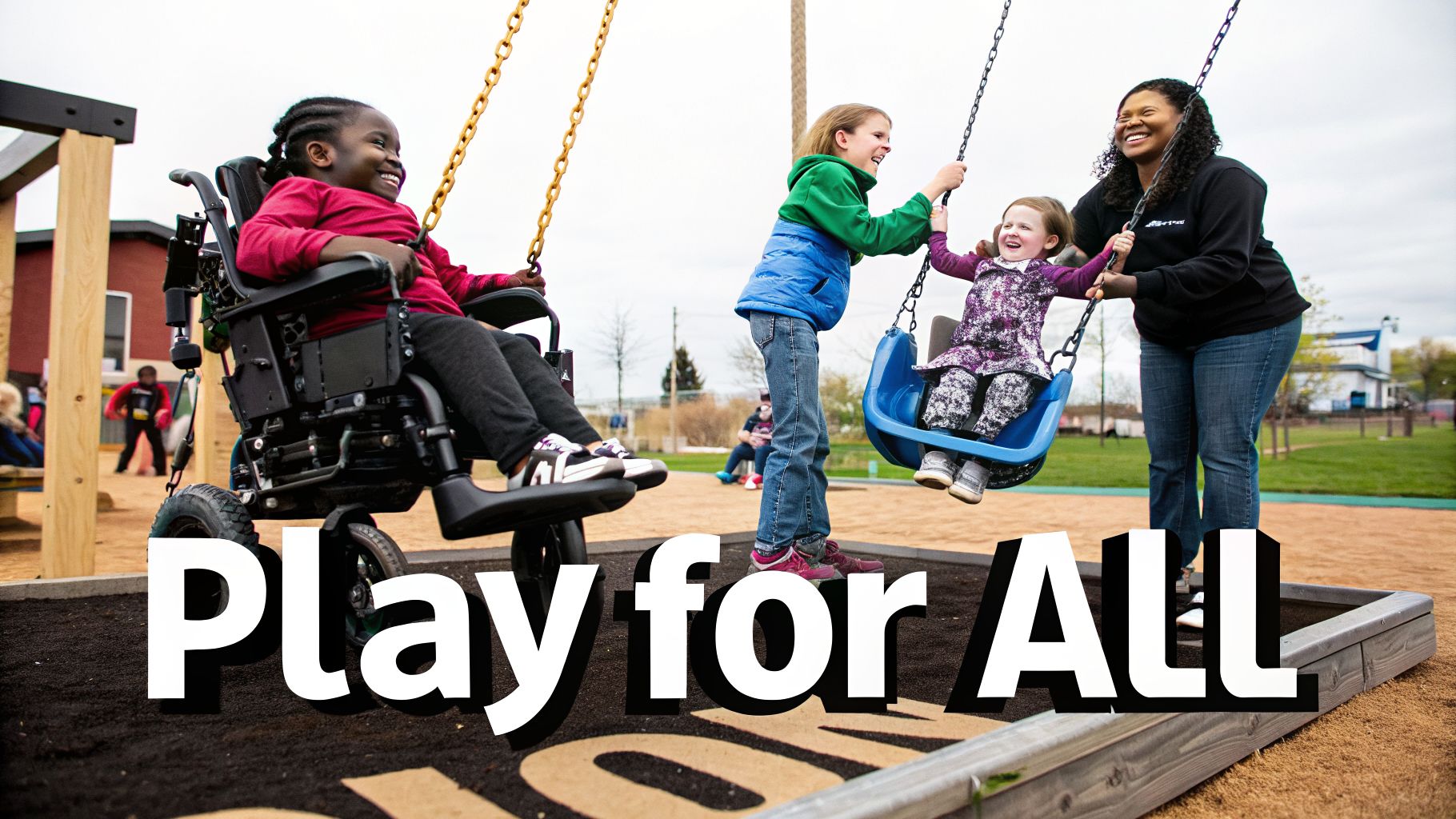
It all comes down to a simple, powerful idea: every child deserves the joy of play. A disability swing set isn't just a piece of equipment; it's a bridge to friendship, a source of laughter, and a clear signal that your community sees and values every single one of its members. It turns a patch of grass into a place where everyone belongs.
We’ve covered a lot of ground together, moving from the 'why'—the real impact of play exclusion—to the 'how' of making a truly inclusive playspace a reality. The goal has been to equip you with the practical knowledge to see a project through from a simple idea to a thriving community hub.
You now have a solid framework for action. We've looked at the different types of swings, from high-back supportive seats to wheelchair platforms, because we know that the right fit makes all the difference. You're also prepared to navigate Australian safety standards, ensuring your playspace is not just accessible, but fundamentally safe.
From there, we laid out the entire project lifecycle, covering everything from smart site selection and layout to the final installation checks. We even broke down the costs and pointed you towards funding opportunities, because a great vision needs a practical budget to get off the ground.
A playground is a mirror, reflecting a community's heart. By choosing to install a disability-friendly swing, you're not just adding equipment—you're actively fostering a culture of empathy, acceptance, and shared delight. You're making sure no child is ever left on the sidelines.
Now, the real work begins. It’s time to take this information and start those crucial conversations with your school, council, or community group. You have the tools and insights to move beyond good intentions and drive real, tangible change.
This is your chance to create a lasting legacy—a playground where laughter is the only language that matters and where every child can feel the simple, soaring freedom of a swing. To get more inspiration, have a look at our guide on what to install in an inclusive playground.
As you start planning your project, whether you're a school principal, a council project manager, or a landscape designer, you'll naturally have a lot of questions. Getting the details right from the beginning is key. Here are some of the most common queries we get about bringing a disability-friendly swing set to life.
This is a big one, and the answer depends entirely on the swing you choose. An accessible swing needs a much larger footprint than a standard one, and it all comes down to safety and compliance with Australian Standard AS 4685.
The main thing to account for is the impact area, or fall zone—the safety surfacing that surrounds the entire swing. Think about a wheelchair platform swing, for instance. You don't just need space for the swing itself; you need a clear, level area for its ramp, plus enough room for someone to approach, get on, and get off without feeling cramped or obstructed.
As a starting point, you should plan for a use zone of at least 6 metres by 8 metres for the swing. On top of that, you'll need accessible pathways leading to it, which should be at least 1.5 metres wide to give people using mobility devices a comfortable amount of space.
The best advice we can give? Get a professional site consultation. A specialist can give you precise measurements based on your specific equipment and site, ensuring your plan is safe, compliant, and genuinely usable right from the start.
The perfect surface under a disability swing set does two jobs: it absorbs impact from a fall, and it’s completely accessible. This immediately rules out loose materials like sand, wood chips, or gravel. Imagine trying to push a wheelchair through soft sand—it's a non-starter and creates a massive barrier to play.
Australian Standards point towards unitary surfaces as the best solution:
Both these options are designed to meet the critical fall height requirements for your swing, offering top-tier protection while guaranteeing smooth, barrier-free access. While they might have a higher upfront cost, their safety, accessibility, and sheer durability deliver far better value in the long run.
Not at all. That’s a common misconception. While some models, like platform swings, are made specifically for wheelchair users, the term "disability swing set" actually covers a whole family of inclusive equipment designed for a wide range of needs. The real goal is universal design—creating play opportunities for everyone, together.
Just like any piece of quality equipment, regular maintenance is absolutely vital for keeping an accessible swing safe and extending its life. We always recommend setting up a simple, structured maintenance schedule.
And don't forget the surfacing! Keeping the surrounding pathways and safety surfaces clear of leaves, sticks, and other debris is a simple but crucial part of ongoing safety.
Planning an inclusive playspace can feel like a complex puzzle, but you don't have to solve it alone. The team at Kidzspace specialises in creating playgrounds that are safe, engaging, and truly inclusive for every child. Contact us for a free playground consultation to talk about your project and see what’s possible.


Copyright © Kidzspace. All Rights Reserved.
Copyright © Kidzspace. All Rights Reserved.