
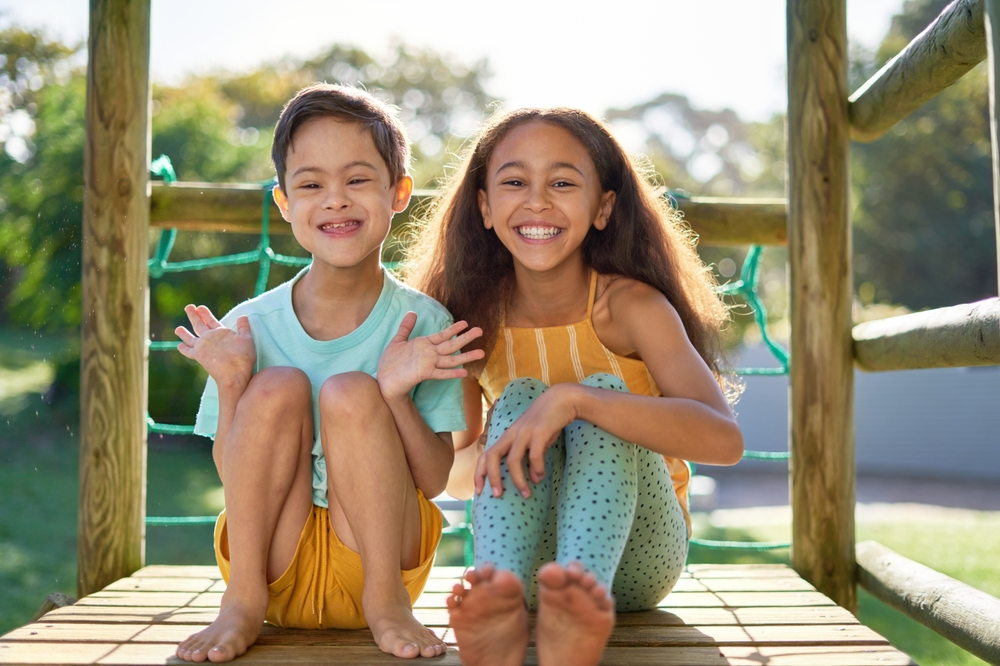

A disabled swing seat is far more than just a piece of playground equipment. It's a gateway to inclusion, giving children with physical limitations the secure support they need to finally experience the simple, soaring joy of swinging. These specialised seats can transform a standard swing set into an accessible activity, breaking down very real barriers to play.
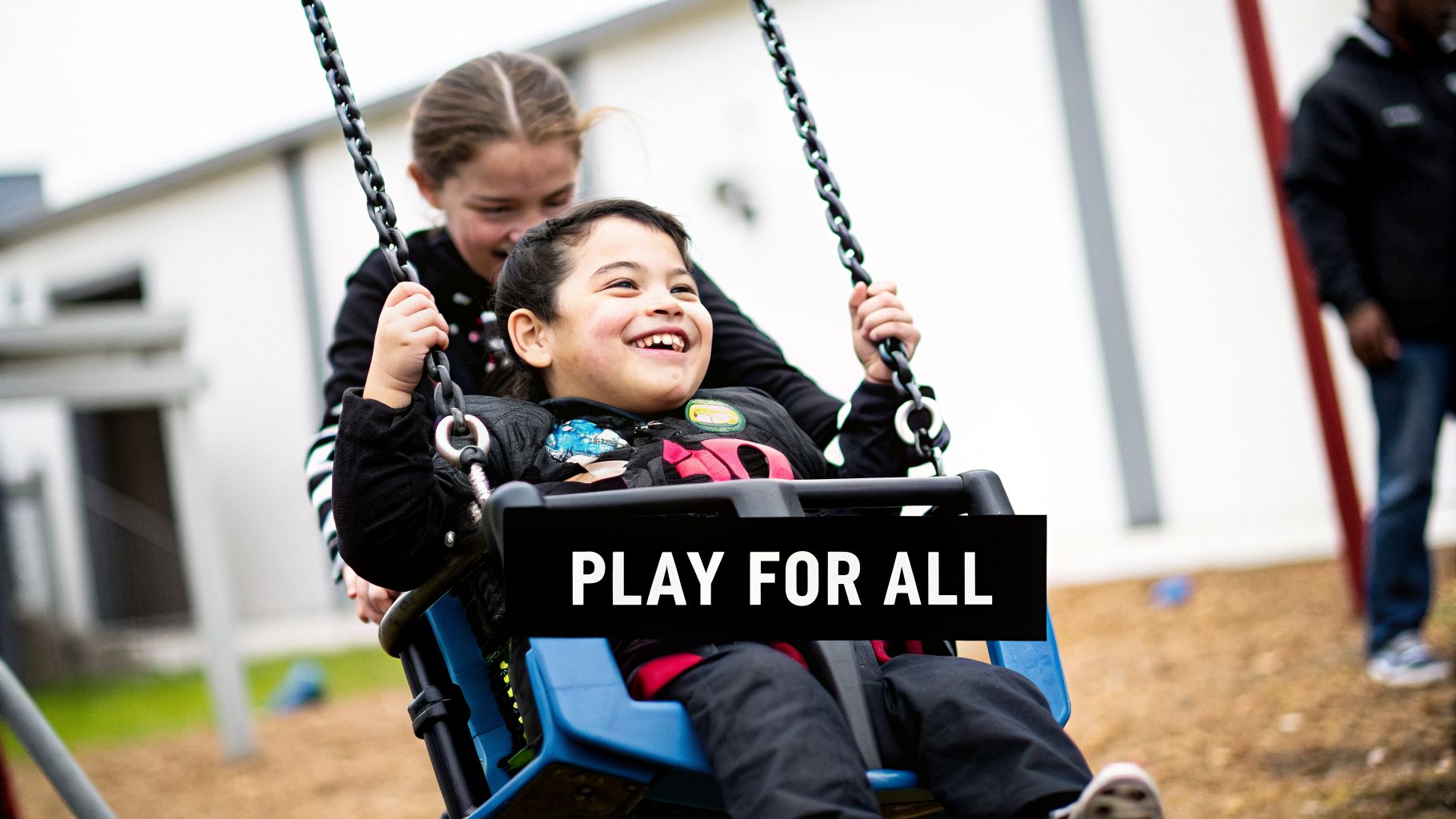
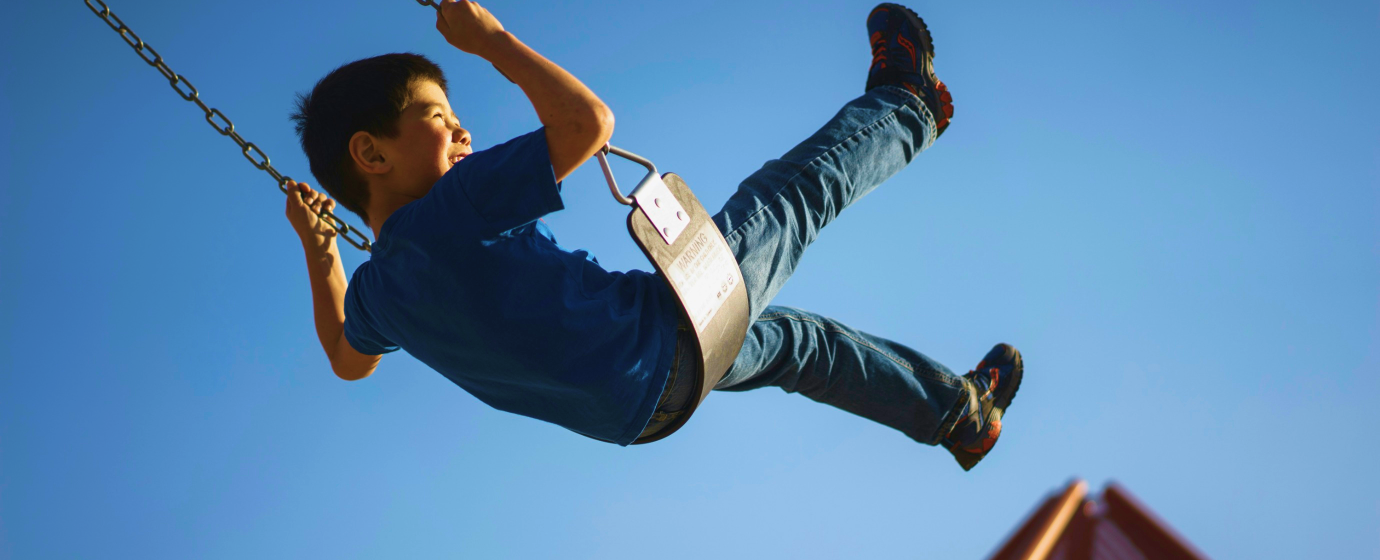
Think back to the feeling of swinging—that weightless moment as you fly towards the sky. It's a core memory for so many of us. But for countless children with disabilities, this fundamental childhood experience has always been just out of reach. Traditional playgrounds, with their standard belt swings, can leave some children stuck on the sidelines.
A disabled swing seat is specifically designed to bridge this gap. It provides the stability and support for children who may lack the trunk control, balance, or strength needed for a conventional swing. It’s not just a separate piece of equipment; it’s the key that unlocks the entire playground experience for a child who was previously excluded.
When a child can finally swing alongside their friends, the benefits go far beyond just physical activity. This shared, joyful experience is where crucial social and emotional development happens. It’s a moment of connection, shared laughter, and true belonging, sending a powerful message that every child matters here.
Without this kind of equipment, we create a developmental void. Swings are a staple of Australian playgrounds, but their typical design frequently excludes children with disabilities. Research has uncovered a significant problem: a staggering 71% of wheelchair users find their local playground inaccessible, with swings often cited as a primary barrier. You can find more detailed findings in the full play report.
By incorporating a disabled swing seat, a playground moves from being merely compliant to being genuinely welcoming. It’s a deliberate choice to prioritise social equity and ensure no child is left watching from the fence.
This guide is here to give schools, councils, and community planners the practical knowledge to make informed decisions. We'll walk through the different types of accessible swings, help you navigate Australian safety standards, and cover the essentials of installation, maintenance, and funding.
A disabled swing seat is a vital first step, but it’s all part of a bigger picture. For more ideas on creating a truly inclusive space, you can also check out our guide on what to install in an inclusive playground. Ultimately, this is about creating a space where every single child can feel the wind in their hair and the pure joy of playing together.
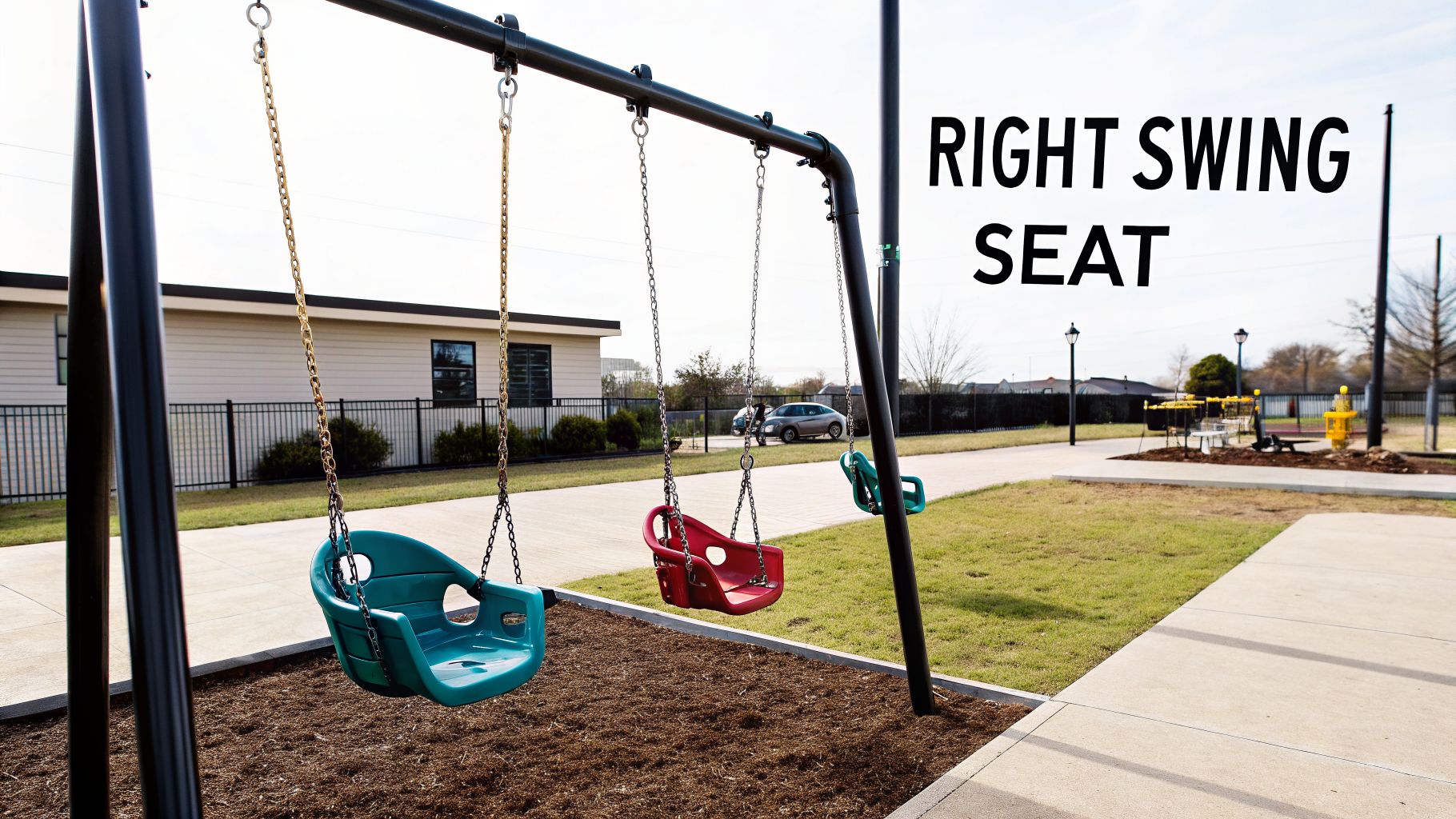
When you’re choosing an accessible swing seat, it's not a one-size-fits-all situation. Think of it like picking out a car seat for a child—you wouldn't put a seven-year-old in a newborn’s capsule. The right swing depends entirely on the age, ability, and specific support needs of the kids who'll be using it.
Getting this choice right goes beyond just ticking a box for compliance. It’s about creating real opportunities for joyful, freeing play. To do that, you need a good grasp of the different accessible and inclusive swings out there so you can find the perfect match for your community.
First things first: you need to work out the level of physical support a child might need. Not every child with a disability requires the same thing, so offering just one option rarely works. The sweet spot is providing enough support to keep them safe, but not so much that it restricts the feeling of freedom that makes swinging so much fun.
Take a moment to consider the main users of your playspace. Will they need complete, full-body support, or maybe just a little extra help with balance and posture?
For children with limited trunk control or significant physical disabilities, a full-body support seat is an absolute game-changer. You might hear them called "cocoon" seats, and for good reason—they securely and comfortably enclose the user.
These seats are designed with a high back, supportive sides, a leg separator, and a locking safety harness. This structure ensures a child who can't sit up on their own is held safely in place, letting them experience that amazing sensory rush of swinging without any risk. They are a must-have for any playground truly committed to serving children with profound disabilities.
A high-backed adaptive swing seat offers a fantastic middle-ground option. It gives more support than a standard belt swing but is less enclosed than a full-harness model. These seats are perfect for kids who have some trunk control but still benefit from extra postural support to swing safely.
You can think of it as a booster seat for the swing set. The high back helps them stay upright, while the moulded design and a safety chain or bar stop them from slipping. This type of disabled swing seat is a wonderfully versatile choice that caters to a broad range of abilities.
The most effective inclusive playgrounds often feature a combination of swing types. Offering both a full-body harness seat and a high-backed adaptive seat ensures you can cater to a broader spectrum of needs, making your playspace truly welcoming for more families.
While accessible swings focus on meeting an individual's physical needs, inclusive swings are all about encouraging interaction and shared fun. These designs are brilliant because they allow multiple children, with or without disabilities, to play together and break down social barriers.
One of the most popular and effective inclusive designs is the nest or saucer swing. These large, round swings can hold several kids at once, whether they're sitting up or lying down. A child with a disability can swing right alongside their friends or even a parent or carer, making it a powerful tool for social connection.
These group swings naturally encourage teamwork, communication, and cooperation. And because you can use them for everything from a gentle rock to an energetic swing, they appeal to all ages and provide rich sensory feedback for everyone. They are a fantastic addition for any playground wanting to put social play front and centre.
To help you decide, this table breaks down the different seats based on the user they're designed for, the support they offer, and where they work best.
| Seat Type | Primary User | Level of Support | Best For |
|---|---|---|---|
| Full-Body Harness Seat | Children with very limited trunk or head control | Maximum | Ensuring safety for users with significant physical disabilities. |
| High-Backed Adaptive Seat | Children who need postural assistance but have some trunk control | Moderate | A versatile option for a wide range of needs and abilities. |
| Inclusive Nest Swing | Children of all abilities, including those with disabilities | Minimal to Moderate | Promoting social interaction, group play, and sensory experiences. |
By considering these options, you can select a swing—or a combination of swings—that will make your playground a more joyful and welcoming place for every child.
There’s more to installing a disabled swing seat than just choosing a model and bolting it down. To create a space that’s genuinely safe and truly inclusive, you need to get your head around Australia’s strict safety and accessibility standards. These aren't just bureaucratic hurdles; they are the essential framework that prevents injuries and guarantees the equipment is actually usable for every child.
Think of these standards as the foundational blueprint for a safe playspace. Just like a house needs solid footings to stand strong, a playground must be built on a base of proven safety principles. When it comes to any playground equipment, including a disabled swing seat, the primary document is Australian Standard AS 4685.
The AS 4685 series is the definitive rulebook for playground equipment and surfacing in Australia. It's a comprehensive set of documents that dictates everything from the structural integrity of the swing’s frame to the precise depth of the soft fall material underneath it. Following this standard isn't just good practice—it's a legal and ethical responsibility.
When you're installing a disabled swing seat, several parts of the standard are critical, but three areas are absolutely non-negotiable:
Getting any of these wrong doesn’t just put children at risk; it can expose your school or council to serious legal liability. For a more detailed breakdown of these requirements, you can explore our guide on school playground safety standards, which unpacks these topics further.
The intense focus on compliant equipment and surfacing is a direct result of decades of injury data. The numbers speak for themselves. Research from Victoria, for example, showed that swings were involved in 18% of 8,298 playground-related hospitalisations over an eight-year period, with most injuries caused by falls.
A similar story comes from New South Wales, where falls from equipment resulted in 16,828 hospitalisations for children aged 0-14 over a single decade. You can read more about the research into playground safety and inclusion to understand the scale of the problem. A modern, compliant disabled swing seat is designed to directly combat these risks.
These standards transform a playground from a potential hazard into a safe haven for adventure. They are the difference between hoping for safety and engineering it from the ground up.
So, what does this all mean on the ground? First, every single disabled swing seat must be installed over a surface that meets the critical fall height requirements laid out in AS 4685. This almost always involves using certified materials like rubber soft fall or an approved loose-fill material like bark, installed to a very specific, tested depth.
Next, you have to create a clear and unobstructed fall zone around the swing. This area needs to be completely free of any obstacles—no benches, tree roots, bins, or other equipment. A certified playground professional is the best person to calculate the exact size of this zone, as it depends on the swing's height and type.
Finally, accessibility has to be seamless. You need a continuous, firm, and level path leading from the playground entrance right up to the swing's transfer point. The path must be wide enough for a wheelchair and have a surface that's easy to roll on, empowering a child to approach and use the swing independently or with minimal help. Working with an expert from the start ensures every detail is covered, creating a space that’s not only compliant but genuinely welcoming for all.
Getting a new inclusive swing in the ground is a fantastic feeling, but the real work starts long before anyone breaks out a shovel. Success hinges on careful, considered planning. A well-laid-out project ensures your new disabled swing seat isn't just a piece of compliant equipment, but a genuinely joyful and central part of your playspace.
Think of it this way: you wouldn’t draw up blueprints for a house without first surveying the land. The same principle applies here. The groundwork you do upfront is what separates a good installation from a great one.
First things first, you need to walk the ground. Get a real feel for your proposed location. Is the site level? You'll need to consider drainage, because pooled water can quickly turn a play area into a muddy mess and wreck the integrity of your soft fall surfacing.
Just as important is the journey to the swing. An accessible swing seat is pointless if a child can't actually get to it. You must map out a clear, continuous path from the entrance of the playspace right to the swing itself. This pathway needs to be wide enough for a wheelchair and feature a firm, stable surface that’s easy for wheels and feet to navigate.
The flowchart below shows how these core elements—surface, safety zones, and access—all work together in a safe playground design.
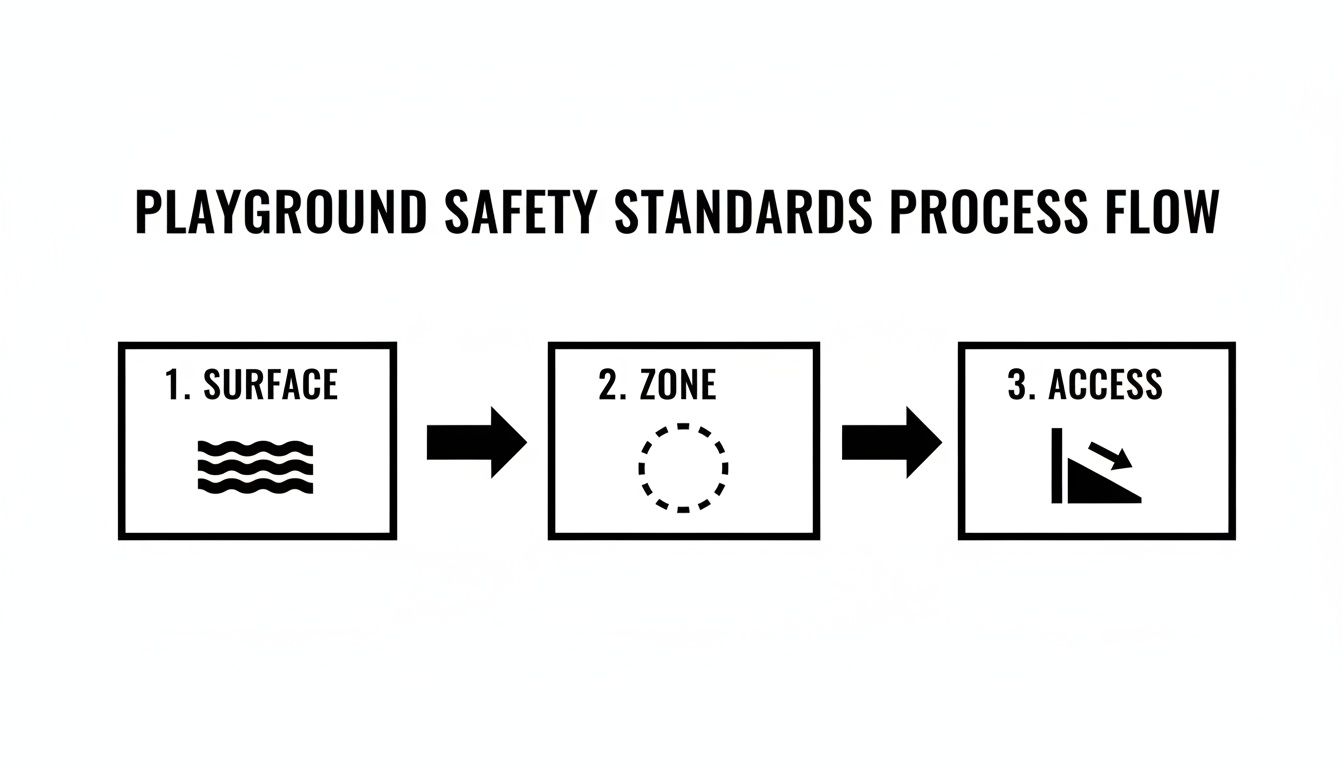
As you can see, creating a truly safe and inclusive space is about more than just the swing; it’s about planning the entire environment as one cohesive system.
One of the most common mistakes we see is underestimating just how much room a swing needs. It's not just the frame you need to account for. You have to factor in the full range of motion and the non-negotiable safety zones that extend well beyond the swing's arc.
To get this right, you need to calculate three distinct areas:
The exact dimensions for the fall zone are determined by the swing's height and specific model. A professional playspace provider can give you the precise measurements required for full compliance with Australian Standard AS 4685.
Failing to properly map out the fall zone is one of the most frequent and dangerous installation errors. Always measure and mark this area on-site before any work starts to ensure it remains clear.
It can be tempting to try and save money with an in-house or volunteer installation, but for playground equipment, this is a job best left to certified professionals. A disabled swing seat and its frame are heavy-duty pieces of engineering designed to handle significant dynamic forces. If they're assembled incorrectly, the risk of structural failure is very real.
Professional installers don't just put the pieces together. They ensure every bolt is tightened to the manufacturer's specification and that the entire structure is anchored securely for long-term stability. Crucially, they live and breathe the safety standards like AS 4685. They guarantee your installation is fully compliant, protecting you from future legal headaches and, most importantly, keeping every child safe.
Beyond the technical side, a great installation team can help you weave the swing into a broader, more imaginative play theme. After all, accessibility shouldn’t feel clinical—it can and should be a creative, seamless part of an exciting world of play.
So, you have a brilliant vision for an inclusive playground, but one question always looms large: how do we pay for it? The reality is that the cost of a commercial-grade disabled swing seat, compliant surfacing, and professional installation can feel like a huge hurdle.
But it doesn't have to be a showstopper. I've seen countless community groups and councils turn these projects into reality. The secret is knowing where to look for funding and how to build a case that's impossible to ignore. It’s rarely a single source, but more like a mosaic of grants, community fundraising, and smart partnerships.
A major slice of the funding pie often comes from government grants at the federal, state, and even local council levels. These programs are specifically set up to back community projects that champion inclusion, health, and accessibility. In Australia, for example, programs like the Commonwealth's 'Accessible Australia' initiative are a perfect fit for projects that add or upgrade community infrastructure for people with disability.
State governments run their own grant programs, too, often focused on community wellbeing, sport, and recreation. It's well worth your time to keep a close watch on these grant rounds, as a single successful application can cover a huge chunk of your project's total cost.
Getting a grant application across the line is about more than just filling out forms. You need to tell a compelling story. Don't just say you need a swing; explain the why.
Nothing sinks a grant application faster than a vague or incomplete budget. Before you even think about applying, you need to map out every single cost, down to the last dollar. This shows funders you're organised and have a realistic grasp of what's involved.
Your budget needs to go far beyond just the swing itself. Make sure you get quotes and include line items for:
This level of detail isn’t just for the funders; it’s for you. It proves your plan is viable and that their investment will be managed responsibly.
A strong budget is your financial roadmap. It not only helps you secure funding but also guides your project management from start to finish, preventing costly surprises down the line.
Wading through the world of grants, budgets, and safety standards can feel overwhelming. This is where leaning on an experienced playground provider like Kidzspace can be a game-changer. A true expert partner does more than just sell you equipment; they become your guide through the entire maze.
A specialist can help you nail down your project goals, choose the right equipment for your community’s specific needs, and provide the accurate quotes that will form the backbone of your budget. They can also offer priceless advice on how to make your funding proposals stronger. To get started on building a solid strategy, you can read also about securing funding and grants for new playgrounds.
Ultimately, a good partnership removes the guesswork, dramatically increases your chances of success, and helps you deliver an incredible asset for your entire community.
Putting in an inclusive swing is a fantastic achievement for any community, but the work doesn't stop once the concrete sets. That shiny new disabled swing seat is a promise of safe, joyful play, and it's our job to make sure it stays that way for years to come.
Think of it this way: you wouldn't let a school bus run for years without checking the tyres and brakes. This equipment faces the same daily demands, not to mention the full force of Australian weather. A simple, regular maintenance routine isn't just best practice; it's fundamental to keeping children safe and getting the most out of your investment. Catching a small issue, like a slightly worn strap, can stop a major failure before it ever happens.
You don’t need a complex engineering degree to run effective safety checks. A straightforward checklist, run through weekly or fortnightly, is the single most powerful tool for guaranteeing the long-term integrity of your swing.
Your inspection should zero in on the parts that take the most strain—the moving components and crucial safety features. These are the areas where wear and tear will show up first.
Your regular checklist should include checking for:
A perfectly maintained swing in an unsafe area is still a hazard. Your safety check must always extend to the entire play zone, because true accessibility is about the whole environment, not just one piece of equipment.
Regular maintenance isn't an expense on a balance sheet. It's a direct investment in the safety of children and the trust of your community. It proves you're committed to providing a secure, high-quality play space for everyone, every single day.
This wider check absolutely has to include your soft fall surfacing. If you're using loose-fill materials like bark, make sure to rake it back into place. It tends to get kicked away right under the swing's path, creating a dangerously shallow spot. For rubber surfaces, be on the lookout for cracks, peeling edges, or hardened patches that won't absorb impact properly.
Finally, do a quick scan to make sure the fall zone is completely free of any obstacles. A stray toy, a forgotten bag, or an encroaching garden bed can turn a simple tumble into a serious injury.
Thinking about adding a disabled swing seat to your playground? You probably have a few questions. We get it. Here are the straightforward answers to the queries we hear most often from schools, councils, and community groups, helping you get your project off the ground.
It’s more than just the space the swing frame takes up. To meet Australian safety standard AS 4685, you have to factor in the swing's full arc of movement plus a significant safety area around it. This is often called the 'fall zone'.
This zone, which requires certified soft fall surfacing, can extend several metres in front of, behind, and to the sides of the swing. The only way to know the exact dimensions for your site and chosen swing is with a professional site assessment. It’s the best way to ensure you're fully compliant and, most importantly, that everyone stays safe.
Absolutely! In fact, retrofitting an existing playspace is one of the most popular and cost-effective ways to start making it more inclusive for all children. It can be a brilliant first step.
The main things you’ll need to confirm are whether you have enough space for the new swing and its required fall zone. Just as important is planning an accessible, barrier-free pathway that leads directly to the swing, so everyone can get to it easily.
Accessible vs. Inclusive: What's the Difference?
You'll hear these terms used a lot, and while they're related, they mean slightly different things.
- Accessible equipment is often designed with a specific disability in mind, like a high-backed swing seat that includes a supportive harness.
- Inclusive equipment is designed so children of all abilities can play together. Think of a large 'nest' swing where a few kids can pile in at once and interact.
A truly great playground will often feature a mix of both. This ensures you’re catering to a wide range of needs while actively encouraging kids to play and socialise together.
You can expect a high-quality commercial swing to last for a very long time. With the right materials and proper care, a robust model made from galvanised steel and tough, UV-resistant plastics can easily serve your community for 15-20 years, sometimes even longer.
The key is regular maintenance. Sticking to the inspection and care schedule from your supplier is the best way to maximise its lifespan. A little bit of consistent care not only keeps the swing safe year after year but also protects your community's investment for the long haul.
Ready to bring inclusive play to your community? The team at Kidzspace is here to help you plan, design, and install the perfect disabled swing seat for your playground. Contact us today for a free consultation and let's get started.



Copyright © Kidzspace. All Rights Reserved.
Copyright © Kidzspace. All Rights Reserved.