



A quality timber cubby house is far more than a simple plaything. It’s a permanent community asset, an investment in childhood development that pays dividends for years to come. Unlike the flimsy models you might find for a backyard, commercial-grade timber cubby houses are engineered to be a lasting part of your landscape, built for high-traffic environments and designed to enrich the community.
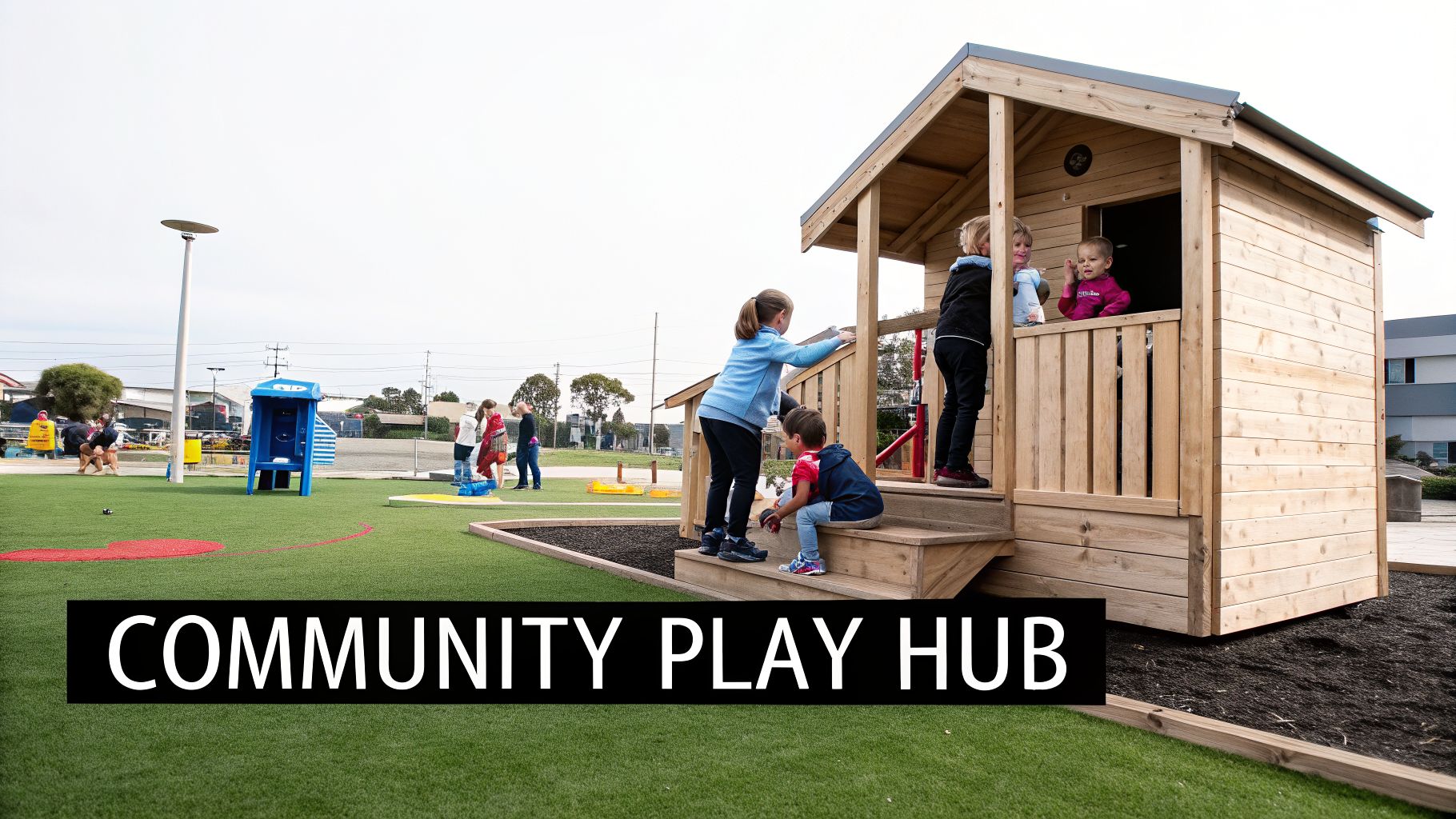
When you're budgeting for playground equipment, it's tempting to focus on the upfront price tag. But for schools, councils, and childcare providers, the real value isn't found in the initial quote. It's measured in longevity, safety, and the positive impact on children's lives. A commercial timber cubby house isn't a disposable toy; it's a durable piece of community infrastructure.
These structures are in a completely different league from what you’d buy at a retail store. They are purpose-built to handle the daily rigours of countless children and are constructed in strict compliance with Australian safety standards. This commitment to solid engineering and safety makes them a smart long-term investment, not just another expense.
Think of a commercial timber cubby as a miniature community hub for kids. It’s a dedicated space where they naturally develop essential life skills. Inside those timber walls, children aren't just playing; they're learning to negotiate, collaborate on shared games, and solve little disagreements on their own.
It's a place that fuels imagination, transforming from a pirate ship one day to a bustling cafe the next. A great cubby house also gets kids moving, drawing them away from screens and encouraging the kind of active, healthy play that’s vital for their development. For a deeper look at the numbers, you can explore the long-term ROI of investing in school playground equipment in our detailed guide.
A commercial-grade timber cubby house is an investment in community well-being. It fosters social skills, sparks imagination, and promotes physical health—all within a safe, durable structure that becomes a beloved landmark for years.
The sheer durability of timber is what makes it such a sound financial choice. This isn’t just an opinion; it’s backed by market trends. In 2023, the Australian kids' storage furniture market, a category that includes wooden play structures, was valued at USD 313.8 million.
Within that market, the wooden segment was the clear leader, capturing a massive 50.46% revenue share. Why? Because buyers know that timber holds up against the relentless energy of children’s play.
For institutional decision-makers, choosing high-quality timber is a strategic move that offers several distinct advantages:
By investing in a quality timber cubby house, you're making a forward-thinking decision that not only provides a tangible asset but also actively supports your community’s developmental goals.
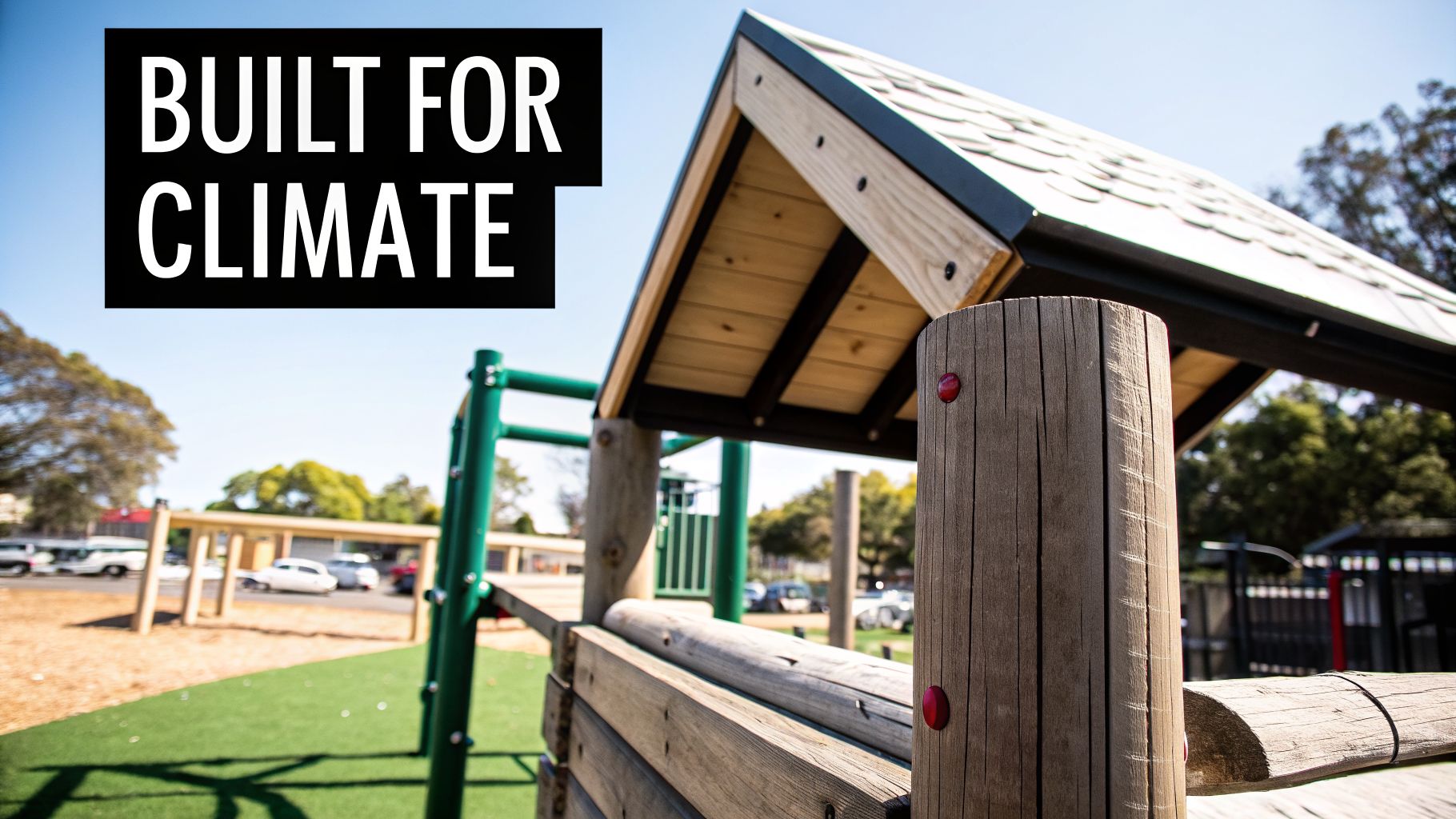
When you're choosing materials for a public playground, you’re up against the full force of the Australian climate. The relentless sun, sudden downpours, and wild temperature swings demand something tougher than just 'strong'. They demand resilience. This is exactly where high-quality timber shines, proving time and again why it's the right choice for commercial timber cubby houses.
The benefits go far beyond timber’s classic, natural look. It has an incredible, built-in ability to handle the heat. Think about a scorching summer afternoon—a metal slide or pole can quickly become dangerously hot to the touch. A timber structure, on the other hand, stays remarkably cooler, making sure the play space is safe and usable even on the hottest days of the year.
This thermal property is a massive, often overlooked, advantage for Australian schools and councils. Unlike plastic that can turn brittle and fade under constant UV rays, or metal that heats up like a stovetop, timber provides a stable, reliable structure built for all-day, all-season fun.
Deciding between materials for a commercial play structure is like choosing between building a forever home and putting up a garden shed. One is engineered for generations of memories, the other is a short-term fix. Commercial timber cubby houses are built like that forever home—designed from the ground up for exceptional strength and a long, useful life.
In fact, a properly constructed timber cubby made from treated, commercial-grade wood can easily last 15 to 20 years in a busy public space. This impressive lifespan comes down to its inherent structural integrity.
Choosing high-quality, treated timber isn't just a purchase; it's an investment in the structure's whole life. It guarantees your cubby house won't just survive Australia's climate but will remain a safe, repairable, and enduring asset for your community.
Today, a project’s environmental impact matters. For councils and schools looking to make responsible choices, timber is a standout performer that aligns perfectly with modern sustainability goals.
Unlike plastics made from fossil fuels, wood is a completely renewable resource. When it comes from responsibly managed forests, you're using a genuinely eco-friendly building material. This commitment to the environment now extends to the way the timber is treated.
The old days of harsh, toxic chemical treatments are long gone. Modern commercial-grade timber is protected using much safer, environmentally sound processes like Light Organic Solvent Preservative (LOSP) or Alkaline Copper Quaternary (ACQ). These treatments offer fantastic protection against Australia’s biggest timber threats—termites, rot, and fungal decay—without posing a risk to children or the local ecosystem.
This unique combination of natural performance, brute strength, and eco-friendly credentials makes timber the most logical choice for commercial timber cubby houses in Australia. It’s a material that delivers across the board—on safety, durability, aesthetics, and sustainability—ensuring a fantastic long-term return on your community's investment.
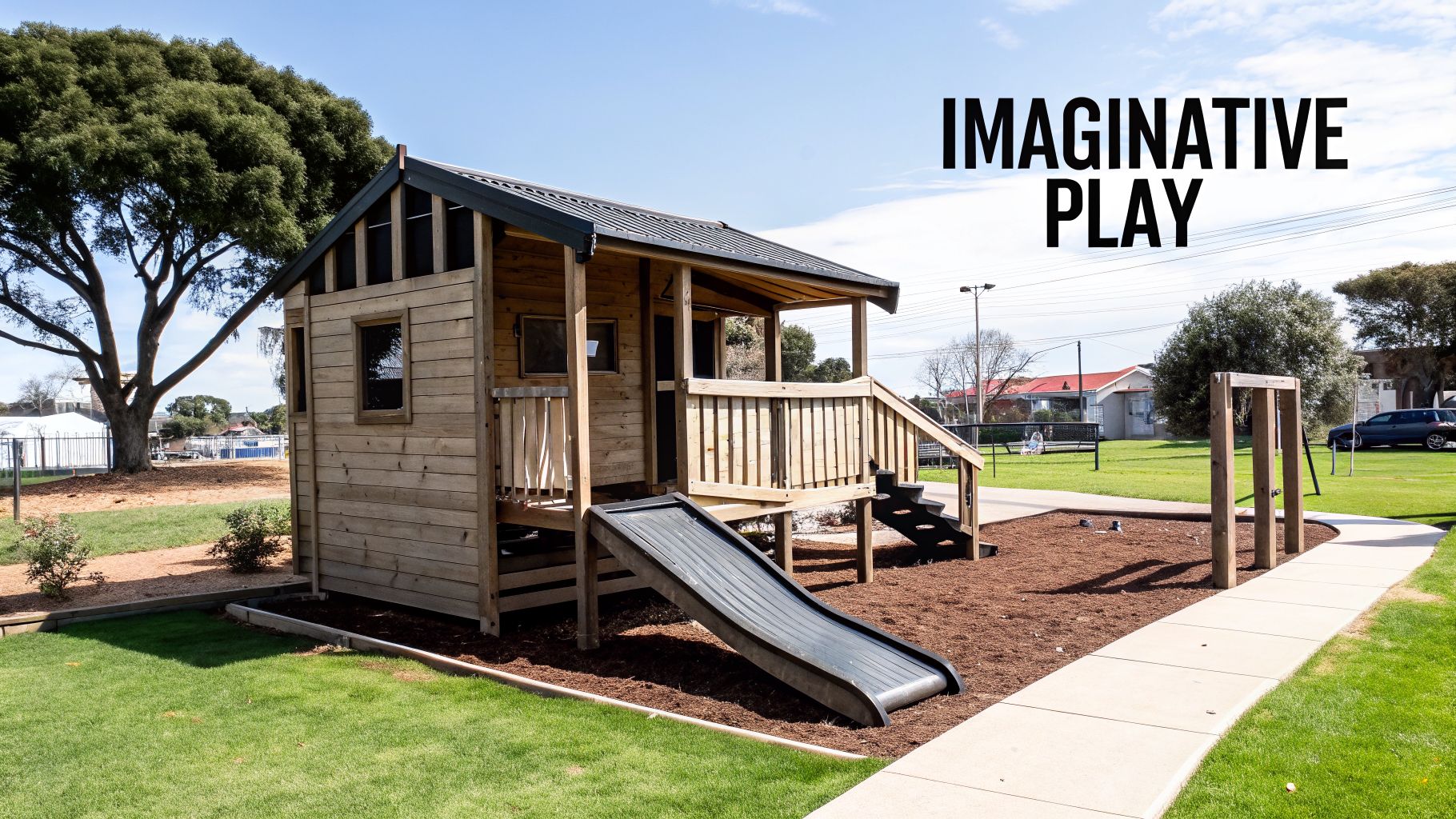
A commercial timber cubby house is never just a box with a roof. In the hands of a child, that wooden frame instantly becomes the bridge of a pirate ship, the counter of a busy outback cafe, or the secret entrance to a magical forest fort.
The real power of these structures is their ability to become whatever a child can imagine. This is where thoughtful, thematic design elevates a simple play structure into a dynamic learning environment. When you move past a standard four-walls-and-a-roof design, you can start to inspire specific types of play and target developmental goals.
A great theme doesn’t just make a cubby house look good—it actively guides children into everything from collaborative problem-solving to rich, imaginative storylines. Customisation lets you shape that experience to align with your educational or community goals. You’re not just providing a generic space; you’re creating the programmable centrepiece of your entire play area.
Thematic design is really about creating a narrative that children can step into. By embedding clever cues and functional elements into the cubby itself, you provide the building blocks for countless stories. While the possibilities are endless, some of the most effective themes draw from concepts kids already recognise and love.
Just think about how different themes can steer the direction of play:
This is where timber really shines. Unlike moulded plastic, wood has incredible versatility. It can be shaped, painted, and customised to bring practically any theme to life. A few deliberate design choices can completely change the play dynamic, turning a passive structure into an active catalyst for learning and social connection.
A thematic timber cubby house acts as a stage for development. It provides the setting and props that empower children to direct their own complex play, building cognitive and social skills in an environment crafted specifically for them.
Great design is more than just looks; it's about function. By building specific features into your timber cubby house, you can dramatically increase its play value and ensure it serves children of all ages and abilities.
For schools, councils, and community centres, these functional additions are where you really maximise the investment. They show a clear commitment to high-quality, inclusive play that supports a wide range of developmental needs.
Here are a few key functional elements to consider:
When you thoughtfully blend a compelling theme with these functional components, a timber cubby house transforms from a simple object into a world of play. It becomes a versatile, multi-purpose asset that actively contributes to the developmental goals of your organisation.
When you're commissioning a play space for a school, council, or early learning centre, safety isn't just a box to tick. It’s the very bedrock of the entire project. For commercial timber cubby houses, the regulations can look like a confusing tangle of codes, but they don't have to be intimidating. The real goal is to understand the thinking behind the rules, not just to get a compliance certificate.
In Australia, the guiding document for all things playground safety is AS 4685. It’s less of a dry rulebook and more of a common-sense manual built on decades of real-world experience. It’s written to prevent the kinds of accidents you can see coming, addressing the way kids actually play, climb, and, yes, sometimes fall. Understanding the 'why' behind the standards is what lets you create a genuinely secure environment.
This standard scrutinises every single detail, from the structural integrity of the timber right down to the gap between two fence palings. It's all designed to build a space where kids can have an adventure and you have complete peace of mind. For a more detailed breakdown, our article on school playground safety standards is a great resource.
At its core, AS 4685 is all about preventing common playground injuries before they can even happen. It forces manufacturers and designers to put themselves in the shoes of a curious child, looking for places where a small head could get stuck or a tumble could lead to a serious injury. As a buyer, getting a handle on these concepts is crucial when you’re assessing a potential supplier.
A few of the most critical areas include:
To help you navigate these requirements, here’s a quick summary of what you should be looking for.
This table outlines the critical safety areas institutional buyers must verify to ensure their chosen cubby house is compliant and, most importantly, safe for children.
| Safety Area | Key Requirement (AS 4685) | Why It Matters |
|---|---|---|
| Fall Zones & Surfacing | A clear, impact-absorbing surface must extend a specific distance around the equipment. | Cushions falls and prevents serious injury from an accidental tumble. |
| Structural Stability | The entire structure must withstand significant force, simulating heavy use and even misuse. | Ensures the cubby house won't tip, collapse, or break under the weight of many children playing at once. |
| Entrapment Points | All openings must be either too small for a child’s body to enter or large enough for their head to pass through easily. | Prevents a child from getting their head or neck dangerously stuck. |
| Guardrails & Barriers | Elevated platforms require guardrails of a specific height with no climbable footholds. | Stops children from accidentally falling from raised decks and platforms. |
| Material & Finish | All materials must be non-toxic, and surfaces free from splinters, sharp edges, or protruding nails/screws. | Protects against cuts, splinters, and exposure to harmful chemicals. |
By asking potential suppliers how they address each of these points, you can quickly gauge their commitment to safety beyond just a simple compliance claim.
The Australian Standards aren't there to limit fun—they exist to make it possible. A compliant timber cubby house is a place where kids are free to imagine and explore without being put at risk by hidden, preventable dangers.
A truly fantastic community space is one where every single child feels they belong. Moving beyond just the mandatory safety rules, many organisations are now embracing universal design to make sure children of all abilities can play together. This is where a custom-designed timber cubby house really shines.
True accessibility is so much more than just adding a ramp; it’s about thinking through the entire play journey from a child's perspective.
When you deliberately design for accessibility, a timber cubby house becomes more than just a piece of playground equipment. It becomes a powerful tool for social inclusion, sending a clear signal that every child in your community is valued and creating a space that builds friendships and shared joy.
When you’re managing a budget for a school, council, or early learning centre, it’s easy to get fixated on the initial price tag. But the real story of a smart investment isn't on the first invoice; it’s revealed over the next two decades. We always encourage clients to look at the Total Cost of Ownership (TCO), which covers everything from the day it's installed to the day it's retired.
With commercial playground equipment, a high-quality timber cubby house really shines in this department. It’s the difference between building a solid brick-and-mortar community hall versus putting up a temporary marquee for an event. One is a lasting asset built for generations, while the other serves a short-term need and is gone tomorrow. A premium timber structure is an investment that pays you back, year after year, in durability and minimal fuss.
Let's be clear: the commercial-grade timber we use isn't just any wood from the hardware store. It’s a material specifically chosen and treated to stand up to the tough Australian environment. Our unforgiving UV rays, coastal humidity, and persistent pests will make short work of inferior materials.
This is where properly treated timber proves its worth. Unlike plastic, which can go brittle and fade to a chalky mess under the relentless sun, or untreated pine that's a welcome mat for termites and rot, quality commercial timber is engineered to endure. It's this built-in resilience that makes it the go-to choice for so many public spaces.
A well-made timber cubby house is designed for a lifespan of 15 to 20 years, sometimes even longer. Its whole-life value just can't be matched by cheaper alternatives you might have to replace two or three times in that same period.
This isn't just a trend in playgrounds; it’s a shift seen across the entire construction industry. The Australian market for prefabricated wooden buildings is booming, with a projected size of $699.0 million by 2026. It’s a clear sign that professionals trust engineered timber to create safe, sustainable, and long-lasting community assets. If you're interested in the numbers, you can read the full industry analysis on IBISWorld.
Looking after your investment is far easier than you might think. The maintenance for a commercial timber cubby house is refreshingly straightforward and slots easily into any facility manager’s existing routine. Honestly, a simple annual once-over is all it takes to guarantee decades of safe play.
Here’s a practical checklist to run through each year:
Sticking to this simple yearly check-up is the single best thing you can do to get the most out of your timber cubby house. It ensures the structure remains a safe, attractive, and beloved feature for a whole generation of kids, making it a truly practical and cost-effective choice for any organisation.
Bringing a commercial-grade timber cubby house from an idea on paper to a much-loved community playground isn't complicated, but it does follow a clear, collaborative path. For project managers, landscape architects, and developers, this process is designed to give you complete confidence from start to finish.
Think of it as a partnership. We work together to make sure the final structure is not only stunning but also fully compliant and tough enough for years of public use. It's a bit like building a small home—you need a solid plan, skilled hands, and careful checks along the way to get a quality result.
Getting your project off the ground follows a well-trodden path that turns your vision into a physical structure for the community to enjoy. Each stage builds on the one before, ensuring nothing is left to chance.
The journey generally unfolds in a few key steps:
This flow chart shows how the initial purchase price is just one part of the equation. True value comes from a structure that lasts and is easy to look after.
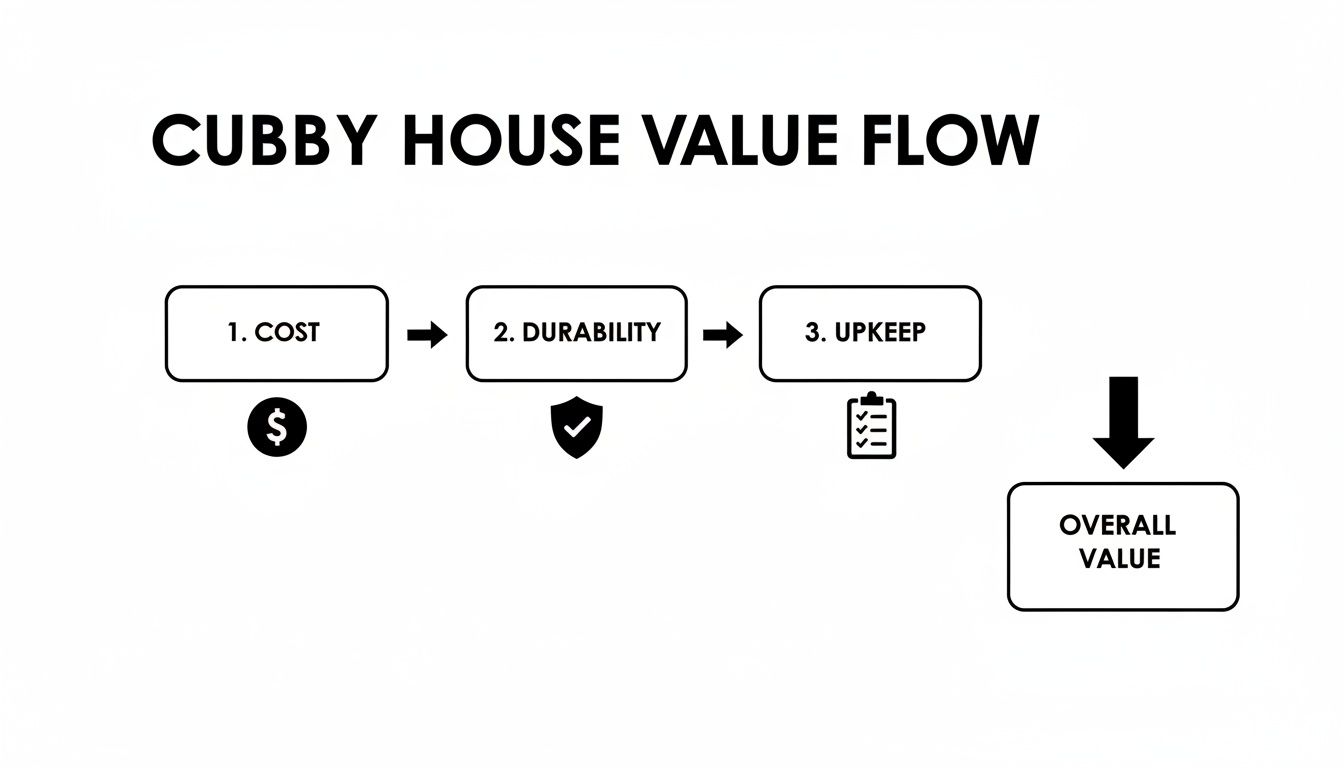
As you can see, the real worth of a timber cubby house is realised over its lifespan through its resilience and low maintenance needs, not just its sticker price.
While the DIY spirit is great for a backyard project, it’s a definite no-go for commercial play equipment. Professional installation isn't just a strong suggestion—it's essential for meeting safety standards, ensuring compliance, and activating your product warranty.
Professional installers are trained to build these structures exactly as they were engineered and in line with Australian Safety Standards. They ensure every bolt is torqued correctly, every guardrail is secure, and all fall zones are perfectly measured.
Trying to install a commercial structure yourself might seem like a way to save money, but it can easily void your warranty and expose you to serious liability. A certified installation gives you the peace of mind that your cubby house is safe for public use from day one. It's the final, vital step in protecting both your investment and the children who will get years of joy from it.
When you're looking to invest in a commercial timber cubby house for a school, park, or new development, it’s completely normal to have a few questions. As a project manager, you need to be sure you're making a sound decision. Here are some straightforward answers to the questions we hear most often, designed to help you move forward with confidence.
We’ll cover the big topics: how long they last, how safe they are, what upkeep is involved, and just how much you can customise a design.
A well-built commercial timber cubby house is a long-term asset. With the right materials and a simple maintenance routine, you can realistically expect a lifespan of 15 to 20 years or more. This isn't just under ideal conditions; this is in the real world of harsh Australian sun and coastal air.
The secret is in the timber itself. Using properly treated pine, like ACQ or LOSP, is crucial for durability. From there, a quick annual check for weathering or loose fittings is all it takes to ensure the structure remains safe and sound for decades of play.
Absolutely, provided they are built to spec. Any reputable commercial supplier will tell you that a cubby house destined for public use must be designed and installed to meet the strict Australian Safety Standard AS 4685. This isn't just a guideline; it's a non-negotiable for us.
Meeting this standard means every single element has been thought through—from the structural integrity and the type of timber used down to fall heights and making sure there are no entrapment hazards. When you work with an experienced, accredited supplier, you’re not just buying a cubby; you’re investing in a certified-safe play environment.
A compliant timber cubby house isn't just a structure that has passed a test; it's a carefully engineered environment where children are free to explore and play without being exposed to preventable risks.
You’ll be pleasantly surprised at how little upkeep a commercial timber cubby house needs. It's designed for low-touch maintenance that fits easily into any council or school's existing schedule.
The main tasks are simple and can be done annually:
Yes, and this is where timber really shines. Unlike off-the-shelf plastic equipment, timber gives us enormous flexibility to create something that is truly yours. We can work with you to shape a design that fits your unique theme, site footprint, budget, or specific play goals.
This means you can go far beyond a standard design and build a landmark piece for your community that no one else has.
Ready to create a landmark play space that combines safety, durability, and imaginative fun? The team at Kidzspace specialises in designing and building commercial playground solutions that deliver long-term value. Explore our project gallery or schedule a free consultation to bring your vision to life.



Copyright © Kidzspace. All Rights Reserved.
Copyright © Kidzspace. All Rights Reserved.