



Most playground briefs still ask the wrong question. They ask, “How do we make this accessible?” when the better question is, “How do we make this playable for different bodies, sensory profiles, confidence levels, and social styles at the same time?”
That gap matters in Australia because inclusive play isn't a niche issue. The Australian Bureau of Statistics reported in the 2022 Survey of Disability, Ageing and Carers that about 1 in 6 Australians had a disability, and among children aged 0 to 14 years the disability rate was 5.7% in a discussion of inclusive play and public space access published through PMC. If you design only for the child who can climb, queue, tolerate noise, and traverse uneven surfacing without support, you've excluded a measurable part of the community before play even starts.
The strongest examples of inclusive play don't rely on a single hero feature. A ramp alone won't fix a playground that has nowhere quiet to reset, nothing tactile at ground level, no social equipment for mixed-ability groups, and no path logic for a child with low vision. Good inclusive design works as a system. Children should be able to arrive, orient themselves, choose a level of challenge, join others, step back when needed, and re-enter play without being singled out.
Australian guidance has increasingly moved in that direction. The accessibility framework shaped by the National Construction Code, the Disability (Access to Premises, Buildings) Standards, and the AS 4685 playground standards sits behind a wider shift toward universal design and meaningful participation, not just entry, as discussed in Playworld's overview of inclusive playgrounds.
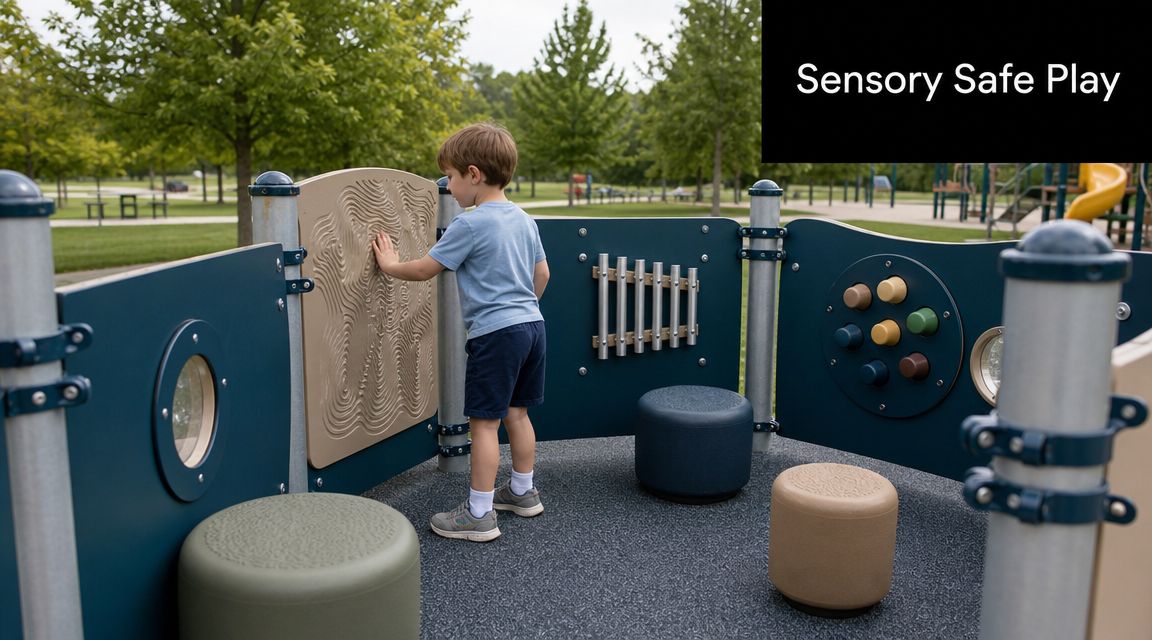
Some of the best examples of inclusive play start with children who won't go near a busy climbing frame. A sensory pod, sensory wall, or low-arousal multi-sensory zone gives those children a reason to enter the space on their own terms.
These installations work when they offer choice, not bombardment. Textured panels, turning elements, chimes, tactile pathways, colour contrast, and enclosed nooks can all help. What doesn't work is piling every sensory effect into one corner and calling it inclusive. If the space is visually loud, acoustically harsh, or exposed to constant through-traffic, many children will avoid it.
Kidzspace's range of sensory playground equipment in Australia is useful to review because it shows how sensory play can sit within a broader outdoor setting rather than being treated as a specialist add-on.
A sensory feature rarely succeeds in isolation. It needs a support setting.
Practical rule: Design sensory play on a dial, not an on-off switch. Children need low, medium, and high stimulation options.
I also recommend testing sensory concepts with occupational therapists and with the children who'll use the site. On paper, a musical panel looks inclusive. In practice, it may be too sharp, too repetitive, or too exposed. For a helpful plain-language overview of the developmental value behind these features, this piece on how sensory play boosts kids' skills is a useful companion.
A ramped structure changes who gets to move through a playground independently. That sounds obvious, but many designs still treat the ramp as a side entrance to one deck, then return to stairs, ladders, or bottlenecks everywhere else.
The better approach is a continuous circulation path. Children using wheelchairs, walking aids, or just needing a more gradual route should be able to travel through the play sequence, not merely reach the edge of it. Ramps also help younger children, grandparents, and carers who are moving with a child rather than supervising from a distance.
The biggest design mistake is over-focusing on compliance geometry and under-thinking play value. A ramp that leads to one token panel isn't meaningful access. A ramp that connects social decks, lookout points, tactile activities, slides with supported transfer points, and pause spaces creates real participation.
I'd also check these details early:
On sloping sites, civil and site coordination matters as much as equipment choice. The most elegant inclusive route is often shaped by the terrain itself, which is why early input from teams handling slope stability solutions and design can prevent awkward retrofits later.
Australian practice increasingly treats inclusive play as a linked environment rather than a single accessible object. Transferable case-study work on an all-inclusive adventure playground, discussed through UTA's landscape architecture thesis archive, reinforces that inclusivity depends on accessibility, social interaction, and physical skill development together. That's exactly the standard ramp systems should be judged against.
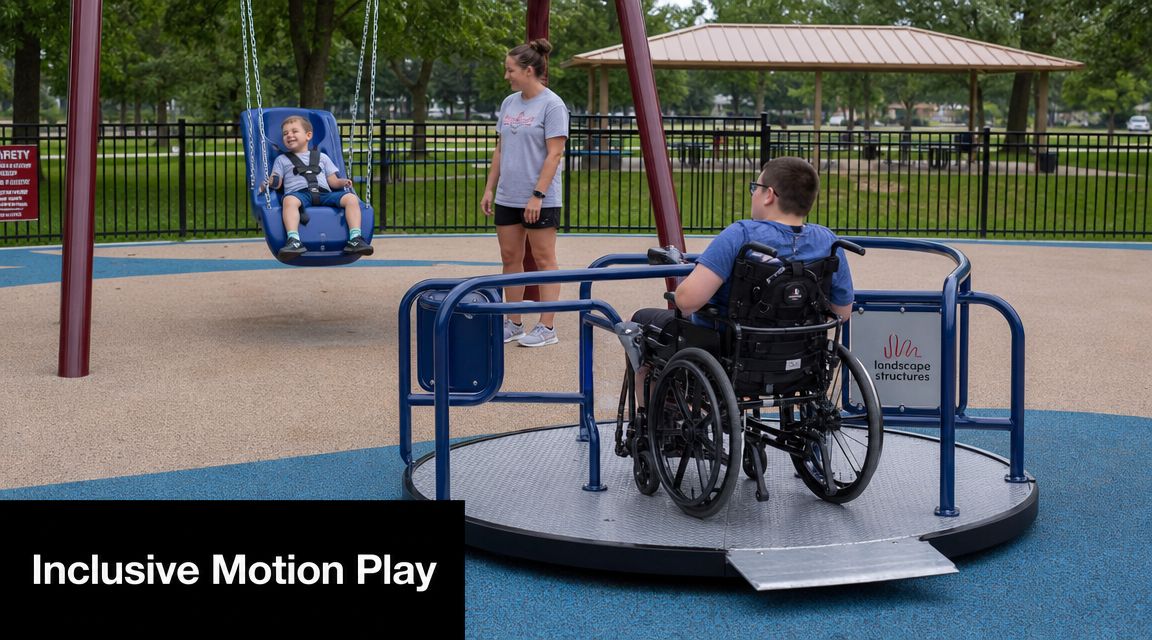
Motion play is where exclusion becomes very visible. One child swings. Another watches. One child can join the roundabout. Another can't get onto it, can't transfer safely, or can't tolerate the entry method. That's why adaptive motion equipment is one of the clearest examples of inclusive play done properly.
Wheelchair-accessible roundabouts, supportive nest swings, high-back seats, and platform-based motion elements expand who can participate in classic playground experiences. The value isn't only physical access. It's social parity. Children notice quickly when one activity lets everyone join the same game.
Not every adaptive swing solves the same problem. A body-support seat helps with trunk stability. A platform swing may help a child remain in a mobility device. A nest swing supports shared use and varied body positions. If you install only one “inclusive” swing, it often serves one user group well and leaves others out.
That's why I prefer mixed swing bays and a motion zone with genuine choice. Review options such as Kidzspace's disabled swing seat range as part of a whole play sequence, not as a standalone purchase.
Motion equipment should never force a child to choose between safety and dignity.
The practical side matters too. Adaptive roundabouts need level, slip-resistant approaches. Platform units need enough circulation space for entry and exit without congestion. Caregivers need clear setup guidance, especially where locking, latching, or transfer assistance is involved.
What works best is simple. Pick fewer motion pieces, but make each one usable, intuitive, and well supported by surfacing, spacing, and supervision lines.
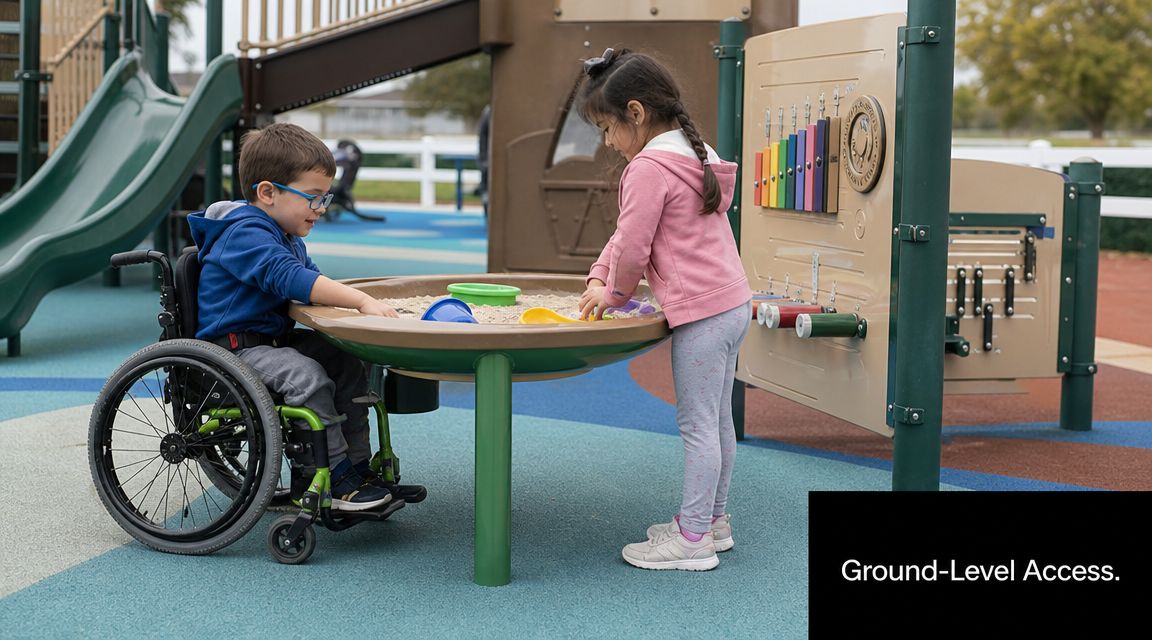
Ground-level play is often where inclusive design becomes most generous. It removes the social divide between “children who can get up there” and “children who must stay down here” by making the ground plane active, engaging, and worth choosing.
Accessible sand tables, play counters, music panels, cubby spaces, role-play stations, spinner bowls, tactile games, and low challenge balance features all belong here. When they're arranged well, children move between them naturally. When they're scattered as afterthoughts, they feel like waiting areas.
A zero-entry feature doesn't require a transfer, a climb, or a helper to get started. That independence changes how a child uses the space. It also changes how peers interact, because the activity begins on shared terms.
Good ground-level design usually includes variation in height and reach. A single fixed bench-height panel won't suit every user. Some children play seated, some standing, some kneeling, and some from a mobility device. A strong layout acknowledges that without making the area feel clinical.
A few details separate good from frustrating:
This is also one of the most budget-efficient ways to improve inclusivity in existing sites. If a full structural rebuild isn't possible, upgrading the ground layer with better surfacing and more meaningful zero-entry activities often delivers a stronger result than adding one inaccessible tower.
Children with low vision or blindness don't just need safe edges. They need a playground that communicates. The route should say where it goes, where it changes, and where key decision points sit.
That's where tactile pathways and auditory landmarks earn their place. A textured guide path from entry to the main play area, warning textures before changes in level, and sound-based orientation points can make the site easier to understand without over-signing everything. The layout should feel consistent enough that children can build confidence through repeated use.
I've seen projects spend heavily on equipment and almost nothing on navigation. The result is a technically accessible park that still requires constant adult guidance. For many families, that isn't independence.
What works better is spatial logic. Keep primary circulation clear. Use repeated textures for repeated meanings. Place auditory cues at important points, not everywhere.
You also need specialist input. Vision impairment consultants and users will pick up problems general design review often misses, such as confusing edge conditions, low-contrast transitions, or audio elements drowned out by adjacent activity.
If children can't read the site, they can't use it confidently.
Orientation maps and simple verbal descriptions at the entrance can help as well, especially in larger civic parks where multiple paths, toilets, seating areas, and play zones need to connect clearly.
Some children don't need more stimulation. They need permission to step out without leaving the social world of the playground.
A quiet zone does that when it's placed well. It should sit close enough to the main action that a child still feels part of the group, but screened enough to reduce noise, movement, and visual pressure. Planting, low walls, timber screening, curved seating, and small tactile activities often work better than over-designed “sensory shelters” that feel like separate rooms.
A regulation space isn't a timeout area. It isn't a place to send a child away for being overwhelmed. It's a self-directed reset point built into the environment.
I prefer muted colours, natural materials, and simple occupation. A bench with enclosure, a low lookout, soft tactile panels, or a small nook with passive play can all help. What usually fails is a token gazebo placed too far from supervision, with no reason for a child to choose it before they're already distressed.
A useful design and operations reminder for schools and carers is understanding the difference between overload states, which this explainer on autistic meltdown vs shutdown outlines in practical terms. The design takeaway is straightforward. Children need spaces that support regulation before escalation, not only after it.
Australian guidance also stresses that inclusive play should support social participation, not just access, which was highlighted earlier in the discussion of local planning and inclusive design through the PMC article. Quiet zones support that principle because they help children rejoin shared play instead of exiting it completely.
Some inclusive equipment is accessible but socially thin. A child can use it, but it doesn't give peers a reason to join. Cooperative play pieces solve that by making interaction part of the activity.
Think group seesaws, multi-user spinners, shared drums, hand-powered play events, and role-based structures where one child can lead, another can respond, and another can observe before joining. These are strong examples of inclusive play because they broaden what counts as participation. A child doesn't have to climb fastest or balance longest to matter in the game.
Good cooperative play gives each user a meaningful role. That's the detail many products miss. If one child does all the action and another merely occupies the accessible seat, the equipment hasn't solved the social problem.
Look for structures that allow different styles of involvement:
This matters for mixed-age and mixed-confidence groups as much as mixed-ability ones. In schools especially, collaborative play can reduce the way equipment gets dominated by the boldest children.
I've had the best results when these pieces sit near circulation routes and social seating, not hidden at the edge of the site. Children are more likely to invite others in when the equipment is visible, easy to interpret, and clearly built for group use.
Inclusive play shouldn't stop at early-years equipment. Older children often get left out because public sites assume “playground” for younger ages and “sport” for everyone else. If the sporting zone isn't accessible, participation drops away quickly.
Inclusive athletics stations close that gap. They can include wheelchair-friendly courts, hand-cycle style fitness pieces, multi-height skill walls, rebound elements, strength stations with seated access, and open activity zones that don't demand one narrow movement pattern. The best setups feel like recreation space first and “special access” second.
Teenagers and upper primary students often want challenge, repetition, and social competition. If your inclusive strategy ends at the junior tower and sand table, you've missed a large group of users. At this stage, councils and schools can extend inclusion into active recreation, not just traditional playground play.
Clear instruction matters more here than on many play items. Fitness and sport pieces should include text, pictures, and straightforward operating cues. Entry routes need to be wide, smooth, and obvious, and circulation around each station must allow side-by-side use.
The harder conversation is equipment selection. Some products look inclusive because they're low to the ground, but they offer limited utility for mixed-ability use. I'd rather see a smaller number of effectively usable activity stations than a crowded outdoor gym nobody understands.
This is also an area where maintenance can undo good intentions. Moving parts, bearings, and adjustable elements need regular checks, or the most inclusive equipment on the site becomes the first to fail.
Theme matters more than many spec sheets admit. Children don't arrive asking for a compliant route. They arrive wanting to drive the bus, run the animal rescue, defend the pirate ship, or hide in the forest camp.
That's why themed play is one of the strongest examples of inclusive play when handled well. A narrative-rich environment gives children multiple ways to enter the same game. One child can captain, another can deliver supplies at ground level, another can operate a sensory panel, and another can watch from a quiet cove before joining in.
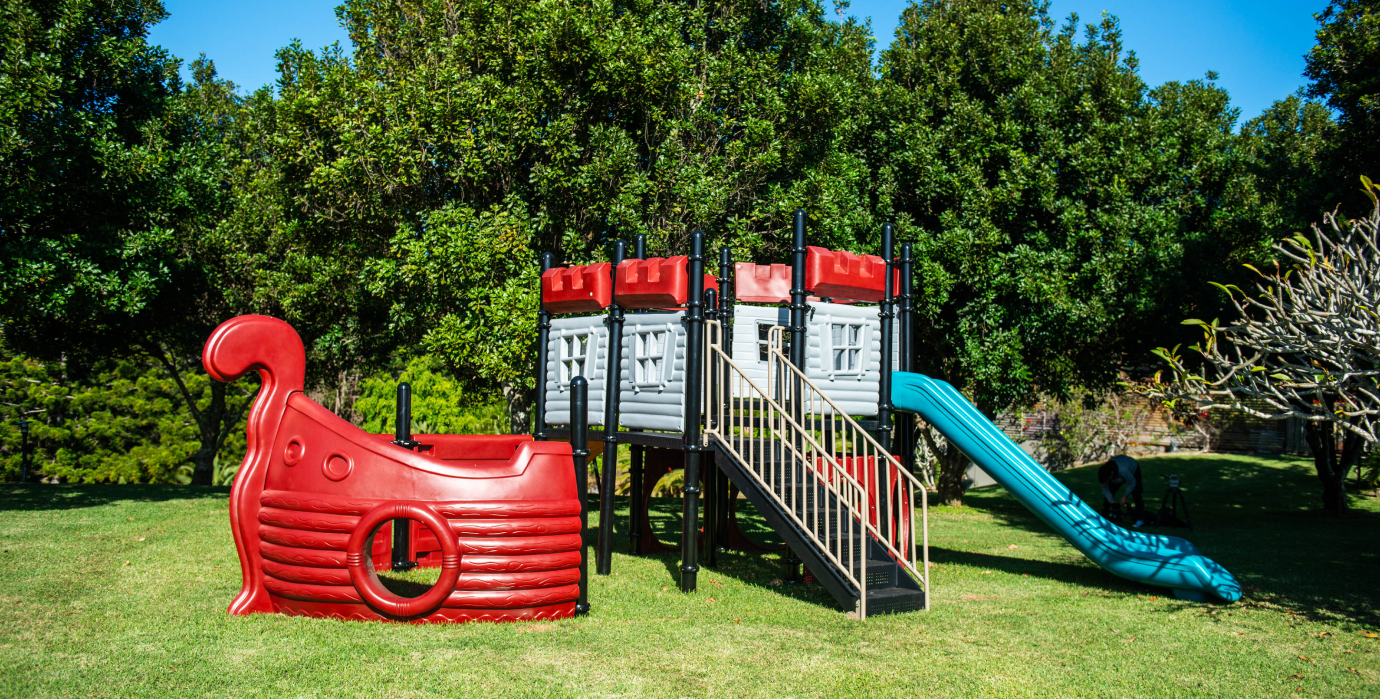
A painted pirate panel on an inaccessible structure isn't inclusive storytelling. A real narrative environment uses the theme to connect routes, roles, and sensory experiences. Paths become tracks, decks become stations, quiet corners become caves, and tactile elements become part of the story rather than separate therapeutic inserts.
Kidzspace's themed ranges are relevant here because they span animals, forest, vehicles, pirates, seasons, aircraft, soccer, and cube concepts across complete systems and freestanding pieces. That makes it easier to build a theme across different access points rather than concentrating all the “good stuff” on one raised unit.
The strongest themed environments also allow parallel play. Not every child wants dramatic role-play with a group. Some prefer to manipulate themed details, repeat a familiar script, or move through a story world independently. Inclusive design should support all of those patterns.
A good theme gives children shared language for play. A good inclusive theme lets them use that language in different ways.
For schools and councils, community input is especially important here. A theme should feel welcoming, culturally appropriate, and flexible enough to support different ages and identities.
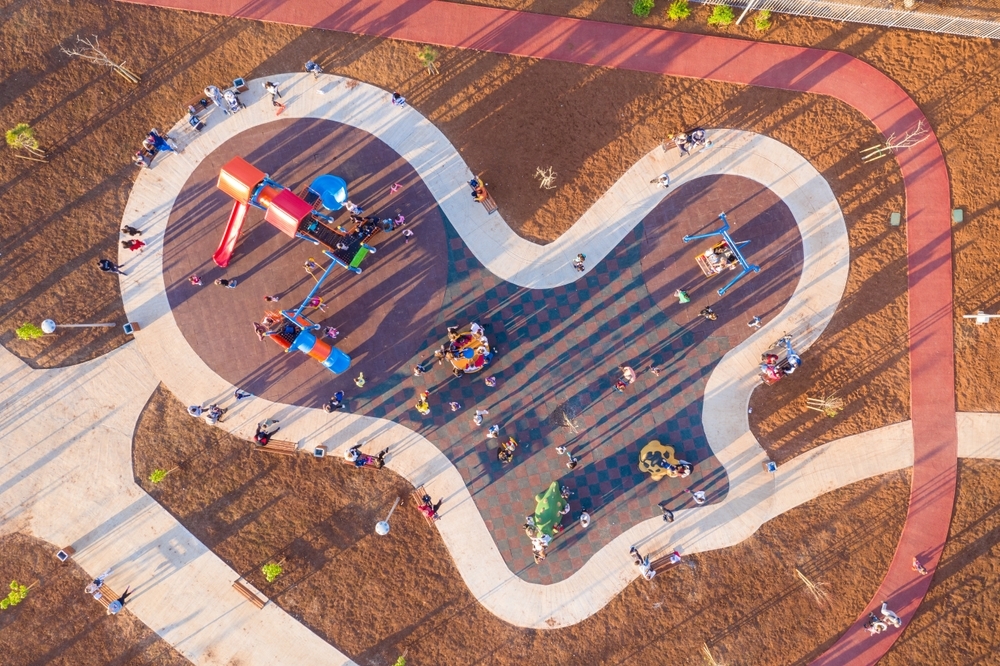
The most effective inclusive playgrounds don't rely on one standout item. They work because every layer supports the next. Entry, path, surfacing, equipment, seating, shade, signage, toilets, and social space all line up.
That system thinking is where universal design earns its keep. Instead of retrofitting access after the equipment is chosen, the site starts with the assumption that different abilities, regulation needs, and play styles will be present from day one. The result is usually calmer, clearer, and more durable.
A complete system often includes ramped access, ground-level activities, varied challenge levels, quiet nodes, sensory features, seating that supports carers and intergenerational use, and circulation routes that connect everything cleanly. It also plans for maintenance, because an inclusive site that can't be kept usable won't stay inclusive for long.
The overlooked question is often scale. Smaller regional and remote communities may not have the budget or staffing for a large destination park. In those settings, “minimum viable inclusivity” matters. The Sensory Trust's guidance on inclusive play is useful here because it reinforces that inclusion depends on a rich mix of physical, sensory, creative, and social opportunities, plus accessible information and signage, not just wheelchair access.
If you're planning from scratch, it helps to review how an all-abilities play space is assembled as a coordinated environment rather than as isolated products.
For Australian schools, councils, and community groups, this is the benchmark now. Inclusive play has moved beyond specialist provision and into mainstream planning expectations across public settings, as noted earlier in the broader shift toward universal design and shared participation.
| Play solution | Complexity 🔄 | Resources & maintenance ⚡ | Expected outcomes ⭐📊 | Ideal use cases 📌 | Key advantages 💡 |
|---|---|---|---|---|---|
| Sensory Play Pods & Multi‑Sensory Equipment | High, specialist design + electronics integration | High, electronics, weatherproofing, regular checks | Strong sensory engagement; improved regulation and inclusion | Schools, special‑ed centres, public parks | Safe, research‑backed multisensory exploration |
| Ramp‑Based Play Systems & Sloped Access | Moderate‑high, civil/engineering works required | High, space, structural materials, surface upkeep | Greater independent access to elevated play | Parks, schools, landscape masterplans | Enables mobility‑aid access; reduces caregiver dependence |
| Adaptive Motion Equipment (roundabouts, swings) | High, specialised installation and safety systems | High, mechanical parts, harness upkeep, inspections | Vestibular input; social inclusion; therapeutic benefits | Schools, therapy centres, public parks | Allows wheelchair users to experience motion play |
| Ground‑Level & Zero‑Entry Play Equipment | Low‑moderate, layout and accessibility detailing | Moderate, accessible surfaces, drainage, adjustable fittings | Independent participation for mobility‑limited children | Early learning centres, parks, community spaces | Eliminates vertical barriers; broad immediate accessibility |
| Visual‑Impairment Friendly (tactile/audio) | High, specialist sensory and wayfinding design | Moderate‑high, tactile paving, audio tech, ongoing maintenance | Improved wayfinding and independent navigation | Schools, parks, community recreation areas | Reduces reliance on sighted support; boosts confidence |
| Quiet Zones & Regulation Spaces | Low, placement and low‑stimulus design | Low‑moderate, sound‑dampening, seating, supervision | Reduced sensory overwhelm; longer, safer play sessions | Schools, parks, early learning centres | Cost‑effective calming space for neurodivergent users |
| Collaborative & Cooperative Multi‑User Equipment | Moderate, coordinated safety and interaction design | Moderate, durable build, signage, supervision | Enhanced peer interaction, cooperation and social skills | Primary schools (mixed ages), programmed parks | Promotes inclusive social play and teamwork skills |
| Accessible Sporting & Fitness Stations | Moderate‑high, specialist equipment layout | High, mechanical maintenance, space, specialist suppliers | Increased physical activity access; skill development | Schools, community sports facilities, parks | Enables athletic participation for diverse abilities |
| Themed Imaginative Play with Inclusive Design | High, narrative design + accessible integration | High, themed props, ongoing maintenance, designers | Sustained imaginative engagement across abilities | Parks, primary schools, community spaces | Integrates accessibility into appealing storytelling |
| Accessible Playgrounds as Complete Systems | Very high, master planning & stakeholder coordination | Very high, consultants, construction, long‑term upkeep | Genuine universal inclusion; community‑wide benefits | Park redevelopments, school masterplans, councils | Universal design from inception; avoids piecemeal retrofits |
Creating inclusive play spaces isn't about chasing a checklist of approved features. It's about deciding, early, that the playground should work for a wider range of children than the default brief usually imagines. Once that decision is made, your design choices become clearer. You stop asking whether to add one accessible item and start asking how the whole environment can support participation.
That shift changes procurement as much as design. Schools often begin with equipment categories. Councils often begin with site constraints. Community groups often begin with a wish list. All three approaches can work, but only if someone steps back and asks how children will move through the space, where they'll pause, how they'll orient themselves, what kind of social play will happen, and what support the site gives a child who is overwhelmed, less mobile, vision impaired, or reluctant to join high-energy activity.
The strongest examples of inclusive play usually combine three layers. First, there's physical access. That includes paths, surfacing, approach widths, ramps, and zero-entry elements. Second, there's sensory and emotional usability. That covers quiet zones, low-arousal options, tactile features, legible wayfinding, and places to regulate. Third, there's social value. That means children can do things together, not just alongside one another in separate “special” areas.
If you're working with a limited budget, don't assume inclusion requires a giant destination playground. In practice, smaller sites often improve fastest when they focus on a connected accessible route, a good mix of ground-level play, one or two well-selected adaptive motion items, and a calm retreat space. That combination usually serves more users than a single expensive structure with poor circulation and no regulation support. Durable materials and low-maintenance features also matter, especially in regional settings where upkeep capacity may be tight.
I'd also be realistic about what doesn't work. Token ramps that lead nowhere don't work. Sensory equipment without a quieter nearby reset zone doesn't work. Signage that explains inclusion but a layout that still isolates children doesn't work. A playground only becomes inclusive when children can participate with some independence and with dignity.
For Australian projects, standards and compliance frameworks matter, but they should be the floor, not the ambition. The better target is meaningful participation. Children should be able to arrive, understand the space, choose challenge, play with others, take a break, and return without the environment pushing them to the margins.
If you're comparing suppliers or preparing a concept brief, look for teams that can support complete-system thinking. Kidzspace is one option in that conversation because its range includes complete play systems, freestanding inclusive elements, themed environments, sensory play features, swings, and outdoor fitness equipment that can be combined across different site types and age groups. That breadth can help schools, councils, and community organisations build a more coherent inclusive strategy instead of buying isolated pieces that don't connect well on site.
A good inclusive playground doesn't announce itself with one feature. It feels easy to use, easy to join, and hard to outgrow.
If you're planning an inclusive play upgrade or starting a new project, Kidzspace can help you shape a practical brief, compare equipment options, and develop a playground layout that balances accessibility, durability, budget, and play value for your site.
Ready to Build Your Playground?
Explore our full range of commercial playground equipment — from play systems and swings to soft fall surfacing and fitness stations.



Copyright © Kidzspace. All Rights Reserved.
Copyright © Kidzspace. All Rights Reserved.