


A lot of outdoor gym projects start the same way. A park has good foot traffic but low dwell time, or a school has a spare edge zone that isn't doing much, and someone gets asked to turn it into something useful. The brief sounds simple at first: add an outdoor gym equipment pull up bar.
The difficult part is not selecting a bar. It is ensuring the final installation withstands Australian weather, fits the individuals who will use it, and avoids becoming a maintenance or safety compliance issue two years down the line.
That's where many first-time specifiers get caught. Cheap imports can look fine in a brochure. Surface-mounted units can seem easier. A single adult-height bar can appear versatile. On site, those decisions often age badly. Salt air, UV exposure, drainage, user mismatch, and documentation gaps have a way of exposing weak choices quickly.
A council project manager usually isn't starting with a blank sheet. There's already a park, a budget line, a timeline, and a set of competing expectations from community teams, asset managers, and risk officers. One group wants visible health outcomes. Another wants low maintenance. Parents want something family-friendly. Older teens want equipment that feels real, not token.
That's why a pull up bar installation works best when it's treated as public infrastructure, not as a catalogue add-on.

Search behaviour backs up what many councils and schools are already seeing on the ground. The pull-up bar market saw search volume increase by 100% from 2020 to 2025, with interest rising from a normalised score of 35 to 70, according to pull-up bar market trend data. That matters because it signals a broad shift toward accessible, effective outdoor fitness equipment rather than a passing fad.
In local government settings, the request rarely arrives as “we need a pull up bar”. It usually arrives in one of these forms:
A well-specified pull up bar station can serve all of those goals, but only if it's located and configured properly.
A good fitness node changes how people use a park. It gives older children and adults a reason to stop, not just pass through.
The difference between a successful installation and a disappointing one usually comes down to mindset. If you buy for the opening day photo, you focus on appearance and price. If you buy for the next twenty years, you focus on compliance records, material finish, foundations, replacement risk, and who will inspect it.
That's the right lens for any outdoor gym equipment pull up bar in Australia. The bar itself is only one part of the decision. The surrounding questions are what determine whether the site becomes a fitness hub or another line item that facilities teams have to keep rescuing.
The planning mistakes happen before any contractor arrives. If the wrong site is chosen or the wrong user group is assumed, even excellent equipment won't perform well.
Start with the people, not the product. Ask who the station is really for. A single adult-height bar in a family park sends a different message from a multi-height station near a youth recreation zone.
A practical planning review should cover these areas:
For councils evaluating broader outdoor gym layouts, it helps to review examples of commercial outdoor gym planning in Melbourne to compare how stations are grouped, spaced, and integrated into public spaces.
A pull up bar works better when it belongs to a small activity zone rather than standing alone in isolation. That doesn't mean overbuilding the site. It means thinking about how people move through the space.
A useful layout often separates users by activity style:
| Zone focus | What belongs there | Why it works |
|---|---|---|
| Strength and bodyweight | Pull up bars, parallel bars, low support bars | Keeps dynamic movement together |
| Family edge | Lower challenge items nearby | Makes mixed-age use feel more welcome |
| Rest and supervision | Seating, shade, open sightlines | Supports carers, teachers, and social use |
That simple zoning approach reduces conflict between users. It also makes the site easier to understand at a glance.
Practical rule: If people can't tell from the path that the station is meant to be used, usage will be lower than expected.
Three issues come up repeatedly in first installations.
First, the site gets chosen for leftover space rather than suitability. Second, the station is placed too close to other park elements, which creates awkward movement and supervision problems. Third, no one checks how the subgrade behaves after rain.
The strongest projects avoid all three. They place the pull up bar where it feels intentional, visible, and connected to the wider park, not hidden at the boundary because that's where space happened to be available.
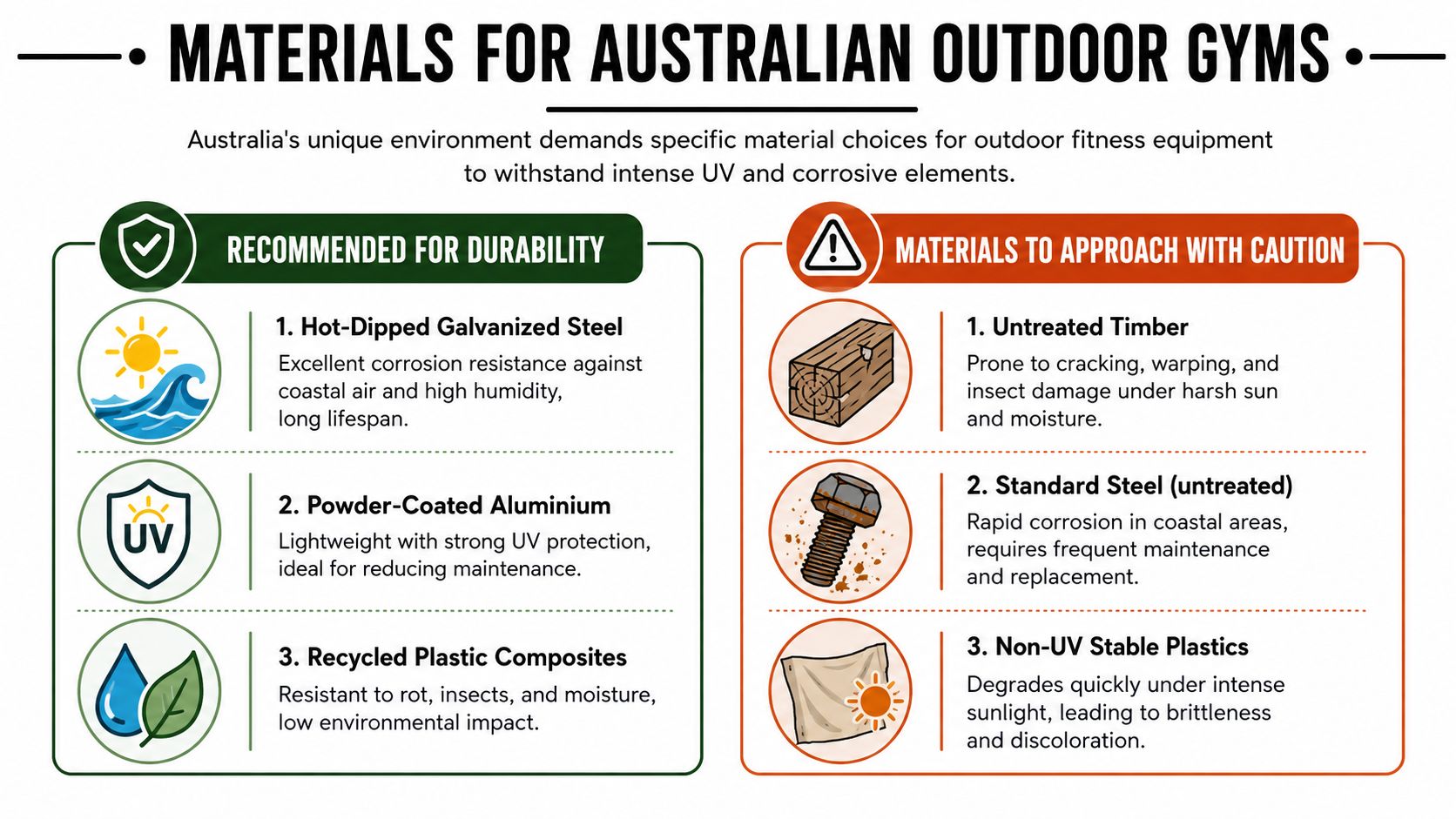
Material choice is where lifecycle cost is won or lost. In Australian conditions, the finish system matters just as much as the steel itself. Coastal salt, strong UV, humidity, and wet-dry cycles expose weak specifications quickly.
That's why the generic overseas advice often falls short. It may describe a functional pull up bar, but it doesn't always account for what happens after repeated summers, salt-laden air, or poor edge protection around welds.
Professional outdoor pull-up bars are engineered with 11-gauge steel and multiple bar diameters ranging from ø25mm to ø48.3mm, which allows for different grips and user abilities, according to outdoor pull-up bar construction guidance. The same source notes that a practical bar height is 20 to 30 centimetres above the user's head, which allows full range of motion and supports training across the back, biceps, shoulders, and core.
For specifiers, that translates into a few essential requirements:
| Material or finish | Practical outcome in Australia | Procurement view |
|---|---|---|
| Hot-dip galvanised steel | Strong defence against corrosion, especially in harsher environments | Usually worth the upfront cost |
| UV-stabilised powder-coated metal | Better colour and surface durability in strong sun | Good where coating system is specified properly |
| Untreated standard steel | Vulnerable to early corrosion | False economy for public sites |
| Non-UV-stable plastics | Can become brittle or discoloured | Use carefully and selectively |
If you're reviewing coating options in more detail, this guide to durable metal finishes for external environments is a useful companion resource. It's not Australia-specific, but it helps frame the questions a supplier should be able to answer about outdoor finishing systems.
Australian outdoor assets don't fail only because the base material was wrong. They fail because the whole specification chain was weak. The steel might be adequate, but the galvanising is light. The powder coat looks fine, but UV performance is poorly matched to exposure. The product may be structurally sound, but fittings and touch points age at a different rate.
In coastal and high-exposure settings, locally considered solutions usually justify themselves. For examples of systems intended for these harsher environments, it's worth comparing corrosion-resistant commercial fitness equipment against standard products and asking where the specification differs.
The supplier should be able to explain not just what the product is made from, but how it's protected after fabrication and why that suits your site.
A common procurement mistake is to accept broad phrases such as “weather resistant” or “outdoor rated” without asking what they mean in technical terms. Another is to focus on wall thickness while ignoring finish quality and detailing.
The result is familiar. The bar still stands, but the appearance drops, corrosion starts around joins, and the asset team inherits a maintenance burden that wasn't obvious in the quote stage. For an outdoor gym equipment pull up bar, the better question isn't “what's the cheapest acceptable unit?” It's “what material system still looks and performs properly after years outside?”
Compliance is where many projects either become defensible or exposed. In public space, a pull up bar isn't just exercise equipment. It's an asset people will climb, hang from, swing on, misuse, and test in ways the brochure photos never show.
That's why the Australian standards framework matters. It gives specifiers and asset owners a structure for checking whether the equipment and installation are fit for public use.
For outdoor gym pull-up bars in Australia, compliance centres on the AS 4685 series, with load testing methodologies referenced in AS 4685.6, and related public safety obligations also touching AS 1926.1 in the verified data. The testing isn't symbolic. It includes static load testing at 1.25 times the maximum user weight, dynamic impact testing simulating 1000 cycles of 110kg drops from 100mm height, and fatigue testing of 50,000 cycles at operational loads, as set out in the verified compliance summary at Australian pull-up bar testing and pass-rate guidance.
The same verified data notes that a 2023 Standards Australia survey found 22% of non-compliant imported equipment failed due to undersized galvanising, while compliant Kidzspace equipment reported a 99.7% pass rate in independent NATA-accredited testing.
Those figures tell a simple story. Compliance paperwork isn't red tape for its own sake. It's one of the clearest indicators of whether the product has been engineered for public conditions.
A supplier may say a unit is “built to standard” or “tested for quality”. That's not enough. Public buyers need actual evidence.
Check for:
If those records are missing, the asset owner carries the risk.
If a supplier can't provide the compliance trail, treat that as part of the specification, not an administrative detail to resolve later.
The bar itself is only part of the safety picture. Signage, intended user information, surrounding surfacing, maintenance intervals, and inspection records all support the compliance position. A strong product can still become a liability if the operating context is poor.
That matters especially for mixed-use parks where children may use equipment intended for older users. In those settings, risk control comes from design choices, station selection, and documented maintenance, not from assuming users will self-regulate.
For councils and schools, the practical takeaway is straightforward. A compliant outdoor gym equipment pull up bar costs more to procure properly than a loosely documented import. It costs far less than defect rectification, early replacement, or a preventable incident tied to foreseeable non-compliance.
Most failures blamed on “the equipment” are, in fact, installation failures. The bar may be sound, but the footing is shallow, drainage was ignored, or the mounting method never suited the site.
For public settings, anchoring deserves the same scrutiny as the steel and finish.
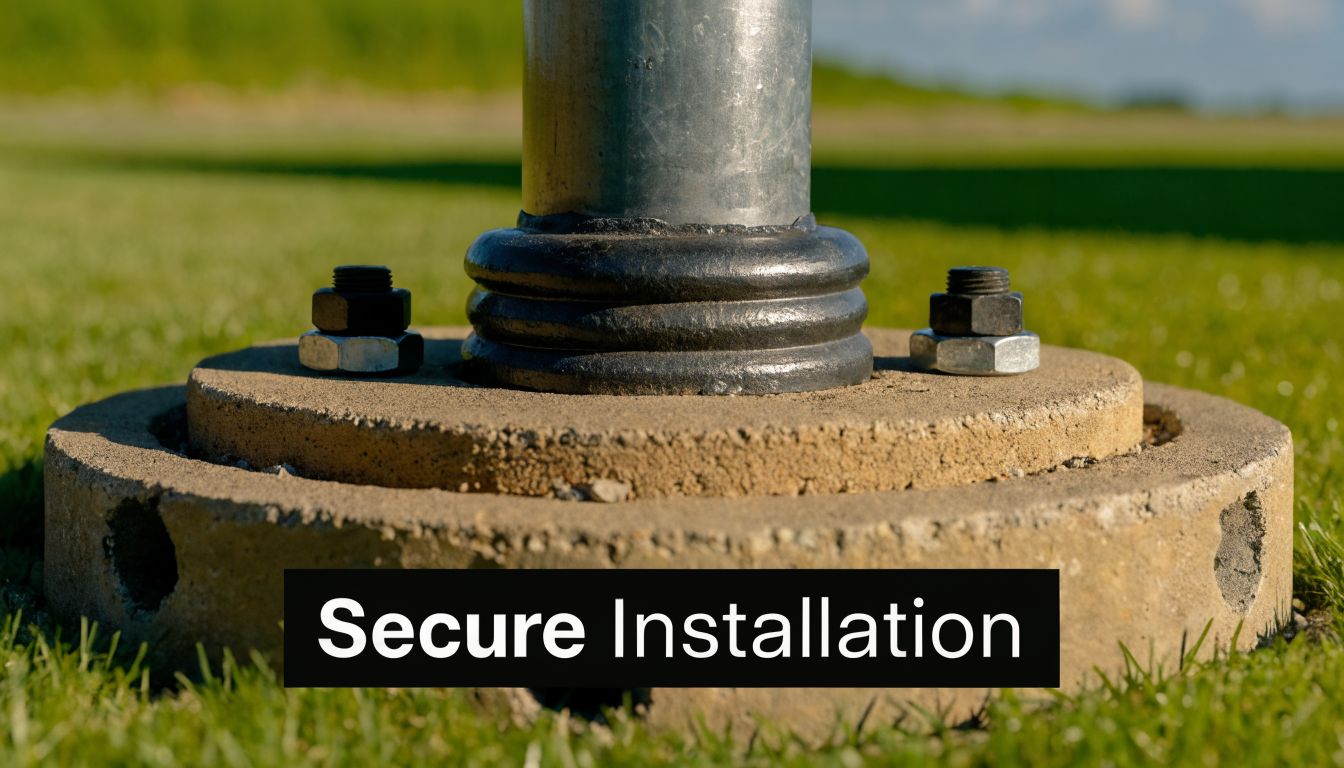
Surface mounting can work in the right context, but it often gets overused because it looks simpler. In clay soils or exposed areas, it can become the weak point of the whole installation.
Verified installation guidance describes a 7-step process that includes a site geotechnical survey, wind load calculations, 900mm deep concrete foundations, galvanising, controlled assembly, functional testing, and sign-off. According to a 2025 APLA report, this process achieves a 92% first-time success rate, compared with lower outcomes for DIY-style approaches, as summarised in professional outdoor pull-up bar installation guidance.
The same verified data flags common failures from poor drainage and unanchored surface mounts in clay soils. Those aren't small details. They're often the reason an otherwise decent product has to be revisited.
A dependable install usually follows this logic:
Check the ground first
Soil bearing, drainage path, and local wind exposure affect the foundation design.
Build the footing for the site, not for convenience
Public-use pull up bars need footing depth and reinforcement that match the expected loading and local conditions.
Use the right fixings and torque control
Hardware quality is part of structural performance, not an afterthought.
Confirm alignment and functional behaviour before sign-off
A slight twist or level issue becomes obvious once users start swinging and transitioning.
For readers comparing anchoring principles across other outdoor structures, this overview of hurricane anchors for sheds is useful as a general reference for thinking about uplift, restraint, and site-specific anchoring loads.
Before practical completion, check these items on site:
This installation clip gives a useful visual sense of fit-out and assembly context in outdoor settings:
| Method | Best use case | Main caution |
|---|---|---|
| In-ground footing | Most public parks, schools, high-use sites | Requires proper excavation and concrete works |
| Surface mount | Limited retrofit situations with suitable slab and engineering | More sensitive to site and anchoring errors |
A pull up bar feels simple because it has few moving parts. Installation proves that simplicity can be misleading. The public will apply repeated dynamic force to a small structural footprint. If the ground interface is weak, everything above it suffers.
A single high bar may satisfy a specification line, but it won't serve the whole community. The best outdoor fitness spaces give more people a way in. That means beginners, children, teenagers, older users, and people who need modified movement options all need a realistic point of entry.
Inclusive design is often treated as a separate conversation from strength training. In practice, they're closely linked. A station that only works for strong adult users will have lower community value than one that supports progression.
Verified child-safety data shows that standard adult pull-up bars increase injury risk for under-12s by 40%, and that youth-inclusive designs with height-adjustable bars and impact-absorbing surfaces are critical, according to guidance on youth-inclusive pull-up bar design. The same verified data notes that themed stations boosted usage by 35% in trials.
That matters in schools, mixed-use parks, and neighbourhood reserves where younger users will interact with the equipment whether or not they were the original target group.
An inclusive station usually combines several ideas rather than relying on one.
Good inclusive design doesn't water down the training value. It increases the number of people who can use the space meaningfully.
People don't use outdoor fitness stations merely because they exist. They use them when the station looks approachable, fits their ability level, and feels socially acceptable to try.
That's why lower bars matter. So does spacing for bodyweight movement. So does making the equipment legible from a path. If a first-time user can see one movement they feel capable of doing, the station has a much better chance of becoming part of their routine.
For councils and schools, an outdoor gym equipment pull up bar serves as a nexus for accessibility and participation. It should challenge confident users, but it should also invite everyone else.
The cheapest quote is rarely the cheapest asset. With outdoor gym equipment, the number that matters most isn't the purchase price. It's the combined cost of supply, installation, inspection, maintenance, repair, repainting, and replacement over the life of the station.
That's where many imported products lose their appeal. They can enter the project at a lower upfront cost, then absorb staff time and maintenance budget for years.
Verified lifecycle data shows that investing in locally made equipment designed for Australian conditions, including systems with AS 2312.1 galvanising, can cut long-term maintenance costs by 45% and extend equipment lifespan by 85% over 20 years, according to outdoor pull-up bar lifecycle cost guidance.
Those outcomes matter more than the sticker price because they affect operating budgets, replacement timing, and procurement frequency. A slightly cheaper unit that needs earlier remedial work isn't a savings story. It's deferred cost.
A sound procurement process should test more than dimensions and appearance. It should ask:
Where a project includes bodyweight training elements beyond a single bar, it can help to compare complementary assets such as commercial parallel bar gym equipment during specification so the precinct works as one coordinated system rather than a series of isolated pieces.
The best maintenance plan is the one your team will realistically carry out. Keep it simple and repeatable.
Buy the station your maintenance team can live with, not the one that only looks competitive at tender stage.
Budget pressure is real, especially for schools and councils balancing multiple site upgrades. But compromise should happen in scope, not in compliance or durability. It's better to install fewer well-specified elements than to install a larger package that starts deteriorating early.
That's the core procurement lesson for an outdoor gym equipment pull up bar. If the station is meant to serve the public for years, lifecycle thinking is the only sensible way to buy it.
Kidzspace helps schools, councils, and community project teams plan outdoor fitness and play spaces that are compliant, durable, and functional. If you need support with specification, budgeting, or selecting equipment that suits Australian conditions, book a consultation with Kidzspace.


Copyright © Kidzspace. All Rights Reserved.
Copyright © Kidzspace. All Rights Reserved.