



A lot of school boards, P&C committees, and council teams start in the same place. One swing seat has cracked, another has faded hard in the sun, and someone says, “Let’s just replace the seats.” Then the quote requests go out, product photos start arriving, and the job stops looking simple.
That’s usually the point where the key questions surface. Which seat type suits which age group? What will pass an Australian compliance audit? Which materials hold up near the coast or through repeated heatwaves? How do you make the swing zone more inclusive without creating a maintenance headache or buying a seat that won’t suit the frame you already have?
Childrens swing seats sit in that awkward category of playground procurement where the item looks straightforward, but the consequences of getting it wrong are not. A poor choice can create avoidable injury risk, shorten replacement cycles, complicate supervision, and push up lifecycle cost. A good choice supports safe movement, broader participation, and a cleaner long-term asset plan.
A facilities manager replacing “just two seats” often ends up reviewing the whole swing bay. The chains may still look serviceable, but the connectors are worn. The surfacing has compacted. The toddler seat that worked years ago no longer suits the service mix, because the school now has stronger inclusion expectations and a wider age spread using the space.
That’s where price-only decisions usually go wrong. The cheapest catalogue option can look acceptable in a product thumbnail, but public and school playgrounds don’t operate like backyards. They face heavier daily use, stricter duty of care, and exposure to Australian UV, wind, heat, and in many areas, salt.
In practice, the seat itself is only one part of the decision. The actual procurement question is broader:
Practical rule: If a supplier can describe colour options faster than they can describe compliance, material performance, and replacement planning, keep asking questions.
The best childrens swing seats are rarely chosen in isolation. They’re selected as part of a swing system, a surfacing system, and a supervision strategy. That’s why experienced buyers assess seat type, hardware, spacing, surfacing, and maintenance together, not as separate line items.
The term childrens swing seats covers several very different products. They don’t just vary in shape. They serve different developmental stages, different support needs, and different supervision realities.
A bucket seat works a bit like a high-support first chair. It surrounds the child, limits slip-through, and gives carers confidence that the user is held in a stable position.
These are the seats commonly chosen for toddler zones because they create containment and support. They suit supervised play areas where the priority is secure early movement rather than big arc or speed. The trade-off is throughput. Bucket seats are highly age-specific and can’t do the broad all-ages job that a flat seat can.
Cradle seats sit between a bucket and a conventional flat seat. They offer more support than a belt seat but don’t enclose the child to the same extent as a full toddler bucket.
These can work well where the user group is transitioning out of a fully enclosed seat. The limitation is predictability. If the site attracts a very wide mix of users, cradle seats can become a compromise product that doesn’t fully satisfy either the youngest users or older children seeking freer movement.
Inclusive seats are designed for children who need more support with posture, balance, transfer, or body positioning. Some use harness-style support, some rely on higher backs or more stable seating geometry, and some are configured to make adult assistance easier during transfer.
Their strength is obvious. They broaden who can participate. Their trade-off is that specification needs to be more precise. If the seat doesn’t match the likely support needs of the users, it can become underused or difficult for supervisors to manage efficiently.
Nest seats create a shared play experience. They can support multiple body positions and often appeal to children who prefer a gentler, more social swing experience.
For public parks, they can be excellent community pieces because siblings and friends can engage together. The challenge is that they require disciplined planning around space, motion path, and supervision. If they’re squeezed into a layout designed for standard seats, they can create circulation and clearance problems.
The belt or flat seat is still the workhorse of most school and council swing bays. It’s simple, familiar, easy to supervise, and suits a broad age range once children have the balance and coordination for independent use.
For many sites, this is the highest-value seat type because it gets steady use and is easy to replace. The drawback is that it offers the least support. It should never be treated as a universal answer for all users.
| Seat Type | Target Age | Primary Use Case | Key Features |
|---|---|---|---|
| Bucket Seat | Infants and toddlers | Early years play with high support | Enclosed seating, greater security, supervised use |
| Cradle Seat | Younger children transitioning from toddler support | Intermediate support where full enclosure isn’t needed | More supportive shape than flat seats, easier progression |
| Inclusive or Adaptive Seat | Children needing additional physical support | Accessible play and integrated play opportunities | Higher support profile, transfer-friendly options, stability-focused design |
| Nest Seat | Mixed ages under supervision | Social swinging and varied body positioning | Shared use, broad appeal, non-traditional movement style |
| Belt or Flat Seat | Older children with independent balance | High-throughput school and park use | Familiar profile, easy supervision, versatile general use |
A good swing bay usually mixes seat types. A bad one assumes every child wants, or can use, the same seat.
What works is matching the seat to the dominant user pattern on the site. An early learning centre needs a different mix from a district park. A primary school with an inclusion unit needs a different mix from a reserve used mostly by older children after school.
What doesn’t work is copying a layout from a catalogue image. Procurement teams should treat childrens swing seats as functional equipment, not decorative accessories. The right seat earns its place by serving a real user need, fitting the frame, and staying manageable for staff over time.
A council can approve a swing package that looks balanced on paper, then spend the next five years managing queues, staff complaints, and avoidable wear because the seats do not match the children using the site. Age matters, but it is only one part of the specification. Ability, transfer needs, supervision levels, and the way Australian schools and parks are used day to day matter just as much.
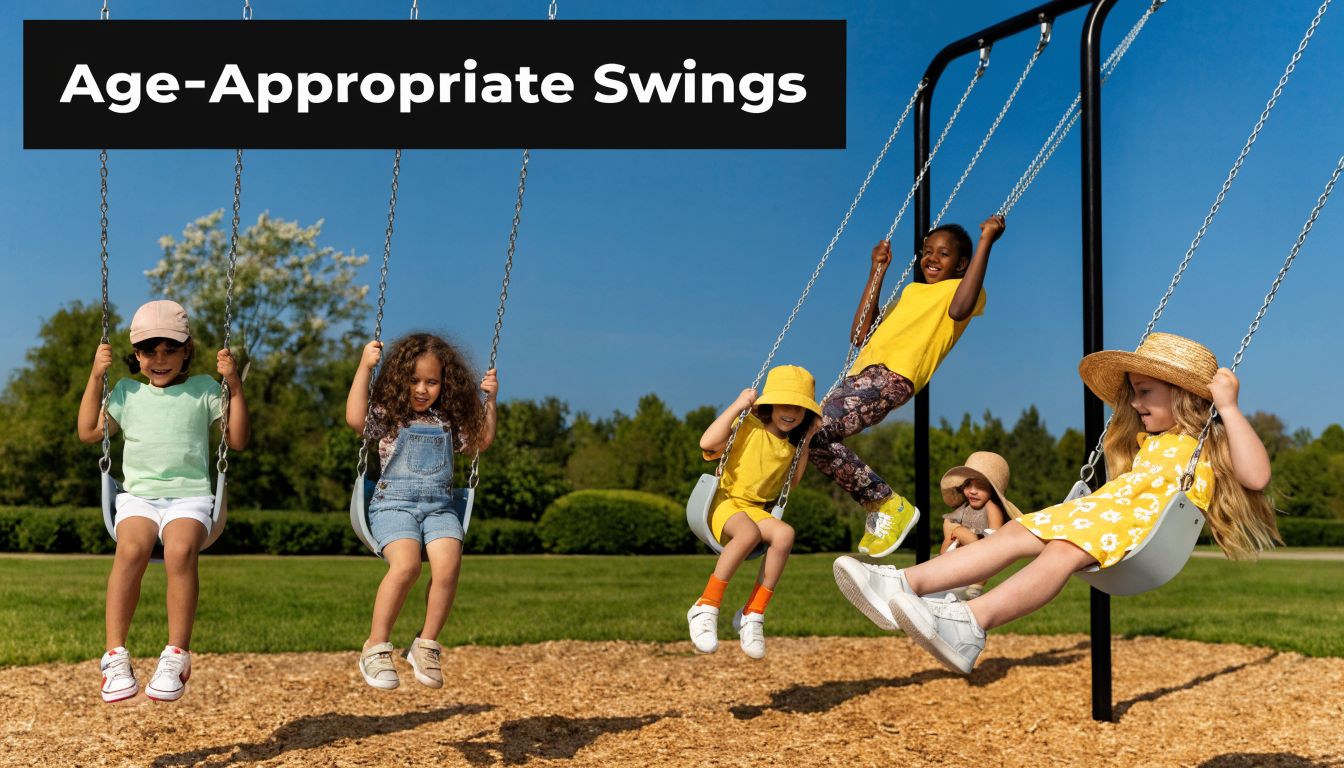
For the youngest users, the priority is support, body position, and containment during ordinary movement. Toddlers do not sit square and hold consistently. They slump, twist, lean sideways, and let go without warning. That is why high-support seats are usually the right call for children who are still developing trunk control and basic swing confidence.
In practice, procurement teams should check more than the age label on the product sheet. Seat depth, leg opening geometry, front restraint profile, and chain connection height all affect how secure the child feels and how easily a carer can place and remove them. The swing also needs to suit the actual supervision model on site. A sessional kindergarten with close adult assistance can specify differently from a busy public reserve.
The transition stage is where many projects get the mix wrong. Children in this group want more freedom, but they still benefit from some shaping and support, especially in schools where play periods are short and staff cannot provide one-to-one assistance at every bay.
Cradle-style or intermediate-support seats often work well here. They let children practise mounting, gripping, and balancing with less confinement than a toddler seat. That makes them a practical bridge, particularly in early primary settings and inclusive school environments.
The test I use is simple. Can the child approach, transfer onto the seat, swing, and dismount with the level of supervision the site can realistically provide every day? If the answer is no, the seat is wrong for that location, even if the catalogue says it suits the age range.
Older children usually want a cleaner swing action and more control over movement. They pump harder, jump off more often, and use swings repeatedly through high-traffic periods. Belt and flat seats generally suit that pattern because they are quick to use, easy to supervise, and less likely to slow turnover in a busy school or municipal park.
There is a trade-off. A highly supportive seat can look safer to adults, but for older capable users it often reduces play value and leads to disuse. The reverse is also true. A flat seat installed too early can create avoidable assistance demands and poor access for children who are not ready for that level of independence.
Inclusive provision needs more than a token accessible seat. The whole swing setting should allow children with different abilities to participate alongside peers, with practical access for carers and staff.
A useful specification approach is to plan combinations based on actual user groups:
Adaptive seats also need a harder procurement review than standard seats. Check transfer method, harness or restraint complexity, manual handling implications for staff, and whether the seat will still be used during peak periods. Some products perform well for a narrow user group but create delays, supervision pressure, or maintenance issues in general community settings.
Seat selection and bay layout should be decided together. An inclusive seat placed at the far end of a swing run, with poor path access or limited standing room for assistance, often underperforms no matter how good the product is.
Clear lines of sight matter. So does enough circulation space for carers, education support staff, and mobility devices. For school and council projects, it helps to review seat selection against broader school playground safety standards and risk planning requirements before the order is locked in.
The strongest result usually comes from specifying for the dominant user pattern, then adding range where it will be used. That approach gives better supervision outcomes, better wear performance, and better value over the life of the site.
A swing project can look settled at committee stage and still fail at practical review. The usual problem is not the seat alone. It is the gap between a supplier’s marketing language and the evidence needed to show the installation will comply on an Australian site.
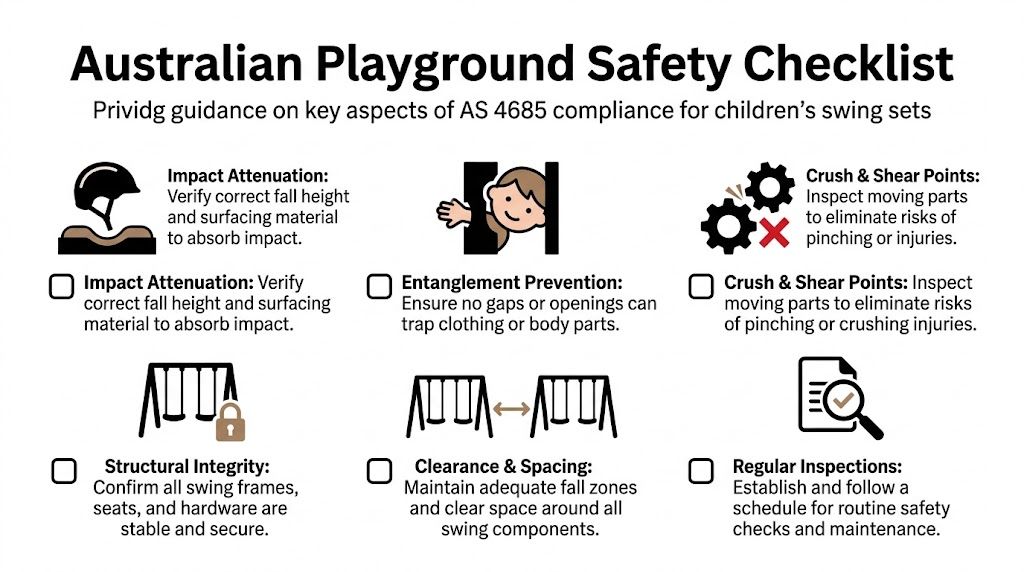
For childrens swing seats, AS 4685 applies to more than the moulded seat body. It affects the full swing system, including clearances, impact area, entrapment risks, moving parts, and the way the equipment is assessed after installation. That is the point many buyers miss. A seat can arrive with paperwork and still be wrong for the bay, spacing, chain set, or surfacing specified on site.
Procurement teams should also be careful with overseas sizing and performance claims. Australian compliance decisions should be based on local documentation, local installation conditions, and the relevant parts of AS 4685, not catalogue language such as “commercial grade”, “heavy duty”, or “school suitable”.
In practice, I advise schools and councils to ask a simple question early. Can the supplier show exactly how this seat, chain, shackle, bay spacing, and surfacing combination meets the intended Australian installation standard?
The compliance risk usually sits in the details around the seat, not just in the seat itself.
Check these items before approval:
Experienced specification work saves money. The cheapest tender often becomes the expensive one if the site team has to correct spacing, replace hardware, or answer audit questions after handover.
A guide written for North America or Europe can be useful for basic product categories, but it rarely deals properly with Australian exposure conditions. High UV levels, extreme heat, salt air, and heavy school or council usage all affect how well a swing stays within safe operating condition over time.
That matters under AS 4685 because compliance is not just a purchase event. It has to hold up in service. On a coastal reserve, for example, I would look much harder at connector corrosion, chain coating wear, and replacement part availability than I would for the same seat on a sheltered inland site. On a school project, supervision patterns and student traffic near the swing zone often deserve as much attention as the seat model itself.
For committees that need broader context beyond the swing bay, school playground safety standards in Australia provide a useful reference point for the wider compliance and risk management framework.
Before sign-off, buyers should be able to answer four questions clearly:
If any answer is vague, the specification work is incomplete. In Australian public and school settings, that usually leads to extra cost later.
A council approves a swing upgrade in late spring. By the second summer, the seats are chalking, the chain coating is splitting, and exposed fittings are already showing corrosion. I see this pattern when the specification was written from a catalogue description instead of the actual site conditions.
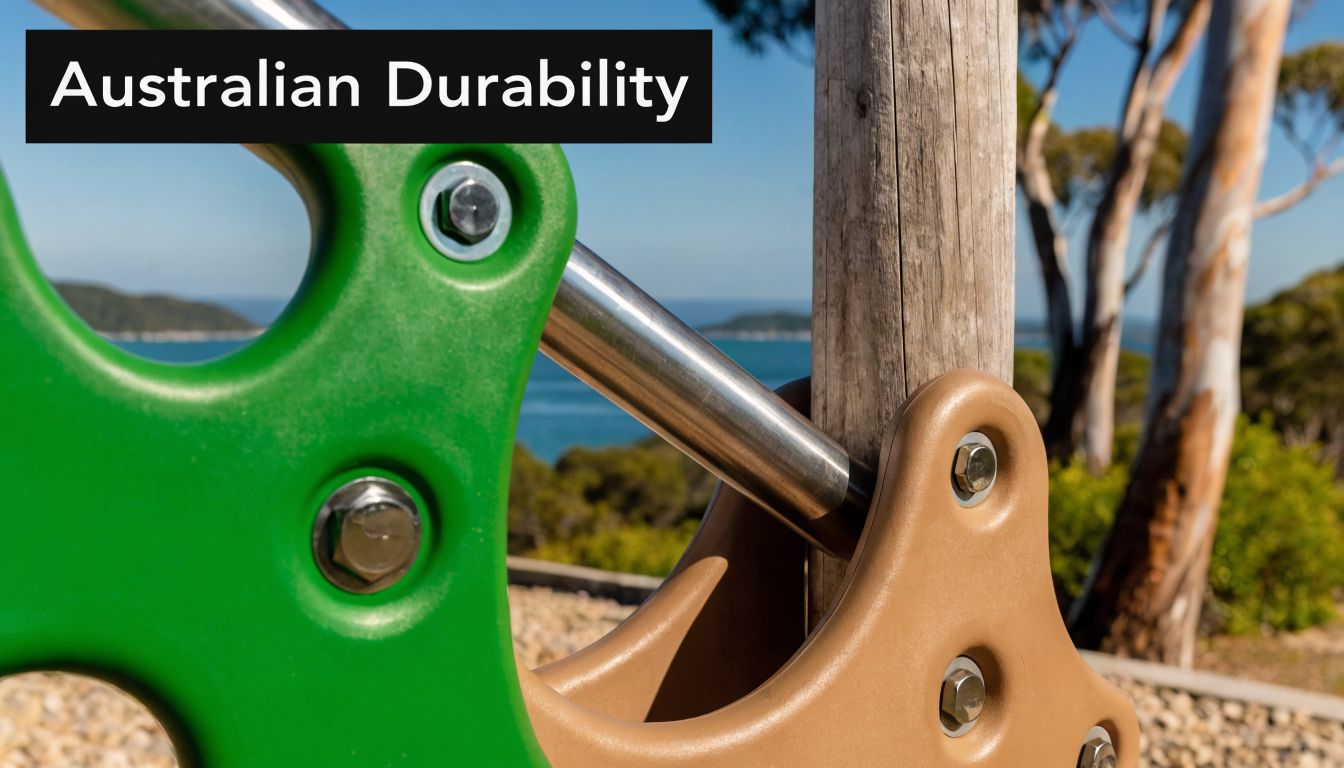
Material selection for childrens swing seats needs an Australian lens. High UV, sustained summer heat, salt exposure near the coast, and heavy daily use in schools and public parks all shorten service life if the wrong seat materials are chosen.
Heat changes how polymers behave. UV breaks down surfaces that looked sound at handover. Salt and moisture work into fasteners, chain links, and any damaged coating. Under AS 4685, that matters because the seat has to remain fit for use over time, beyond its initial delivery with the correct paperwork.
Generic overseas specifications often understate these pressures. A seat that performs adequately in a mild northern climate can age much faster in Western Sydney, regional South Australia, Far North Queensland, or on a foreshore reserve in Victoria.
For many Australian sites, the better starting point is a seat assembly designed for sun, heat, and repetitive public use, with wear parts that can be replaced without chasing uncommon components.
In practice, I would usually give closer consideration to:
One detail buyers often miss is replacement compatibility. A seat may look acceptable on day one, but if the chain connection, insert, or reinforcement detail is proprietary and slow to source, a minor wear issue can leave a swing out of service for weeks.
Lower-cost materials usually fail in predictable ways. The seat hardens. The coating splits. The hardware stains, pits, or binds. Then the maintenance team carries the true cost through call-outs, interim closures, and repeated part replacement.
That is why I advise committees to assess lifecycle cost, not invoice cost. A slightly higher spend on UV-stable seat material and corrosion-conscious hardware often reduces disruption and replacement frequency enough to justify itself within the first few years of public use.
| What to ask | Why it matters |
|---|---|
| Is the seat material UV-stabilised and specified for prolonged outdoor exposure in Australia? | Reduces early cracking, fading, and loss of flexibility |
| What is the internal reinforcement made from, and how is it protected? | Weak reinforcement details often drive premature seat failure |
| How will the chain, shackles, and connectors perform in heat, salt air, or irrigation overspray? | Environmental exposure differs sharply between inland and coastal sites |
| Are replacement seats and wear parts stocked locally or available within a clear lead time? | Faster repairs reduce downtime and supervision issues |
Cheap seats rarely stay cheap once replacement labour, downtime, and risk controls are counted properly.
A black rubber seat in an exposed inland school may handle abuse better than a cheaper moulded alternative, but it can still create heat complaints if there is no shade strategy. A coated chain may improve comfort for younger users, but in a high-vandalism park the coating condition needs close monitoring. Marine-grade thinking makes sense on a beachfront reserve, but it can be unnecessary overspend for a sheltered metropolitan site.
Good specification work is site-specific. Check the seat composition, reinforcement method, chain finish, connector metal, and stated environmental suitability. If those details are vague, the long-term performance usually is too.
A swing bay can pass the product review and still create problems on site. I see this regularly in school and council projects. The seat is suitable, but the installed outcome leads to supervision blind spots, softfall rework, chain wear from poor alignment, or closures while staff wait for the right replacement part.
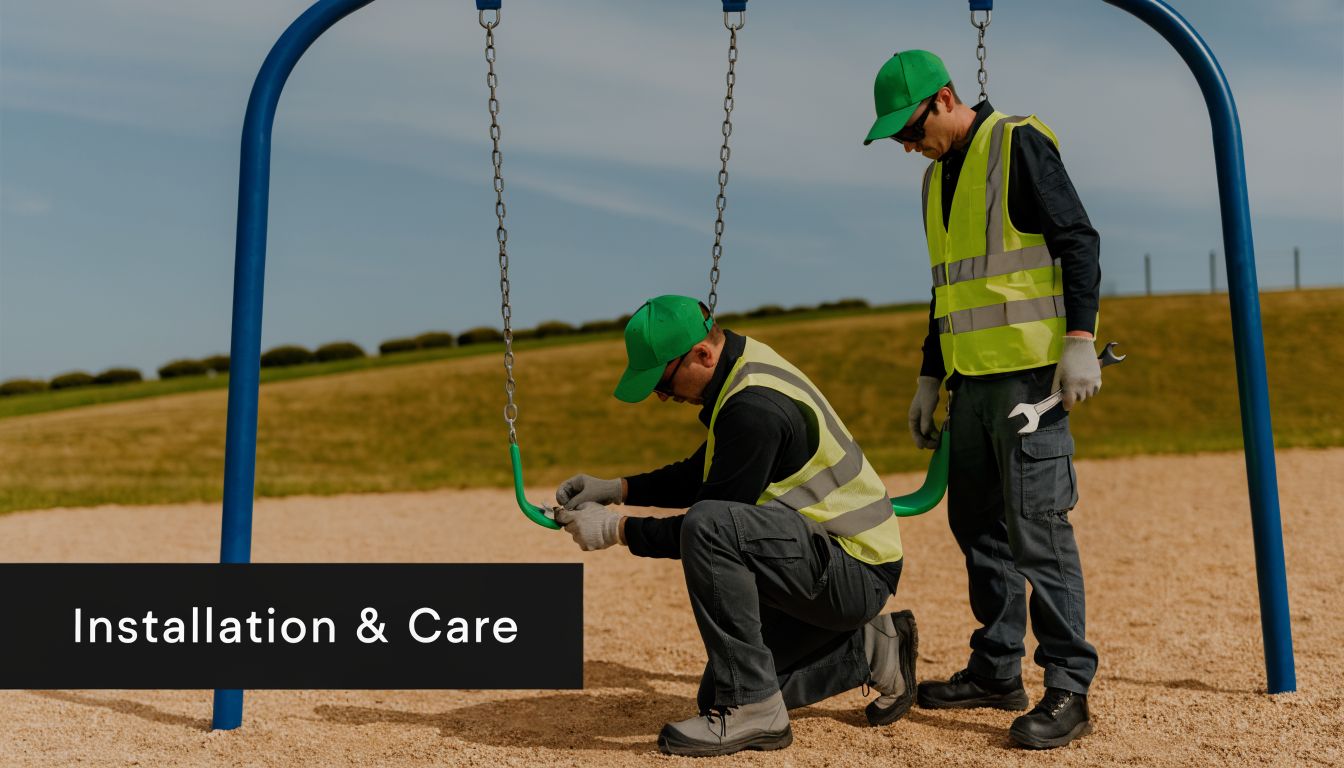
Installation should be planned at the same time as seat selection and frame specification. If those decisions are split across different consultants, contractors, or budget lines, the project often pays for it later through variations, awkward access, or premature component replacement.
The Australian context matters here. AS 4685 compliance is assessed in the installed condition, not in a brochure. Clearances, fall zones, seat height, chain length, frame compatibility, and surfacing depth all have to work together on the actual site. A seat that looks like a simple replacement can trigger wider changes if the bay geometry, softfall, or access path no longer suits the intended users.
For committees comparing options, it helps to review the seat as part of the full swing system, including commercial swing bay configurations for schools and parks. That usually produces a better decision than pricing the seat in isolation.
Three installation checks prevent a lot of avoidable cost:
Coastal and high-UV sites need extra care. In those locations, I would rather see a slightly higher upfront spend on compatible hardware and corrosion-resistant fittings than a cheaper install that starts seizing, staining, or pitting early.
Maintenance performance starts with specification, but it is won or lost at handover. If staff inherit a swing without clear inspection points, part numbers, or retirement criteria, minor wear often turns into extended downtime.
A workable maintenance routine should cover:
The cheapest quote often leaves these tasks to the site owner. For a school or council, that means more labour, more closures, and a harder case to defend if an incident occurs.
A proper handover pack should be specific. It should identify compatible replacement parts, inspection frequency, wear indicators, tightening requirements, and the point at which a part should be replaced rather than patched. That is especially important for public assets in harsh Australian conditions, where UV, salt air, irrigation overspray, and heavy use can shorten service life if the maintenance team is working from guesswork.
This short demonstration is useful because it reminds buyers that swing safety is about the whole installed environment, not just the seat.
A sound approval decision looks beyond supply cost. It weighs installation complexity, inspection burden, replacement lead times, downtime risk, and how well the swing bay will hold up over years of Australian exposure.
That approach usually changes the ranking. The lowest purchase price is rarely the lowest whole-of-life cost.
When a quote lands on your desk, use a checklist before comparing price. Childrens swing seats should be approved because they suit the site, the users, and the maintenance reality.
Start with evidence, not marketing language.
A swing bay should reflect who uses the playground.
At this stage, lifecycle value is won or lost.
Procurement should never stop at delivery.
Good procurement creates fewer surprises after opening day. That’s the standard worth aiming for.
If a product passes this checklist, you’re no longer choosing on appearance or headline price. You’re choosing on safety, durability, inclusion, and long-term operational sense.
If you’re planning a new swing bay or replacing ageing childrens swing seats, Kidzspace can help you assess the site, clarify compliance requirements, and compare options that suit Australian schools, councils, and community spaces.



Copyright © Kidzspace. All Rights Reserved.
Copyright © Kidzspace. All Rights Reserved.